Skip to content
A DWI arrest can be overwhelming—but you don’t have to face it alone. You are likely worried about jail time, losing your license, and what this means for your future. The good news is that an arrest is not a conviction. Understanding your rights and the legal process is the first step toward building a strong defense and minimizing the consequences.
The most critical first step is protecting your right to drive. Most people don't realize that you only have 15 days from the date of your arrest to request a special hearing to challenge an automatic license suspension. Acting quickly is essential to protecting your driving privileges while we build your defense.
Your First Steps After a Texas DWI Arrest
A DWI arrest is disorienting and stressful. It’s easy to feel lost, but you don't have to navigate this process by yourself. Knowing what to expect can help you move from a feeling of uncertainty to one of empowerment.
The moments and days immediately following an arrest are crucial, as they set the foundation for your entire legal defense. From the initial booking process to posting bond, every step is governed by procedures that a skilled Houston DWI lawyer knows how to navigate to protect your rights. The process begins the moment a police officer suspects you of drinking and driving, leading to an arrest and a chemical test to measure your Blood Alcohol Concentration (BAC).
What Is Blood Alcohol Concentration (BAC)?
Blood Alcohol Concentration, or BAC, is a measurement of the amount of alcohol in your bloodstream, expressed as a percentage. In Texas, the legal limit for most drivers over 21 is 0.08%. If a breath or blood test indicates your BAC is at or above this level, you are considered legally intoxicated.
The limits are even stricter for certain drivers. For commercial drivers, the limit is just 0.04%. For anyone under 21, any detectable amount of alcohol can lead to a Driving Under the Influence (DUI) charge. While the BAC reading is a key piece of evidence for the prosecution, it is not infallible. An experienced Texas DUI attorney knows how to challenge the accuracy and reliability of these tests.
From Booking to Posting Bond
After your arrest, you will be taken to a local jail for booking. This is an administrative process where officers will:
- Record your personal information
- Take your photograph (mugshot)
- Collect your fingerprints
Once booked, you will see a magistrate who will set your bond amount. Bond is a financial guarantee that you will appear for all future court dates. Posting bond allows you to be released from jail while your case proceeds. This is often the first opportunity where having a DWI attorney on your side can make a significant difference, as they can advocate for a fair and reasonable bond. To learn more about these initial stages, see the complete DWI arrest process in our detailed guide.
This infographic breaks down these critical first steps, from the traffic stop to the crucial 15-day deadline.

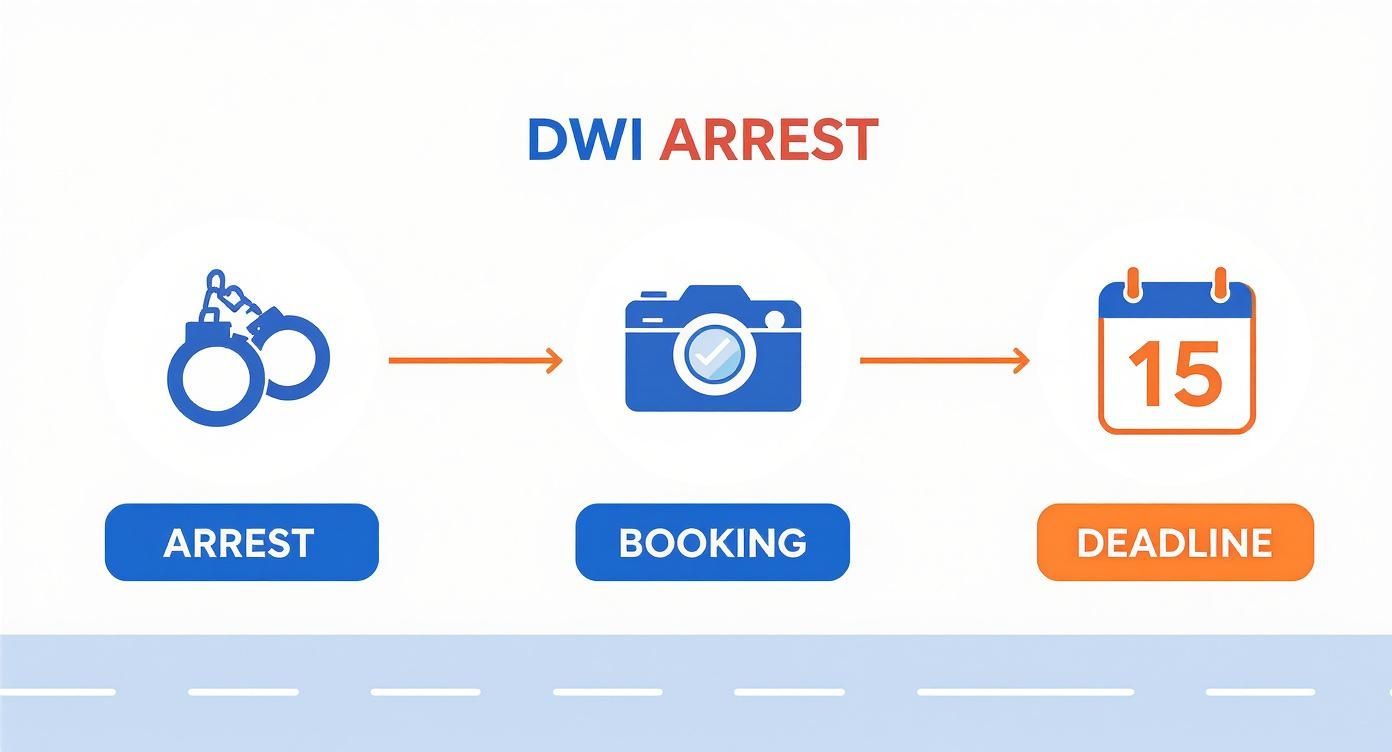
As the graphic illustrates, the clock starts ticking immediately. This makes the decision to request an Administrative License Revocation (ALR) hearing one of your first and most time-sensitive priorities.
Texas DWI Penalties Explained


When you’re facing a DWI in Texas, it’s easy to feel overwhelmed by legal terms and potential penalties. However, the state’s penalty system is structured, with consequences becoming more severe for repeat offenses. Understanding this system is the first step toward building a strategic defense. This is not about causing fear; it's about providing you with clear facts so you can see how a skilled lawyer can protect your rights and minimize consequences.
A DWI charge can range from a misdemeanor to a felony, and this classification determines the penalties you face. Texas law enforcement and prosecutors take these charges very seriously. The state is aggressive in its efforts to improve road safety, especially since nearly 40% of all Texas traffic fatalities involve alcohol. While these statistics are serious, enforcement and prevention efforts are making an impact, as noted in a recent report on statewide DUI trends.
Navigating these penalties means understanding what a conviction could cost you, both in terms of your freedom and your finances. An experienced Houston DWI lawyer can analyze your case, identify weaknesses in the prosecution's arguments, and fight to have your charges reduced or dismissed.
To give you a clearer picture, here's an overview of the penalties for standard DWI offenses in Texas.
Texas DWI Penalties at a Glance
| DWI Offense | Classification | Potential Jail Time | Maximum Fine |
|---|---|---|---|
| First DWI | Class B Misdemeanor | 72 hours to 180 days | Up to $2,000 |
| Second DWI | Class A Misdemeanor | 30 days to 1 year | Up to $4,000 |
| Third DWI | 3rd Degree Felony | 2 to 10 years in prison | Up to $10,000 |
This table provides a baseline, but the specific details of your case can significantly alter the outcome. Let's explore what these penalties mean for you.
Penalties for a First DWI in Texas
For most individuals, a first DWI in Texas is a Class B Misdemeanor, assuming no "aggravating factors" are present, such as an accident or a very high BAC. While it is the lowest-level DWI, the penalties are still significant and designed to be a strong deterrent.
If you are convicted of a first-time DWI, you could be facing:
- Jail Time: A mandatory minimum of 72 hours in jail, with a maximum of up to 180 days.
- Fines: A fine of up to $2,000.
- DWI license suspension: Your driver's license can be suspended for up to one year.
- DWI Education Program: You will almost certainly be required to complete a 12-hour DWI education course.
These are just the standard penalties. For example, having an open container of alcohol in your car increases the minimum jail time to six days. It is crucial to remember that an arrest is not a conviction. There are many effective strategies to fight a first DWI in Texas.
When DWI Charges Escalate to Felonies
The stakes increase dramatically with each subsequent offense. A second DWI is typically a Class A Misdemeanor, which doubles the potential jail time to one year and raises the maximum fine to $4,000. The most significant jump, however, occurs with a third conviction.
A third DWI, regardless of how much time has passed since the prior offenses, is automatically charged as a third-degree felony in Texas. This change from misdemeanor to felony has life-altering implications.
A felony conviction means you are no longer facing county jail time but are now looking at two to ten years in a state prison and a fine of up to $10,000. A felony on your record can also create lifelong barriers to employment, housing, and even the right to own a firearm.
However, certain circumstances can elevate even a first-time charge to a felony. You can find a complete breakdown in our guide on when a DWI becomes a felony charge in Texas.
Factors that can turn any DWI into a felony include:
- DWI with a Child Passenger: If a child under 15 is in your vehicle, the charge becomes a state jail felony, even for a first offense.
- Intoxication Assault: If you cause serious bodily injury to another person while driving intoxicated, you face a third-degree felony.
- Intoxication Manslaughter: If an accident results in a death, the charge is a second-degree felony, which carries a prison sentence of up to 20 years.
Facing these severe penalties is overwhelming. This is why a proactive and strategic legal defense is an absolute necessity. At The Law Office of Bryan Fagan, PLLC, our mission is to stand between you and these consequences, fighting to protect your rights at every step.
Protecting Your Driving Privileges from Suspension
When you're arrested for a DWI in Texas, you face two separate legal battles. Most people focus on the criminal case, which involves potential jail time and fines. However, there is a second, faster-moving administrative action that directly targets your driver's license.
This is a civil proceeding initiated by the Texas Department of Public Safety (DPS), and it can result in a DWI license suspension long before your criminal case is resolved. Understanding this parallel process is one of the most critical parts of your initial defense, as the state gives you a very narrow window of opportunity to fight back.
The Power of Implied Consent in Texas
When you received your Texas driver's license, you automatically agreed to a law known as “implied consent.” This law means that by accepting the privilege of driving on Texas roads, you have already consented to provide a breath or blood sample if a law enforcement officer lawfully arrests you for DWI.
You still have the right to refuse this chemical test, but that refusal comes with immediate consequences. Refusing the test—or taking it and having a BAC of 0.08% or higher—automatically triggers a license suspension. This process is called the Administrative License Revocation (ALR) program. It is a civil penalty, completely separate from the outcome of your criminal case.
The Critical 15-Day Deadline for an ALR Hearing
After a DWI arrest, a clock starts ticking. You have exactly 15 days from the date of your arrest to formally request an Administrative License Revocation (ALR) hearing. This hearing is your only opportunity to challenge the automatic suspension of your license.
If you miss this 15-day window, your license will be automatically suspended. There are no extensions or second chances. This deadline is absolute.
For a first-time DWI where you failed a chemical test (a BAC of 0.08% or higher), the suspension period is 90 days. If you refused to provide a sample, that suspension increases to 180 days. For subsequent offenses, the penalties are even more severe. Successfully requesting an ALR hearing pauses the automatic suspension until the hearing is held, giving you and your attorney valuable time and keeping you legally on the road.
Why the ALR Hearing is Your First Line of Defense
The ALR hearing is more than just a way to save your license—it's a powerful strategic tool. This hearing is often the first chance for your attorney to question the arresting officer under oath and begin identifying weaknesses in the state's case against you.
During the hearing, your lawyer can investigate key details of your arrest, such as:
- Reasonable Suspicion: Did the officer have a valid legal reason to pull you over?
- Probable Cause: What specific evidence justified the DWI arrest?
- Procedural Errors: Did the officer correctly inform you of the consequences of refusing a breath or blood test?
- Test Administration: Were the field sobriety tests conducted according to standardized procedures? Was the breathalyzer machine properly calibrated and maintained?
The information we uncover here can be invaluable for your criminal defense. It's a "preview" of the prosecutor's evidence that allows us to find weaknesses we can use to your advantage later. To learn more about this vital step, read about The Administrative License Revocation Process in Texas and how we can help.
Protecting your license is a top priority. Missing the 15-day ALR deadline can disrupt your life, making it difficult to get to work and care for your family. Don't let this crucial opportunity pass.
The Hidden Financial Impact of a DWI Conviction

When people consider the consequences of a DWI in Texas, they often think of criminal penalties like fines and potential jail time. While those are serious concerns, they are only the beginning.
A DWI conviction triggers a financial chain reaction that can affect you for years, turning a single mistake into a long-term economic hardship. These are the "hidden" costs that go beyond court-ordered fines and can make it difficult to regain your financial stability. Understanding these expenses highlights the true value of a strong legal defense—it's not just about staying out of jail, but also about protecting your financial future.
The societal cost of drunk driving is immense, and you can learn more about the staggering economic and personal impact of drunk driving accidents in Texas. The financial fallout from a conviction is a personal reflection of these larger costs.
Skyrocketing Car Insurance Premiums
After a DWI, your car insurance provider will classify you as a high-risk driver, which will cause your premiums to increase dramatically. It is common for rates to double or even triple, adding hundreds of dollars to your monthly expenses.
In addition, Texas will require you to file an SR-22 certificate. This is not an insurance policy but a document your insurer files with the state to prove you have minimum liability coverage. You will be required to maintain this SR-22 for a specified period, and its high-risk designation will keep your insurance costs high.
An SR-22 filing is a financial penalty that can follow you for years. It's a constant, expensive reminder of the conviction that impacts your budget long after you've paid court fines.
State Surcharges and Fees
The financial penalties continue with the Texas Department of Public Safety (DPS), which imposes annual surcharges through the Driver Responsibility Program. These payments are mandatory and must be paid for three years to prevent your driver's license from being suspended again.
Surcharges can range from $1,000 to $2,000 per year, depending on your offense. This means you could owe the state an additional $3,000 to $6,000 on top of your criminal fines. Failure to pay results in another license suspension, creating a difficult cycle to escape.
Mandatory Classes and Equipment Costs
The court will also order you to complete certain programs at your own expense, adding another layer of financial strain.
- DWI Education Classes: You will be required to attend a state-approved DWI education or intervention program, and you must pay for it yourself.
- Ignition Interlock Device (IID): If the court permits you to drive during your suspension, it will likely require an IID to be installed in your vehicle. You are responsible for all associated costs, including installation, monthly calibration fees, and removal.
These costs add up quickly. Investing in a knowledgeable Houston DWI lawyer to challenge the initial charge is the most effective way to prevent these cascading expenses. A strong defense is your best strategy to protect both your freedom and your finances.
How a DWI Record Affects Your Career and Personal Life

The penalties imposed by a court—fines, jail time, and license suspension—are just the beginning. A DWI conviction creates a permanent criminal record that can follow you long after you have completed your sentence. It casts a long shadow, creating unexpected obstacles in nearly every aspect of your life.
These personal consequences don't appear on a penalty chart but can be just as damaging. They can interfere with your ability to earn a living, secure housing, and maintain important family relationships. Understanding what is at stake is the first step in realizing why a proactive, aggressive defense is so critical.
Texas takes DWI offenses seriously because of the devastating human cost. Tragically, over 1,000 deaths were attributed to alcohol-related crashes in 2024 alone, an average of three lives lost every day. As TxDOT campaigns highlight through real stories, the ripple effects are immense. You can read more about the personal and societal impacts of drunk driving in Texas.
Your Career and Professional Licensing
One of the most immediate and lasting consequences of a DWI in Texas is the impact on your career. Many employers conduct background checks as part of their hiring process, and a DWI conviction can be a major red flag, potentially causing a job offer to be withdrawn or making it difficult to find new employment.
For those who hold a professional license, the situation is even more serious.
- Licensed Professionals: Nurses, doctors, pilots, lawyers, and real estate agents may face disciplinary action from their state licensing boards, which could lead to suspension or even revocation of their professional license.
- Commercial Drivers: For individuals with a Commercial Driver's License (CDL), a DWI conviction can be career-ending, often resulting in immediate disqualification.
- Jobs Requiring Driving: Even without a CDL, jobs in sales, delivery, or any role involving a company vehicle can be jeopardized, as companies may be unable to insure drivers with a recent DWI.
Hurdles in Your Personal Life
The effects of a DWI record extend beyond your professional life and can create significant stress in your personal life. Simple tasks can suddenly become complex challenges. For example, landlords and apartment complexes often run background checks on potential tenants. A DWI conviction could lead to your rental application being denied, making it harder to find a stable home.
A DWI conviction is public record. It can create a lasting stigma that affects how others perceive you, from potential employers and landlords to new acquaintances.
Other personal consequences may include:
- Child Custody: In family court, a recent DWI can be used as evidence of irresponsible behavior, potentially impacting your custody or visitation rights.
- College Applications: Students may face disciplinary action from their university or have applications for admission or scholarships denied.
- International Travel: Many countries, particularly Canada, have strict policies and may deny entry to individuals with a DWI conviction.
Finding a Path Forward
Facing these long-term consequences can feel daunting, but it's important to remember that an arrest is not a conviction. Even in cases where a conviction cannot be avoided, there may be legal options to help you move forward and protect your reputation.
A skilled Texas DUI attorney can explore options such as an order of non-disclosure. If granted, this court order seals your record from public view, preventing most private employers and landlords from seeing the conviction on a background check. This can reopen doors that were previously closed.
Protecting your future begins with a strategic defense today. By fighting the charge, you are not just addressing the immediate penalties; you are actively working to prevent these lifelong personal and professional consequences from taking hold.
Building a Strong Defense Against Your DWI Charge
Facing a DWI charge in Texas can feel overwhelming, and it's easy to assume the worst. However, it is critical to remember this fact: an arrest is not a conviction. The legal system has built-in protections, and the case against you may not be as strong as it seems. Building a smart, strategic defense is your right and your best path forward.
A skilled Houston DWI lawyer does not simply accept the police report at face value. Instead, we meticulously analyze every detail of your arrest, searching for procedural errors and weaknesses that can be used to your advantage. A strong defense is built by asking tough questions and challenging the evidence at every turn.
Questioning Every Stage of the Arrest
A successful defense often begins by examining the very first interaction you had with law enforcement. Every action an officer takes, from activating their lights to requesting a breath sample, must be legally justified.
Your attorney will investigate the most critical aspects of your case, including:
- The Legality of the Traffic Stop: Did the officer have a valid legal reason—known as reasonable suspicion—to pull you over? If not, any evidence gathered after the stop could be suppressed and thrown out of court.
- Administration of Field Sobriety Tests: Were the standardized field sobriety tests (SFSTs) conducted correctly and according to established protocols? These tests are subjective and prone to error. Improper instructions or poor conditions can render the results unreliable.
- Breathalyzer and Blood Test Accuracy: The machines and labs that process chemical tests are not perfect. We will scrutinize the maintenance logs and calibration records of the breathalyzer. For blood tests, we can challenge the chain of custody and lab procedures to ensure accuracy.
An effective DWI defense is about holding the police and the prosecution to their high burden of proof. It is our job to protect your rights and ensure that every piece of evidence is both legally sound and scientifically valid.
Challenging the state's evidence is the foundation of how you can fight a DWI in Texas. An experienced attorney knows that a single procedural mistake or a faulty piece of equipment can be enough to have the charges reduced or even dismissed.
Our goal is to protect your rights, minimize the consequences, and secure the best possible outcome for your case. Your future is too important to leave to chance.
Common Questions About Texas DWI Consequences
If you’re facing a DWI charge, your mind is likely filled with questions and concerns. The uncertainty can be overwhelming, but getting clear, direct answers is the first step toward regaining control. You do not have to go through this alone; the right information and a solid legal strategy can make all the difference.
Below are answers to some of the most common questions we hear from people in your situation. Our goal is to provide the facts you need and show you that there is a path forward.
Can My DWI Charge Be Dismissed?
Yes, a dismissal is a possible outcome. An arrest is only the beginning of the legal process. The prosecution's case may seem strong initially, but a skilled lawyer can often uncover significant weaknesses.
A dedicated Houston DWI lawyer will investigate every detail of your case, from the legality of the traffic stop to the maintenance records of the breathalyzer. For example, if we find that the officer lacked a valid reason to pull you over or made critical errors during the field sobriety tests, we can file a motion to suppress that evidence. A successful motion can weaken the prosecutor's case, often leading to a dismissal of the charges.
How Long Does a DWI Stay On My Record?
A DWI conviction in Texas remains on your criminal record permanently unless you take legal action to remove it. It does not automatically "fall off" after a certain number of years. This permanent record can create long-term obstacles when you apply for jobs, seek housing, or pursue a professional license. This is why it is so important to fight the charge from the very beginning. However, even if your case is not dismissed, there are still options for clearing your record later.
A permanent criminal record is one of the most severe long-term consequences of a DWI in Texas. Fortunately, Texas law provides specific legal tools to help clear your name and protect your future.
Can I Ever Clear My Record After a DWI?
For many people, the answer is yes. Clearing a DWI from your record is an achievable goal, but it requires using the appropriate legal tools. The two primary options are expunctions and orders of non-disclosure.
Here's how they work:
- Expunction: This is a complete erasure of your arrest record, making it as if it never happened. You are generally eligible for an expunction if your case was dismissed or if you were found not guilty at trial.
- Order of Non-Disclosure: This legal tool seals your record from public view. If you successfully completed deferred adjudication for a first-time DWI, you may be eligible for an order of non-disclosure. This means that private employers, landlords, and the general public will not see the conviction during a background check.
Determining the right path for your situation requires a strategic legal approach. An experienced attorney can analyze your case, determine your eligibility, and guide you through the process to help you achieve a fresh start.
Navigating the aftermath of a DWI arrest is complex, but you don't have to face it alone. The experienced attorneys at The Law Office of Bryan Fagan, PLLC are dedicated to defending Texans against DWI charges. We are here to protect your rights, explain your options in clear terms, and fight for the best possible outcome for your case. For a free, confidential case evaluation, contact us today at https://texasduilawfirm.com.