
A DWI arrest can be overwhelming — but you don’t have to face it alone. The chances of getting a DWI dismissed in Texas are often better than people think, especially if this is your first offense. While every case is unique, recent data shows a dismissal rate of 34.2% across the five largest counties in Texas. A skilled Houston DWI lawyer can analyze the details of your arrest to find weaknesses in the prosecution's case, making a full dismissal a realistic and attainable goal.
Why a DWI Arrest Is Not a Conviction

Being arrested for DWI is an overwhelming experience. The flashing lights, confusing roadside tests, and uncertainty can leave you feeling powerless. However, it's critical to remember that an arrest is just the beginning of a legal process, not the final word. The State of Texas must prove its case against you, and there are many opportunities for a strong defense to challenge the evidence they present.
Understanding your rights and the legal pathways available is the first step toward regaining control. A dismissal means the prosecutor drops the charges entirely, preventing a conviction from ever appearing on your permanent criminal record. This is the best possible outcome, and with the right legal strategy, it is more attainable than you might imagine.
A Quick Look at Texas DWI Dismissal Statistics
To give you a clearer picture, let's look at some real numbers. The following table highlights reported DWI dismissal rates in Texas's most populated counties, offering a data-backed perspective on potential outcomes.
| Statistic | Reported Rate |
|---|---|
| Dismissal Rate (Five Largest Counties) | 34.2% |
| Harris County (Houston) | Varies, often aligns with state average |
| Dallas County | Varies, often aligns with state average |
| Tarrant County (Fort Worth) | Varies, often aligns with state average |
| Bexar County (San Antonio) | Varies, often aligns with state average |
These numbers are not a guarantee, but they show that dismissals are far from rare. They happen every day in Texas courtrooms when a strategic defense exposes flaws in the state's case.
Factors That Can Lead to a Dismissal
The path to a DWI dismissal in Texas is built on a meticulous review of every detail of your arrest. An experienced Texas DUI attorney will put the evidence and police procedures under a microscope to find weaknesses that can be used in your favor.
Common areas for a strong defense include:
- The Initial Traffic Stop: Did the officer have a legal reason—known as reasonable suspicion—to pull you over? If the stop was invalid, any evidence collected afterward could be thrown out.
- Field Sobriety Test Administration: These roadside tests are subjective and must be administered under strict guidelines. Improper instructions, poor weather, or your medical conditions can invalidate the results.
- Breath and Blood Test Accuracy: Chemical tests are not foolproof. Breathalyzer machines can malfunction or be calibrated incorrectly, and the chain of custody for blood samples can be broken, contaminating the results.
The prosecution's case is only as strong as its weakest link. Identifying procedural errors, faulty equipment, or constitutional violations is the cornerstone of an effective DWI defense strategy aimed at a full dismissal.
Ultimately, the chances of dismissal of DWI Texas charges depend on the unique facts of your case and the skill of your lawyer. Even if the evidence seems stacked against you, a knowledgeable attorney can find the cracks. Do not assume you are guilty; a strategic defense can protect your freedom, your license, and your future.
Key Factors That Influence Your DWI Dismissal Chances
While statistics provide a broad overview, the real chance of getting your case dismissed in Texas comes down to the specific details of your arrest. No two cases are the same, and a sharp DWI attorney knows that a winning defense is built by examining every piece of evidence and questioning every action law enforcement took. The final outcome almost always depends on a handful of critical factors that can either support the prosecutor's case or tear it down.
Understanding these factors is the first step toward building a defense that works. By identifying procedural mistakes, weak evidence, or violations of your constitutional rights, your lawyer creates the leverage needed to argue for a dismissal.
Your Criminal History and the Details of the Offense
One of the first things a prosecutor will look at is your record. If this is your first DWI in Texas, you are in a much better position. Prosecutors and judges are often more open to considering alternatives for first-time offenders, especially when other details of the case are in your favor.
Several key facts about the incident also carry significant weight:
- Your Blood Alcohol Concentration (BAC): A BAC result that’s just barely over the 0.08% legal limit is much easier to challenge than a very high one. A skilled attorney can argue that breathalyzer errors, calibration problems, or even your own physiology could account for that small margin.
- Was There an Accident? If your DWI arrest did not involve a crash or injuries, the case is seen as far less severe. The absence of an accident removes a major aggravating factor that prosecutors use to push for tougher penalties.
- Your Demeanor with Police: While not a legal defense, remaining respectful and cooperative (while still protecting your rights) can sometimes make a prosecutor more willing to negotiate a favorable outcome later.
The Validity of the Initial Traffic Stop
Before a police officer can pull you over, they must have reasonable suspicion that you have violated a traffic law or are involved in criminal activity. This is a core constitutional right. If the officer cannot provide a clear, valid legal reason for the stop, then everything that happens after—the field sobriety tests, the breath test, and the arrest itself—could be thrown out of court.
A DWI case can be won or lost before you even step out of your car. If the initial traffic stop was unlawful, it can lead to the suppression of all subsequent evidence, often resulting in a complete dismissal of the charges.
This is almost always the first place a good Houston DWI lawyer begins their investigation. Did you actually commit a traffic violation, like speeding or failing to signal? Or was the stop based on a vague "hunch" that does not meet the legal standard? A successful challenge to the stop can cause the prosecutor's entire case to fall apart.
Scrutinizing the Evidence
The evidence gathered during your arrest forms the foundation of the state's case, but it is rarely as solid as it seems. Both the field sobriety tests you took on the roadside and the chemical tests from the station are full of potential errors that can make them unreliable.
Field Sobriety Tests (FSTs) are notoriously subjective and must be administered under very strict, standardized conditions. Factors like bad weather, an uneven surface, your physical limitations, or an officer failing to give correct instructions can invalidate the results.
Likewise, breath and blood tests can be challenged from multiple angles. For example, a breathalyzer may have been improperly calibrated, or the chain of custody for a blood sample may have been broken. A powerful defense involves scrutinizing every step of the evidence-gathering process to find these weaknesses and fight for a dismissal.
Legal Defenses That Can Lead to a DWI Dismissal
When you’re facing a DWI charge, it’s easy to feel like the evidence is stacked against you. But a strong defense isn’t about finding a single "magic bullet"—it’s about methodically taking apart the prosecution's case, piece by piece. Getting a dismissal often comes down to your attorney’s ability to find weaknesses in police procedure, equipment accuracy, and the protection of your constitutional rights.
Many people assume a DWI arrest is an open-and-shut case, but that’s rarely true. From the moment an officer decides to pull you over until a chemical test is administered, there are dozens of strict protocols that must be followed perfectly. Any misstep can become a powerful legal challenge that opens the door to getting your case dismissed.
Challenging the Legality of the Traffic Stop
The entire DWI case against you starts with one moment: the traffic stop. An officer cannot just pull you over on a hunch. They must have reasonable suspicion that you have broken a specific law. If that initial stop was illegal, any evidence they collected afterward—the field sobriety tests, the breath or blood sample—can be thrown out of court.
A traffic stop might be invalid if:
- There Was No Real Traffic Violation: The officer believed you broke a law, but dashcam video proves otherwise.
- The Justification Was Too Vague: The officer claims you were "weaving within your lane," but there were no other signs of erratic driving to support the stop.
- The Stop Was Based on an Unreliable Tip: An officer pulls you over based on a vague tip without observing any bad driving themselves.
If your attorney can show the court that the stop was unconstitutional, the prosecutor's case often collapses. This is almost always the first and most important battleground when you fight a DWI in Texas.
Questioning Field Sobriety and Chemical Test Evidence
The evidence gathered after a traffic stop is what prosecutors rely on most, but it’s far from perfect. Both Standardized Field Sobriety Tests (SFSTs) and chemical tests are surprisingly vulnerable to human error, improper administration, and outside factors that can make them unreliable.
An experienced DWI attorney knows that "scientific" evidence is only as good as the human procedures behind it. Flaws in how tests are administered, how machines are maintained, or how samples are handled are often the key to getting a case dismissed.
Standardized Field Sobriety Tests (SFSTs), like the walk-and-turn or one-leg stand, are notoriously subjective. A skilled lawyer can challenge them by pointing out factors such as:
- Improper Instructions: The officer did not explain or demonstrate the test correctly according to national standards.
- Environmental Factors: Poor lighting, an uneven road surface, or bad weather made it nearly impossible to perform the test fairly.
- Medical Conditions: Your age, physical health, or old injuries impacted your balance and coordination, not alcohol.
Breathalyzer and blood tests are not foolproof, either. Your attorney will investigate whether the breathalyzer was recently and properly calibrated. For blood tests, they will scrutinize the chain of custody—the documented paper trail showing who handled your blood sample from the moment it was drawn to the time it was tested. Any gap or mistake in that chain can contaminate the evidence, making it inadmissible in court.
Leveraging Constitutional and Procedural Violations
Beyond the stop and the evidence, other procedural mistakes can dramatically increase your chances of a dismissal. For instance, if you were arrested and questioned without being read your Miranda rights, any answers you gave could be suppressed. While that may not get the case thrown out on its own, it could remove a key piece of evidence the prosecutor was planning to use against you.
The legal process itself has strict rules. If the prosecutor fails to turn over all the evidence they have (a discovery violation), or if they cause unreasonable delays in bringing your case to trial, a motion to dismiss might succeed. A truly assertive defense holds the state accountable at every step, protecting your rights and creating opportunities to get the charges dropped entirely.
How To Navigate The ALR Hearing And Your Criminal Case
After a DWI arrest in Texas, you are suddenly fighting on two different fronts. It’s a confusing and overwhelming experience. You have two separate legal battles happening at the same time, each with its own rules, goals, and consequences.
The first step to building a strong defense is understanding the critical difference between the Administrative License Revocation (ALR) hearing and your criminal case. They are completely independent, but what happens in one can definitely impact the other. You have to take both seriously, because one threatens your driver's license, and the other threatens your freedom.
Understanding The Administrative License Revocation (ALR) Hearing
The ALR hearing is a civil proceeding that has nothing to do with the criminal courts. It’s managed by the Texas Department of Public Safety (DPS), and its sole purpose is to decide the fate of your driver's license. The state’s goal is simple: prove the officer had a good reason to arrest you and that you either failed a chemical test (with a BAC of 0.08% or higher) or refused to take one.
Here is the critical deadline: you have just 15 days from the date of your arrest to request this hearing. If you miss that deadline, your license will be suspended automatically.
The ALR hearing isn't about guilt or innocence. It's a time-sensitive administrative fight for your driving privileges, but it's also one of the most powerful strategic tools we have for your criminal defense.
This hearing is our first opportunity to question the arresting officer under oath. We can dig into every detail—the reason for the traffic stop, how the field sobriety tests were conducted, and the procedures used for the chemical test. The testimony we gather here is invaluable and can be used to poke holes in the prosecutor's criminal case down the road. To learn more about this critical step, check out our complete guide to the Texas ALR hearing process.
The Criminal DWI Case
Your criminal case is the second, more serious battle. This is where the county or district attorney formally charges you with Driving While Intoxicated. Unlike the ALR hearing, the stakes here are much higher—we're talking about potential jail time, thousands in fines, and a permanent criminal record.
In a criminal courtroom, the prosecutor must meet a much tougher standard. They must prove you are guilty "beyond a reasonable doubt," which is the highest burden of proof in our legal system. Our entire defense strategy is built around creating that doubt by challenging every single piece of their evidence.
Building that defense means putting every action taken by law enforcement under a microscope, from the moment they pulled you over to the final breath or blood test result.
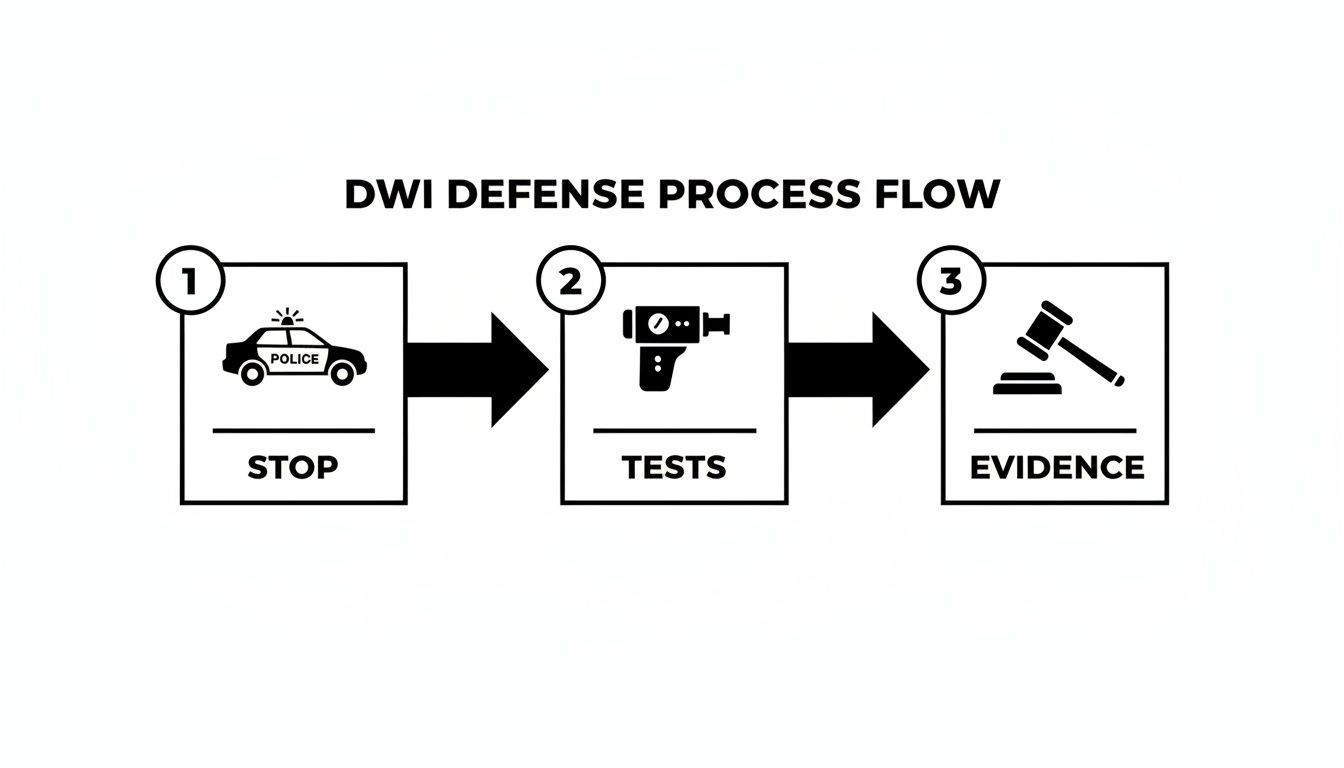
As you can see, a successful defense isn't about one magic bullet. It's about systematically challenging the state's case at every single stage of the process.
ALR Hearing vs Criminal DWI Case at a Glance
This comparison highlights the key differences between the two legal proceedings you face after a Texas DWI arrest.
| Aspect | ALR Hearing (Civil) | Criminal Case (Criminal) |
|---|---|---|
| Purpose | To determine if your driver's license should be suspended. | To determine if you are guilty of the crime of DWI. |
| Who's in Charge? | An Administrative Law Judge (ALJ) from the DPS. | A County or District Court Judge and potentially a jury. |
| Key Issue | Did the officer have reasonable suspicion and probable cause? Did you refuse or fail a chemical test? | Are you guilty of DWI "beyond a reasonable doubt"? |
| Potential Outcome | License suspension or no suspension. | Conviction (jail, fines, probation) or acquittal/dismissal. |
| Deadline | You must request a hearing within 15 days of your arrest. | The prosecutor files charges, and the case proceeds over months. |
| Burden of Proof | "Preponderance of the evidence" (more likely than not). | "Beyond a reasonable doubt" (the highest standard). |
Understanding these distinctions is the first step toward building a cohesive and effective defense strategy across both fronts.
How The Two Cases Affect Each Other
It’s vital to understand that the outcomes of these two cases are not tied together. You could win your ALR hearing and keep your license but still be convicted in your criminal case. On the other hand, you could lose your license in the ALR process but ultimately have your criminal DWI charges dismissed.
The real strategic advantage comes from using the ALR hearing to our benefit. The testimony your attorney gets from the arresting officer becomes locked in. We can then compare that sworn testimony to their police report and anything they say later in criminal court. If we find inconsistencies—and we often do—we can use them to attack the officer's credibility and weaken the prosecutor’s entire case. This makes the ALR hearing a crucial dress rehearsal for the main event in criminal court, dramatically improving your chances of a dismissal.
Exploring Penalties and Alternative Outcomes to a Conviction
While getting a DWI case dismissed entirely is always our primary goal, it's just as important to understand the full range of possible outcomes. Facing a DWI charge is intimidating, but knowing your options empowers you to make smart, strategic decisions for your future. A conviction is not a foregone conclusion, and a skilled Houston DWI lawyer can often find alternative paths that protect your record.
Think of the statutory penalties for a first-time DWI in Texas as the "worst-case scenario"—the maximums we fight to avoid. They are not what you should expect; they are what you should be prepared to fight against. Our focus is always on the strategic routes available to sidestep these consequences altogether.
Texas DWI Penalties Explained: First Offense
A first-time DWI is typically charged as a Class B Misdemeanor in Texas. Understanding the potential penalties helps you appreciate the value of a strong defense designed to protect your future.
- Fines: Up to $2,000.
- Jail Time: A sentence ranging from 72 hours to 180 days.
- DWI License Suspension: Driving privileges could be suspended for 90 days to one year.
These penalties can impact your job, your family, and your finances. But they are not inevitable.
Negotiating for a Reduced Charge
When a full dismissal is not achievable, one of the most powerful strategies is negotiating a plea bargain for a lesser charge. This is a common and effective way to avoid the lifelong stigma of a DWI conviction. The goal is to get the charge reduced to something that is not a DWI, which means significantly lighter penalties and long-term consequences.
A DWI conviction follows you forever. A reduced charge, like reckless driving, does not carry the same heavy social and professional weight. This kind of strategic negotiation is often a major victory.
For example, your attorney might successfully argue for the DWI to be reduced to "Obstruction of a Highway" or "Reckless Driving." These offenses do not trigger the automatic license suspension or the skyrocketing insurance premiums that come with a DWI, making them a much better outcome.
Pretrial Diversion and Deferred Adjudication
For many people facing a first-time offense, pretrial diversion programs offer a direct path to a dismissal. Think of it as a contract with the prosecutor: you agree to complete a set of requirements, and in return, they agree to drop the charges. If you successfully complete the program, there is no conviction, and you can often get the arrest expunged from your record entirely.
These programs often require you to:
- Complete an alcohol education course.
- Perform community service.
- Install an ignition interlock device for a short period.
- Avoid any new arrests.
Similarly, deferred adjudication is a type of probation that, once completed, ends in the case being dismissed without a final conviction. While the arrest itself will stay on your record unless it is sealed, it crucially prevents a finding of guilt. Exploring these alternatives is a critical part of any strong defense strategy, as they can lead to a dismissal through a negotiated process.
Immediate Steps to Take After a DWI Arrest
The moments right after a DWI arrest are disorienting and overwhelming. But what you do in these first few hours and days is absolutely critical. Your actions can directly impact the chances of dismissal of DWI Texas charges. Taking back control starts now with a clear plan to protect your rights and build a strong defense.
When you're arrested for DWI, two different clocks start ticking: one for the criminal case and one for your driver's license. You must act quickly on both fronts. This checklist outlines the immediate steps you need to take to put yourself in the best possible position.
Step 1: Contact an Experienced DWI Defense Lawyer Immediately
This is the most important thing you can do. Before you talk to anyone else, you need to speak with an attorney who focuses on Texas DWI defense. Anything you say can be used against you, but your conversations with your lawyer are 100% protected by attorney-client privilege.
An experienced Houston DWI lawyer can get involved early to preserve evidence, handle complex legal deadlines, and guide you through the process that begins the moment you are released.
Do not wait. The sooner an attorney is on your side, the more time they have to build a proactive defense, find cracks in the prosecution's story, and start fighting for you.
Step 2: Request Your ALR Hearing Within 15 Days
After a DWI arrest in Texas, the clock is ticking on your driver's license. You have exactly 15 days to request an Administrative License Revocation (ALR) hearing. If you miss this hard deadline, the Texas Department of Public Safety will automatically suspend your license.
Requesting this hearing is a crucial move for two reasons:
- It is your only chance to prevent an automatic license suspension.
- It is a powerful strategic tool for your criminal case.
The ALR hearing gives your attorney the first opportunity to question the arresting officer under oath. This is where we can expose inconsistencies in the police report and lock the officer into a version of events that can be challenged later in criminal court.
Step 3: Document Every Detail of Your Arrest
Your memory is a vital piece of evidence, but it fades quickly. As soon as you can, write down every detail you remember about the traffic stop and arrest. Details that seem small now can become major legal arguments later. This written account will be an invaluable resource for your defense team.
Make sure your notes answer these questions:
- What reason did the officer give for pulling you over?
- What questions did they ask you? What did you say?
- Where did you perform the field sobriety tests? Was the ground flat and well-lit, or was it sloped or dark?
- Did the officer read you your Miranda rights? If so, when?
- How much time passed between the traffic stop and the breath or blood test?
Taking these immediate steps builds a solid foundation for your defense, helping you regain control and fight for the best possible outcome.
Answering Your Top Texas DWI Questions
When you're facing a DWI charge, your mind is likely racing with urgent questions. It's a confusing and stressful time, and you need clear answers. Let's address some of the most common concerns after a DWI arrest in Texas so you can understand what you are up against and how to move forward.
Can My DWI Be Dismissed If The Police Didn’t Read Me My Miranda Rights?
This is a common question, and the answer often surprises people. A failure to read your Miranda rights rarely leads to an automatic dismissal of the entire DWI case. However, it can become a powerful part of your defense.
If you were in police custody and they began questioning you without first reading your rights, any statements you made can be suppressed. This means the prosecutor is forbidden from using those statements against you in court. If your answers were a key piece of their evidence, getting them thrown out could seriously weaken their case and improve your chances of dismissal of DWI Texas charges.
I Refused the Breathalyzer. Does That Help My Case?
Refusing to take a breath or blood test makes the prosecutor's job harder. Without a specific Blood Alcohol Concentration (BAC) number to show a jury, they lose a critical piece of evidence. This forces them to rely on more subjective things, like the officer’s observations and your performance on the field sobriety tests.
However, there is a trade-off. Texas operates under an “implied consent” law. This legal concept means that by having a Texas driver's license, you have already agreed to provide a breath or blood sample if lawfully arrested for DWI. Refusing the test automatically triggers a driver's license suspension through a civil process called an Administrative License Revocation (ALR). An experienced DWI attorney can fight that suspension in the ALR hearing while also using the lack of chemical evidence to your advantage in the criminal case.
How Long Will This DWI Case Take?
The timeline for a Texas DWI case can vary significantly. Some cases are resolved in a few months if a plea agreement is reached early on.
However, if you are fighting for a full dismissal and preparing for a potential trial, the process takes much longer. It involves gathering evidence, filing legal motions, and navigating the court's busy schedule. It’s not unusual for a contested DWI case to last anywhere from six months to over a year. Your attorney can provide a more realistic timeline based on the specific facts of your case and the court you are in.
A DWI charge can feel like your world is crashing down, but it doesn’t have to ruin your future. At the Law Office of Bryan Fagan, PLLC, our team is here to protect your rights and fight for the best possible outcome. You don't have to go through this alone—let our strategic and assertive defense guide you forward.
Contact us today for a free, confidential case evaluation and learn how we can help.
