
A DWI arrest can be overwhelming, but you don’t have to face it alone.
You may be planning a work trip to Toronto, a family visit in Vancouver, or a vacation in Banff. Then the question hits you: can you travel to canada with a dwi from Texas? That’s not paranoia. It’s a real legal issue, and too many people find out the hard way at the airport or border crossing.
The short answer is yes, a DWI can stop you from entering Canada. But that doesn’t mean every case ends the same way, and it doesn’t mean you’re out of options. What matters is the status of your Texas case, the date of any conviction, and whether you’ve taken the right legal steps before you travel.
For Texans, this issue is bigger than border paperwork. A strong defense in your DWI case can affect your future travel rights for years. That’s why the smartest move is to treat the Canadian travel problem and the Texas criminal case as connected from day one.
A DWI Arrest Is Overwhelming. We Can Help You Move Forward.
You might have handled everything in your Texas case already. You paid fines, completed probation, got your license sorted out, and moved on with your life. Then Canada brings the whole thing back.
That frustration is understandable. In Texas, many people think of a first DWI as a serious but manageable charge. In Canada, the same conduct can create a border problem that follows you long after the court case ends.
Why this catches Texans off guard
A lot of drivers assume three things that turn out to be wrong:
- A misdemeanor won’t matter internationally because it wasn’t a felony in Texas.
- Old cases are gone because the sentence is over.
- Flying is different from driving so border rules won’t apply if you’re landing in Canada instead of crossing by car.
None of those assumptions is safe.
Canada looks at the offense through its own law, not Texas labels. Border officers also don’t care whether you plan to drive once you arrive. If you’re inadmissible, the issue is entry itself.
Practical rule: Don’t guess. If you have any DWI history in Texas, assume Canada may see it as a problem until a lawyer confirms otherwise.
The Texas side still matters
Many people overlook a significant opportunity. Your Texas DWI case isn’t just about avoiding jail, fines, or a DWI license suspension. It’s also about protecting future options, including travel, employment, and professional licensing.
If you were recently arrested, you also need to understand the Texas process. Key terms matter:
- BAC means blood alcohol concentration. It’s the measurement prosecutors use to argue intoxication.
- Implied consent means that by driving in Texas, you’ve agreed to provide a breath or blood specimen in certain DWI investigations. Refusing can trigger separate license consequences.
- Field sobriety test refers to roadside tests officers use to claim impairment.
- Administrative license suspension usually refers to the separate Texas DPS process that can suspend your license even apart from the criminal case, often handled through an ALR hearing.
If you want to fight DWI Texas style, you need to start early. The arrest, bond conditions, ALR deadline, prosecutor review, and court settings all shape what happens next. And if Canada may be in your future, every one of those steps matters more.
Why a Texas DWI Is Considered Serious Criminality in Canada
You plead to a Texas misdemeanor DWI, pay the fine, finish probation, and assume the case is behind you. Then a Canada trip comes up for work, family, or a hunting trip, and the border officer treats that same case like a serious criminal matter. That surprise is common, and it is expensive.
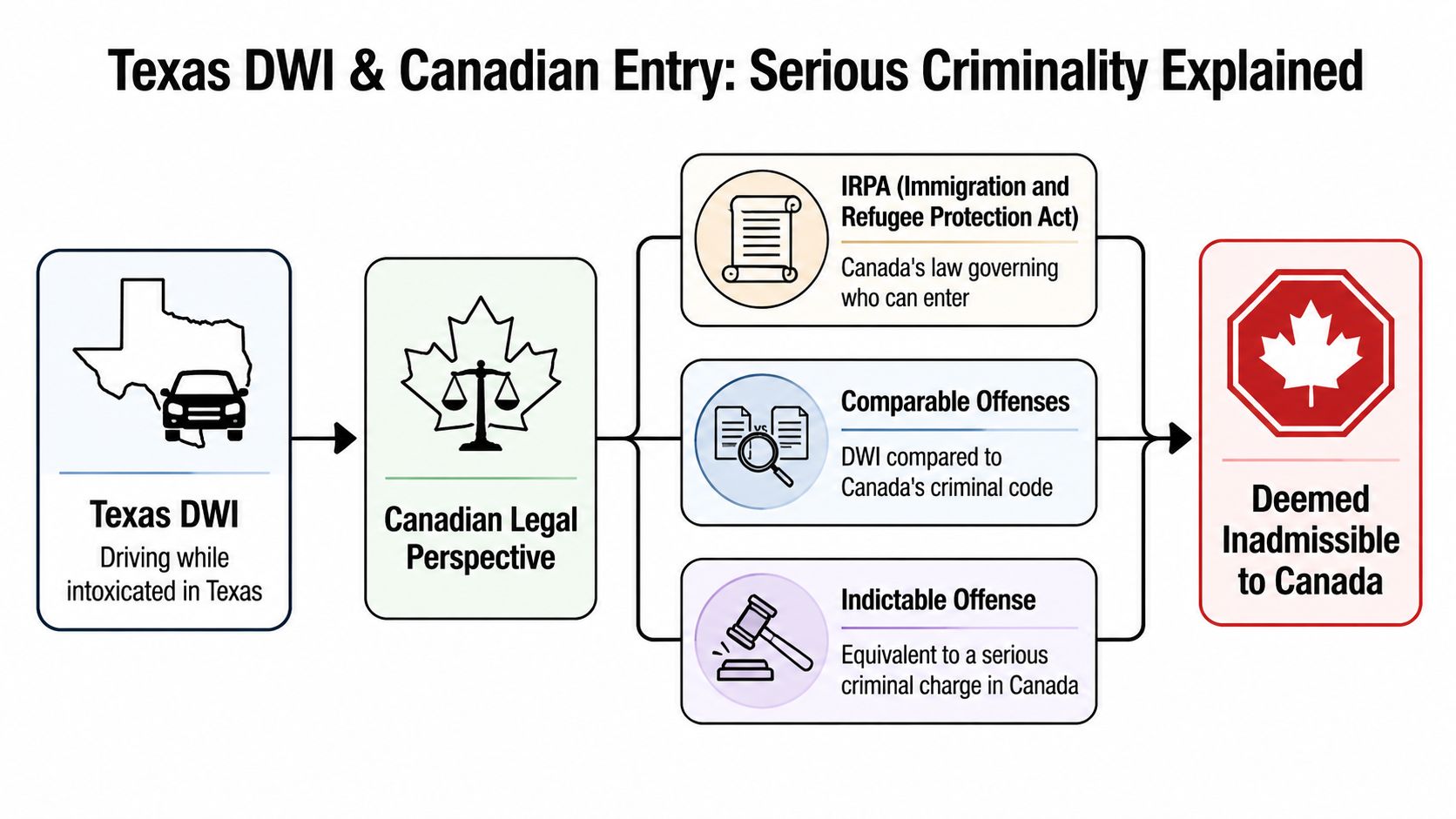
Canada does not care much about the Texas label. It compares your offense to Canadian law and decides whether the conduct matches an offense that makes you inadmissible. For many Texans, one DWI conviction is enough to create that problem. If you want a broader view of how a DWI can affect immigration status beyond border entry, this guide on the immigration consequences of a DWI for I-485 applicants is useful background.
Canada looks at equivalency, not Texas wording
This is the mistake Texans make all the time. They hear "misdemeanor" and assume "minor."
Canada asks a different question. It looks at the underlying conduct and decides what the Canadian equivalent would be. Once that comparison happens, the fact that Texas may have treated a first DWI as a misdemeanor does not protect you at the border.
That is why a case that seemed manageable in a Texas courtroom can become a travel barrier later. No jail sentence is required. No felony label is required. The conviction itself can trigger inadmissibility.
The 2018 change made older assumptions dangerous
Canadian law became tougher on impaired driving after changes that took effect on December 18, 2018. The practical result is simple. Older advice that "enough time has passed, so you should be fine" is often wrong for more recent cases.
Do not rely on casual internet advice or what happened to a friend years ago. Canada treats impaired driving as a public safety offense, and officers apply that framework aggressively.
The Texas outcome still matters more than people realize
Here is the part many defense lawyers never explain clearly enough. Your travel problem often starts long before you ever speak to a Canadian officer. It starts in the Texas case.
A dismissal can put you in a far better position than a conviction. A reduction to a non-equivalent offense may protect travel options that a DWI conviction would damage. Deferred adjudication, nondisclosure, expungement, and the exact wording of the final court records can all affect how your history is reviewed. They do not create automatic entry into Canada, but they can change the analysis and improve your options.
That is why a Texas DWI defense should never be handled as a quick plea decision. If Canada travel matters to you, your lawyer should be thinking about border consequences from day one.
Keep these points in mind:
- One Texas DWI conviction can create a Canada entry problem
- A Texas misdemeanor label does not control the Canadian analysis
- Recent cases face stricter treatment than many travelers expect
- The best time to protect future travel is during the Texas case, not after a denial at the border
If Canada may be in your future, treat your Texas DWI like an international travel issue now, not after the damage is done.
Understanding Your Status – Arrest vs. Conviction
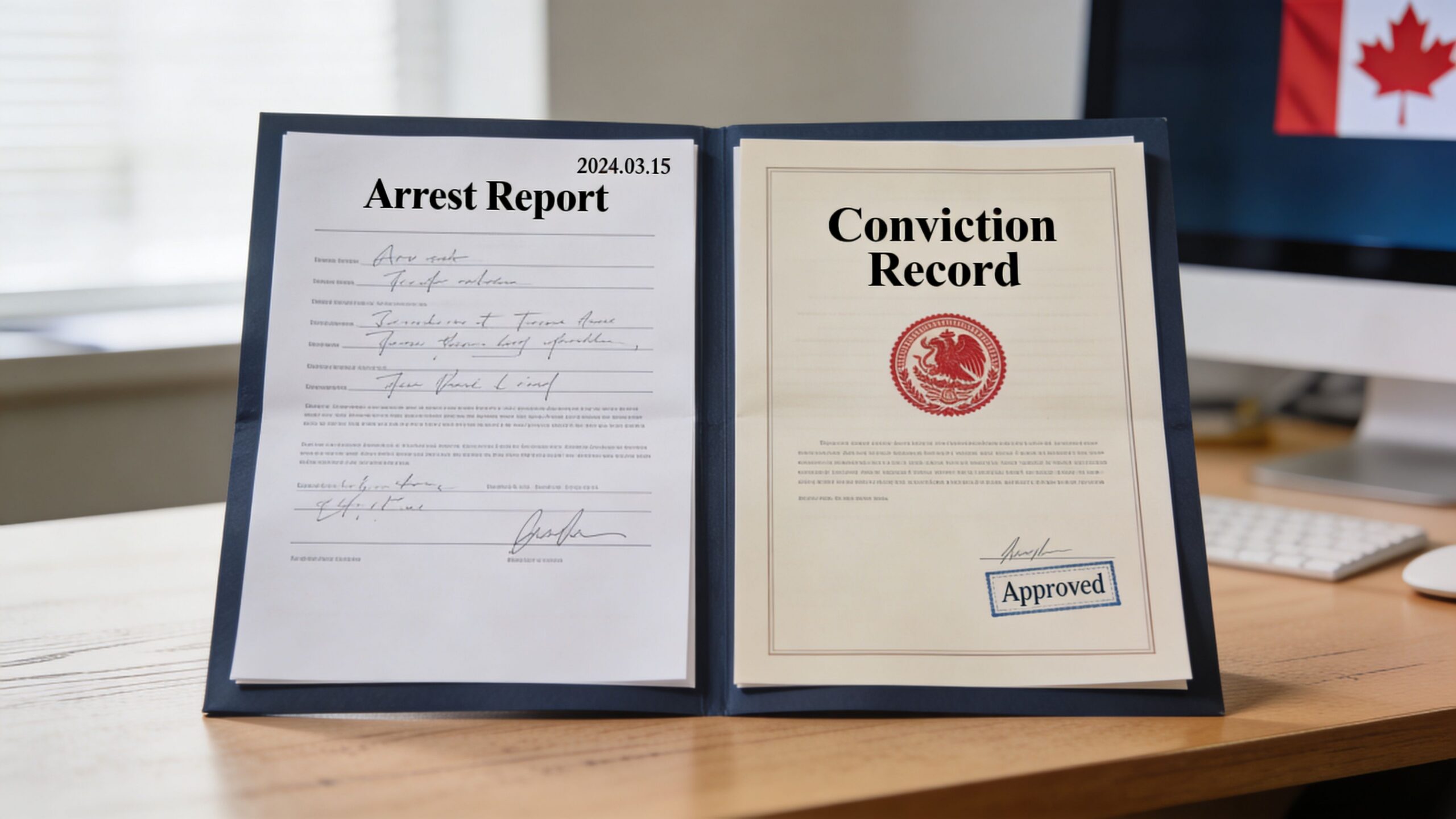
An arrest is not the same thing as a conviction. In Texas court, that distinction is huge. For Canada, it still matters, but it doesn’t mean a pending case is invisible.
A pending Texas case is better than a conviction, but it’s still risky
If you’ve only been arrested and your DWI case is still open, you’re in a stronger position than someone with a final conviction. That said, border officers still have broad discretion. A pending charge can trigger questions, delays, and close review.
That’s one reason early defense work matters so much. If your attorney can expose weak probable cause, challenge the stop, or push toward dismissal, you may prevent the travel issue from hardening into a long-term barrier.
For a closer look at that distinction under Texas law, review this guide on a Texas DUI arrest without conviction.
What documents can help
If you must travel while a case is pending, organization matters. A border officer may want to see exactly what stage your case is in.
Bring documents such as:
- Charging paperwork that shows the case is still pending rather than resolved as a conviction.
- Court setting information that reflects the current posture of the case.
- A legal opinion letter from a Houston DWI lawyer or Texas DUI attorney explaining the status of the case and the absence of a conviction.
- Proof of your reason for travel if the trip is tied to work, family, or another concrete purpose.
A pending case doesn’t automatically bar entry in every situation, but showing up with no documents is asking for trouble.
Why the distinction matters in Texas defense strategy
The best outcome is still to avoid a conviction if the facts and law support that result. That can happen through dismissal, suppression of evidence, reduction to a different offense, or other defense strategies based on the stop, testing, and arrest procedure.
After a Texas DWI arrest, your path usually includes bond conditions, possible ALR issues related to your license, discovery review, negotiations, pretrial hearings, and if needed, trial. If you refused testing or failed a breath or blood test, the administrative license suspension side of the case can move quickly, which is why immediate legal review matters.
If you’re facing a first DWI in Texas, don’t treat it like a routine inconvenience. The outcome can affect more than local penalties.
Your Three Paths to Legally Enter Canada After a DWI
You have a trip to Canada on the calendar, and your Texas DWI case is no longer just a local problem. At this stage, the question is practical. Which legal option gives you the best chance of getting in without wasting time, money, and credibility?
For most travelers, there are three possible paths. The right one depends on the age of the case, how your Texas charge was resolved, and how soon you need to travel. This is also where Texas case strategy matters. A reduction, dismissal, or other favorable outcome can leave you in a very different position than a straight DWI conviction.
The short-term option
A Temporary Resident Permit, or TRP, is the immediate-use option. It asks Canada to let you enter despite inadmissibility because you have a legitimate reason to be there now.
Business travel, a family emergency, or a serious personal obligation usually carries more weight than a vacation. A weak application usually fails because it gives the officer no reason to exercise discretion in your favor.
If your Texas DWI is recent and the trip cannot wait, a TRP is often the first path to examine.
The permanent option
Criminal Rehabilitation is the long-term fix. It is meant to resolve the inadmissibility tied to the offense itself, not just excuse it for one visit.
This is the better choice for people who expect to return to Canada for work, family, or regular travel. It takes time and solid records, but it addresses the underlying problem instead of patching over it trip by trip.
For a Texas traveler, the details matter. Canadian officials may look closely at the final court outcome, including whether the case ended as a DWI conviction, a reduced charge, or something else that affects admissibility analysis.
The limited older-case option
Deemed Rehabilitation only helps a narrower group of people now. It may apply if the qualifying conviction happened before December 18, 2018, and enough time has passed since every part of the sentence was completed.
That includes probation, fines, classes, and any other court-ordered terms. Many newer Texas DWI cases will not qualify.
Options for Entering Canada with a DWI
| Feature | Temporary Resident Permit (TRP) | Criminal Rehabilitation (CR) | Deemed Rehabilitation |
|---|---|---|---|
| Purpose | Temporary permission to enter despite inadmissibility | Permanent resolution of inadmissibility for the offense | Automatic-style relief for some older qualifying cases |
| Best for | Immediate or near-term travel needs | People who want a lasting solution | People with older pre-December 18, 2018 convictions |
| Timing | Used when travel cannot wait | Usually available only after enough time has passed since full sentence completion | Limited to older qualifying cases and enough elapsed time after sentence completion |
| How long it lasts | Temporary permission for a defined period | Permanent relief for that offense if approved | Not a permit application in the same sense |
| Main weakness | Discretionary and document-heavy | Slow and paperwork-intensive | Unavailable for many newer cases |
If you want a broader picture of how a record can affect border crossings, this guide to DUI and international travel risks adds useful context.
Bottom line: A recent Texas DWI conviction usually means you will need a TRP, Criminal Rehabilitation, or both. Do not assume the border officer will sort this out for you on arrival.
Which path makes the most sense
Timing is the key factor.
If the trip is soon, a TRP may be your only realistic option. If you expect repeat travel, Criminal Rehabilitation usually makes more sense because it aims for permanent relief. If your case is old enough and falls before the 2018 rule change, deemed rehabilitation deserves a careful review.
Texas-specific outcomes can change the analysis. Deferred adjudication, reductions, dismissed cases, and record-clearing options do not all translate neatly across the border. Do not guess about how Canada will classify a Texas result. Get both sides reviewed together. A strong Texas DWI defense is not just about avoiding local penalties. It can protect your ability to travel years later.
Multiple DWIs make every path harder. If that is your situation, get legal guidance before filing anything. A rushed application built on the wrong assumptions can create more problems than it solves.
The Risks of Showing Up at the Border Unprepared
A lot of travelers make the same mistake. They assume the officer won’t see the record, won’t care, or will let them explain it away in person. That’s a bad strategy.

What a refusal often looks like
You arrive at preclearance or the land border. The officer scans your documents and starts asking follow-up questions about prior arrests or convictions. Then you get sent to secondary inspection.
At that point, the tone changes. You may be asked for court paperwork, proof of sentence completion, or evidence that you already obtained permission to enter despite the DWI. If you don’t have it, you’re stuck.
People often realize too late that the trip itself was never the deciding issue. The legal record was.
The costs are real even without a new criminal charge
A denial at the border can derail far more than one day of travel. You may lose flights, hotel bookings, event fees, and work opportunities. You may also create a bad paper trail for future attempts to enter.
And there’s the practical damage no one talks about enough. Getting turned away in front of family, coworkers, or clients is embarrassing. It can also complicate future planning because every later trip starts with the same question.
For a quick visual explanation of how these border issues play out, this video is worth watching.
What to do instead
If you know you have a Texas DWI history, prepare before you travel.
- Check your record early so you know whether you’re dealing with an arrest, a conviction, or an old case that may qualify for a different analysis.
- Collect certified court documents before you book anything expensive.
- Confirm admissibility first instead of trying to persuade a border officer on the spot.
- Treat border entry like a legal issue because that’s exactly what it is.
Turning a border crossing into a last-minute gamble is usually what causes the biggest mess.
How a Strong Texas DWI Defense Protects Your Future Travel
A lot of people first worry about Canada after the Texas case is over. That is backwards.
If future travel matters to you, your Canada problem often begins with the choices made in your Texas DWI case. The charge you plead to, the wording in the judgment, whether probation was completed cleanly, and whether the case later qualifies for expunction or nondisclosure can all affect how Canadian authorities view your record. A lawyer defending a Texas DWI should be protecting more than your license and your court outcome. Your ability to cross a border years from now belongs in that strategy too.

Better Texas outcomes can change the long-term picture
Canada looks closely at the actual legal result, not the story you hoped the case would tell. That is why early defense work matters.
A strong Texas DWI defense may focus on:
- Whether the stop was lawful
- Whether the officer had probable cause to arrest
- Whether field sobriety tests were administered correctly
- Whether breath or blood evidence can be challenged
- Whether your statements should be suppressed
Those are not technical side issues. They are the pressure points that can lead to a dismissal, a reduction, or a result that creates fewer immigration problems later. In a Texas case, deferred adjudication, a reduced charge, or another negotiated outcome can be far better for future travel than a straight DWI conviction, but the details matter and should be reviewed with both Texas and Canadian consequences in mind.
Expunctions and sealed records help, but they do not end the analysis
Texas post-case relief still matters. Expunction and nondisclosure can improve how your record appears and what documents you can present. But you should not assume a cleaned-up Texas record makes Canada a non-issue.
Canadian officials may still see older arrest or court data through government databases, even after a Texas case has been sealed or expunged. That is one reason lawyers and applicants continue to rely on court-certified records and careful admissibility review instead of assumptions, as discussed in this analysis of entering Canada with a DUI conviction.
The practical lesson is simple. The best result is to defend the Texas case correctly from day one. Cleanup later helps, but prevention is stronger.
A smart Texas defense protects your record before you need to explain it at a Canadian border crossing.
Early Texas deadlines shape the options you have later
After a Texas DWI arrest, time matters fast. You may need to address bond conditions, protect your driver’s license through the ALR process, and make early decisions about testing evidence.
Terms like implied consent stop being abstract the moment the state claims you refused a breath or blood test or tries to use a test result against you. Those issues affect plea bargaining power, trial strategy, and the final record that follows you long after the case ends.
This is especially important in Texas because the outcome is not just about avoiding jail or a suspension. It is about avoiding a record that can block business travel, family trips, and future opportunities. If you have a pending DWI or an old Texas case that may be eligible for expunction or nondisclosure, get legal advice before you make assumptions about Canada. Professional help early usually creates better options later.
Take Control of Your Future – Your Next Steps
If you’re asking can you travel to canada with a dwi, the right response isn’t panic. It’s action.
You don’t need to know every detail of Canadian immigration law before making your next move. You do need to stop guessing and start organizing the facts of your Texas case.
Start with the documents
Get the paperwork before you do anything else. That means charging records, judgment, sentencing terms, proof that fines were paid, proof that probation ended, and any orders related to dismissal, reduction, sealing, or expunction.
If your case is still pending, gather the current docket information and anything your lawyer has filed that clarifies the status of the charge.
Don’t book first and ask later
This is one of the most expensive mistakes people make. They book flights, hotels, and event tickets, then ask whether entry will be allowed.
Reverse that order.
- Confirm the exact case outcome before assuming anything about admissibility.
- Review the conviction date carefully because timing affects whether an older path may exist.
- Check whether your sentence is complete since probation, fines, and related obligations matter.
- Hold off on non-refundable plans until your travel status is reviewed.
Use a legal strategy, not a hope strategy
A smart plan usually looks like this:
- Assess the Texas record accurately. Was it an arrest only, a conviction, a reduction, or something eligible for cleanup?
- Protect your Texas driving rights. If you’re newly arrested, address the ALR and license side immediately.
- Challenge the DWI aggressively if the case is open. The best travel solution is often avoiding the conviction in the first place.
- Evaluate whether record relief is available. Expunction or sealing can help, even if it isn’t a complete shield.
- Choose the right Canada entry path. For some people that means a TRP. For others it means waiting for Criminal Rehabilitation eligibility.
Why legal help matters here
This is not a do-it-yourself issue. You’re dealing with two systems that view the same event very differently. Texas criminal procedure, DPS license rules, and Canadian admissibility standards don’t line up neatly.
That’s why experienced counsel matters. A seasoned Houston DWI lawyer doesn’t just look at what happens at the next court date. A strategic lawyer looks at the stop, the testing, the ALR process, possible suppression issues, plea consequences, and how the final record may affect your life later.
If your case is active, now is the time to fight DWI Texas style with a plan. If your case is old, now is the time to review whether the record can be cleaned up and whether Canada entry options are available.
You can move forward. But you need a real strategy, not a border crossing gamble.
If you’re dealing with a Texas DWI and worried about how it could affect travel, work, your license, or your future, the Law Office of Bryan Fagan, PLLC can help you evaluate your options. Our team helps Texans challenge DWI charges, fight license suspension issues, and pursue outcomes that protect long-term opportunities. Request a free, confidential consultation today and get clear guidance on your case.