
Yes, a passenger can get a DWI in Texas, but only if the state can prove the passenger operated the vehicle while intoxicated. Riding in the car, even with a drunk driver, is not enough by itself for a conviction.
A DWI arrest can feel unreal when you weren't the one behind the wheel. Maybe the officer told you that grabbing the wheel counts. Maybe there was a crash, everyone had been drinking, and now police are trying to decide who was driving. Maybe you switched seats at the wrong time, or the officer claims you had control of the vehicle for a moment.
If that's where you are right now, take a breath. Passenger DWI cases in Texas are highly fact-specific, and that matters in your favor. These cases are often defensible because the prosecutor still has to prove a key element that many officers blur together in the field: operation.
That distinction matters because alcohol-impaired driving is a serious public safety issue. The National Highway Traffic Safety Administration reports that approximately 32 people die in drunk-driving crashes every day in the United States, or one fatality every 44 minutes, and during nighttime hours, the prevalence of passengers traveling with drivers at BAC levels of 0.08 or higher can reach 35% according to NHTSA drunk-driving data. But serious public safety concerns don't erase your rights. Police still have to apply Texas law correctly.
A Passenger's Nightmare an Unexpected DWI Charge
You get pulled over. The driver is nervous. The officer shines a light into the car, asks who has been drinking, and then starts focusing on you instead of the driver. That usually happens fast. One minute you're a passenger. The next minute you're hearing words like "control," "intoxicated," and "DWI."
That shock is real. It is often assumed that a DWI only applies to the person driving. In many situations, that's true. But Texas law doesn't turn on where you were sitting alone. It turns on whether the state can show you operated the vehicle.
Why passengers get pulled into DWI investigations
Passenger arrests usually happen in a small group of situations:
- Seat-switching claims after a stop or crash
- Physical intervention like grabbing the steering wheel
- Confusion after an accident when nobody admits who drove
- Circumstantial evidence that makes police think you had control at some point
The officer may think they're solving a problem in the moment. Prosecutors may later build a theory around scattered facts. That doesn't mean the theory is strong.
Bottom line: If you were a passenger, the state still has to prove more than your presence, your drinking, or your proximity to the driver.
Why state law matters
This area of law changes from state to state. Some jurisdictions take a broader view of passenger liability. For example, Tennessee recognizes situations sometimes described as DUI by consent, and California may focus on physical control in certain circumstances, as discussed in this state-law overview of passenger DUI exposure. That national variation creates confusion, especially when people search online and find advice that doesn't fit Texas.
Texas is its own legal world here. The question isn't whether another state might charge a passenger. The key question is whether your specific conduct meets Texas's definition of operation.
What you should hear right now
You should hear this clearly: being in the wrong car at the wrong time doesn't automatically make you guilty of DWI.
If police arrested you as a passenger, your case may hinge on a narrow factual dispute. That is exactly the kind of dispute a skilled Houston DWI lawyer and Texas DUI attorney should attack early, before the state's assumptions harden into a courtroom narrative.
The Deciding Factor What Counts as Operating a Vehicle in Texas
Under Texas Penal Code § 49.04, a DWI charge requires proof that a person was intoxicated while operating a motor vehicle in a public place. For a passenger, that single word is everything.
Texas does not require the state to prove the car was speeding down the road with you in the driver's seat. Texas courts treat operation more broadly. If your actions affected the vehicle's movement or put you in active control, the state may argue you operated it.
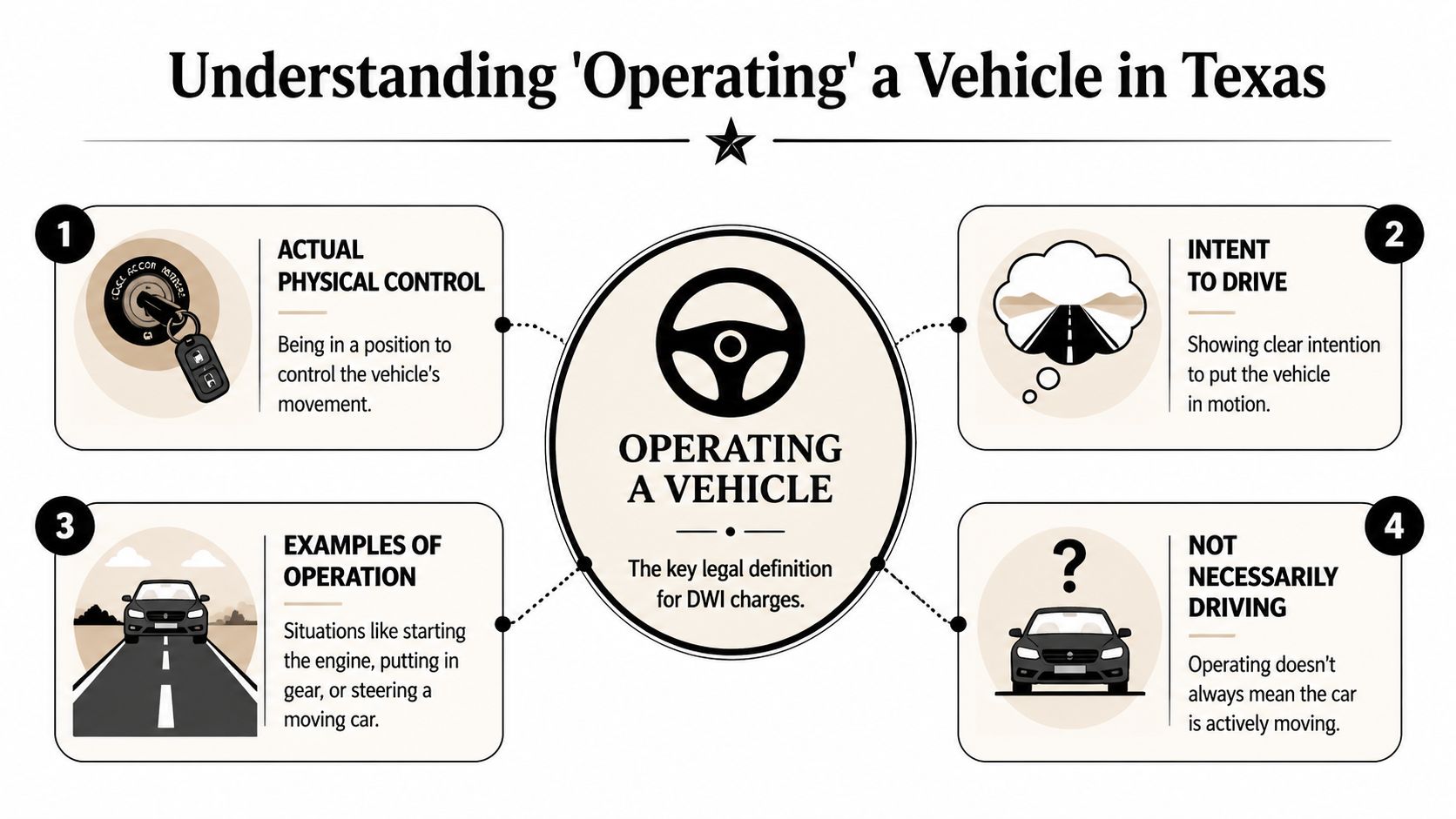
The simplest way to understand operation
Think of operation as the difference between being near the controls and using them.
A passenger remaining in their seat is not operating the vehicle. A passenger who reaches over and steers, shifts, or otherwise takes active control may be.
Texas-specific commentary on passenger DWI cases explains that operation requires active control over the vehicle, and that a passenger who momentarily grabs the steering wheel to steer can be charged. It also notes that in ambiguous cases, such as a multi-occupant crash where no one admits to driving, prosecutors may charge everyone based on circumstantial evidence of operation, while a strong defense can disprove control, as discussed in this Texas analysis of whether a passenger can get a DWI.
What police and prosecutors look at
Officers don't usually get a clean confession. They build the case from context. In passenger cases, that often includes:
- Your location in the vehicle at the time police arrived
- Whether the vehicle was running
- Where the keys were
- Witness statements from other occupants or bystanders
- Physical evidence from a crash scene
- Your own statements, especially if you tried to explain what happened
It is at this point that people get trapped. They try to "clear things up" on the roadside and accidentally give police the missing piece.
Actual physical control in plain English
You'll often hear lawyers talk about actual physical control. In plain English, that means whether the facts show you were in a real position to direct the vehicle's movement, not just whether you touched part of the car.
That concept matters a lot in gray-area cases. If you were asleep in a parked vehicle, sitting in the driver's seat, or found close to the keys, the state may try to build a control argument from those facts. But Texas still requires proof tied to operation, not guesswork.
For a closer look at how Texas treats control in parked-vehicle cases, see this discussion of getting a DWI while parked in Texas.
A passenger DWI case often turns on a narrow question: Did you actually control the vehicle, or did the officer jump from suspicion to arrest?
Key terms you need to know
Here are the terms that matter most after a passenger-related arrest:
| Term | What it means in plain English |
|---|---|
| BAC | Blood alcohol concentration. Texas generally uses 0.08% as the legal threshold, though the state can also allege intoxication based on loss of normal mental or physical faculties. |
| Field sobriety test | Roadside tests officers use to claim impairment. They are not the same as proving you drove. |
| Implied consent | By driving in Texas, drivers are deemed to have consented to breath or blood testing under certain circumstances after a lawful DWI arrest. Whether that applies cleanly in a passenger-control case depends on the arrest facts and should be reviewed carefully. |
| Administrative license suspension | A separate process from the criminal case where the state tries to suspend your license after a DWI arrest or test refusal. In Texas, this is often handled through the ALR process. |
Beyond DWI Other Charges a Texas Passenger Can Face
Sometimes the state can't make a DWI case stick against a passenger, so officers file other charges instead. Those charges may sound smaller, but they still carry risk. They can create a record, affect your job, and give prosecutors an advantage.

Public intoxication
In Texas, passengers often face Public Intoxication under Texas Penal Code § 49.02. It is a Class C misdemeanor, and fines can reach up to $500. Texas DPS reports approximately 5,000 PI arrests annually that originate from DWI stops involving passengers, according to this review of passenger charges in Texas DWI stops.
Public intoxication isn't about driving. It's about whether the officer claims you were intoxicated in a public place to a degree that you might endanger yourself or someone else. In real life, that often comes down to the officer's observations.
Common officer claims include:
- Slurred speech
- Strong odor of alcohol
- Poor balance
- Aggressive or confused behavior
- Stepping out of the vehicle and appearing unsteady
If you were arrested for PI as a passenger, that charge is still worth fighting. Officers often overstate danger when they don't have enough for DWI.
Open container violations
Texas also takes open container allegations seriously. If alcohol is in the passenger compartment, that can lead to charges or citations affecting more than just the driver.
The same Texas source notes that an Open Container violation can lead to fines for all occupants and can become more serious if minors are present. That matters because passengers sometimes assume the bottle belongs to someone else, so it's not their problem. On the roadside, that assumption won't protect you.
Practical rule: If police can point to alcohol in the passenger area, they may write the case first and leave the sorting-out for court.
Why these charges matter even when DWI doesn't
A passenger may avoid a DWI conviction and still face consequences from related charges. That can include court appearances, fines, bond conditions, and a criminal record issue that follows you into employment screenings or professional licensing reviews.
If you're searching can a passenger get a dui, don't stop at the DWI question alone. A strong defense looks at the full stop, the search, the arrest decision, and every charge tied to the encounter.
A quick comparison
| Charge | What the state is trying to prove | Why it matters |
|---|---|---|
| DWI | You operated a vehicle while intoxicated | More serious criminal exposure and possible license consequences |
| Public Intoxication | You were intoxicated in public and allegedly dangerous | Still creates a case and possible record |
| Open Container | Alcohol was unlawfully in the passenger area | Can strengthen the officer's narrative and add fines |
Common Scenarios Where Passengers Are Charged with DWI
The law makes more sense when you put it into real situations. Passenger DWI arrests don't usually come from routine, quiet traffic stops. They come from messy moments where police think a passenger crossed the line into control.

Grabbing the steering wheel
This is one of the clearest examples. If you're intoxicated and reach over from the passenger seat to steer, even briefly, police may claim you operated the vehicle.
That gets complicated when you grabbed the wheel to avoid a crash. The law doesn't automatically reward good intentions if your action still put you in active control. Commentary on this issue highlights the paradox here: a passenger who grabs the steering wheel to stop a drunk driver can still be charged with DWI if that act amounts to control, as explained in this discussion of passenger intervention and DUI liability.
Switching seats after the stop
This happens more often than people think. An officer approaches, sees movement, and later says occupants switched positions before contact. Once that accusation enters the report, the state may use it as the backbone of the case.
These cases are often beatable because they depend heavily on timing, video, and inconsistent witness accounts. But they are dangerous if you try to talk your way out of them without counsel.
The crash where nobody admits driving
After a wreck, everyone may be shaken, injured, or intoxicated. Police arrive and ask the same question over and over: who was driving?
If nobody answers, officers may rely on circumstantial evidence. In some cases, that leads to multiple people being accused. This is one of the hardest situations for defendants because confusion itself becomes part of the state's story.
Trying to help can create new risk
Texas passengers also need to understand the difference between helping and incriminating themselves. If you physically assist with steering, shifting, or controlling the car, the state may treat you as an operator. If you only argue with the driver or tell them to pull over, that's different.
Questions about encouraging or assisting an impaired driver can overlap with related liability theories, which is why this overview of aiding and abetting DWI charges is worth reviewing if your arrest involved more than a straightforward passenger allegation.
Before you watch the video below, keep this in mind: the state's version of events often sounds more certain on paper than it was on the roadside.
Parked car gray areas
A parked car can still create a DWI investigation if police think someone had the ability and intent to control it. For passengers, the risk grows when the facts blur. You were in the front seat. The keys were close. The driver was outside the car. The engine was running.
Those facts don't automatically prove guilt. But they often give police enough confidence to arrest first and sort out details later.
If your case involves a parked vehicle, a seat switch, or a brief grab of the wheel, the defense usually lives in the details the arrest report leaves out.
CDL holders and professionals
If you hold a commercial driver's license or a professional license, even an allegation can create immediate stress. Background checks, employer reporting duties, and licensing board concerns can all start before your criminal case is resolved.
That doesn't change the legal standard. It does mean you should move faster and treat the case like the threat it is.
How to Fight a Passenger DWI Charge in Texas
A passenger DWI charge is not a lost cause. In many of these cases, the state is trying to stretch weak facts into operation. That's exactly where a focused defense should press back.

Attack the operation element first
The strongest defense in many passenger cases is simple: you did not operate the vehicle.
That means forcing the prosecutor to prove actual control with real evidence, not assumptions. Legal commentary on this topic emphasizes that actual physical control is the linchpin in a passenger DUI case, that it varies by state, and that in Texas defense strategies often focus on disproving whether the passenger's conduct met the state's interpretation of control, as discussed in this analysis of actual physical control in passenger DUI cases.
A defense lawyer should examine:
- Dashcam and bodycam footage
- The officer's timeline
- Witness statements that changed over time
- Physical layout of the vehicle
- Whether your conduct affected movement
Challenge the stop and the arrest
Police don't get a free pass because alcohol was involved. If the stop was unlawful, if the arrest lacked probable cause, or if the officer searched beyond what the law allowed, important evidence may be challenged.
That matters in passenger cases because officers often expand the stop once they smell alcohol or hear conflicting stories. Expansion isn't always legal.
Scrutinize field sobriety and chemical testing
A field sobriety test is a roadside set of exercises officers use to claim intoxication. Those tests are already subjective. They become even less useful when the core issue is not just intoxication, but whether you in fact operated the car.
Implied consent refers to Texas rules that treat drivers as having consented to breath or blood testing in certain lawful arrest situations. In a passenger-control case, a lawyer should examine whether police had a valid basis to move from suspicion to a DWI arrest in the first place.
If there was a breath test or blood test, the defense should review:
- Why the test was requested
- Whether the arrest was lawful
- Whether the sample was collected and handled properly
- Whether the result proves anything about operation
Use your facts, not the state's assumptions
Passenger cases often turn on small facts that officers flatten into broad conclusions. The seat was reclined. The driver was outside the car. A witness saw someone else behind the wheel minutes earlier. The bodycam doesn't show what the report claims.
That's how cases get reduced or dismissed. Not with vague arguments, but with precise contradictions.
A good defense doesn't just argue that the officer might be wrong. It shows exactly where the officer's story stops matching the evidence.
If you want to fight DWI Texas style, that's the approach. Start with operation. Challenge probable cause. Then work outward through every statement, test, and recording.
Navigating the Aftermath ALR Hearings and Penalties
After a DWI arrest in Texas, you may be dealing with two separate problems at once. One is the criminal case. The other is the driver's license case.
What ALR means
Administrative License Revocation, often called ALR, is the civil process the Texas Department of Public Safety uses to suspend a person's license after certain DWI-related arrests or test refusals.
One critical issue in a passenger case is whether the ALR process was properly triggered at all. If police arrested you on a theory that you operated the vehicle, they may still try to push the license side forward. That is not something you should ignore.
Texas passenger DWI guidance notes that counsel can challenge probable cause through ALR hearings within 15 days, which makes speed essential after arrest. For a focused breakdown of how these hearings work and how testimony gets challenged, review this Texas guide to ALR hearing cross-examination.
What happens after arrest
The usual sequence looks something like this:
Booking and release
You may be booked, bonded out, and given court dates or release conditions.License paperwork review
You need to determine quickly whether DPS is attempting a suspension.ALR deadline action
Waiting is a mistake. Missing the deadline can make the license side harder to fight.Criminal case review
Your lawyer examines reports, video, testing records, and the operation theory.Court settings and negotiations
Depending on the evidence, the case may move toward dismissal, reduction, or trial.
Penalties depend on the charge
If the state proves a passenger DWI, penalties can be serious. If the case gets reduced to a related offense, consequences may be less severe but still worth fighting.
Here is the practical view:
- DWI exposure can include jail, fines, license consequences, and a lasting criminal record.
- First DWI in Texas cases may carry lower exposure than repeat cases, but they still need a real defense.
- Public Intoxication and Open Container charges can look minor on paper and still create long-term trouble.
Why early action changes the case
Early action helps in two ways. It protects your license position, and it preserves evidence before it disappears into bureaucratic delay.
That is especially important in a passenger case. Video, dispatch timing, and witness memory can make the difference between "we think you operated" and "we can't prove it."
Your Next Steps to Protect Your Rights and Your Future
If you've been arrested as a passenger, stop trying to explain the case to police, friends, or your insurance company in a way that sounds helpful. Helpful statements often become damaging statements.
What to do today
Start with these steps:
- Stay quiet about the facts unless your lawyer tells you otherwise
- Save every document you received from police or the jail
- Write down your memory now while it is still fresh
- Identify witnesses who saw who was driving
- Look for video sources such as dashcam, surveillance, rideshare records, or phone footage
- Act fast on license issues if you received suspension paperwork
Know your rights clearly
You still have the right to remain silent. Use it.
You also have the right to challenge the state's evidence, the legality of the stop, the basis for your arrest, the reliability of field sobriety testing, and any breath or blood evidence. If you're worried about a DWI license suspension, don't assume it's automatic or valid. Make the state prove every step.
What not to do
Don't post about the arrest online.
Don't text detailed explanations to other people in the car.
Don't assume the case is hopeless because the officer sounded confident. Officers make arrests based on incomplete facts all the time. Passenger cases are especially vulnerable to rushed conclusions.
Your case is not defined by the arrest report. It's defined by what can actually be proved in court.
The real answer to can a passenger get a dui
Yes, under Texas law, a passenger can be charged if the state believes the passenger operated the vehicle while intoxicated. But no, merely being present in the car is not enough. That gap between accusation and proof is where your defense lives.
If you're looking for a Houston DWI lawyer or Texas DUI attorney, focus on someone who understands how to dismantle the operation element, protect your license position, and keep a confusing roadside incident from becoming a permanent record.
You don't need panic. You need a plan.
If you were arrested as a passenger and you're worried about what happens next, Law Office of Bryan Fagan, PLLC can help you take control of the situation. Their team defends Texans accused of DWI and related offenses, including license hearings, first-offense cases, and record-clearing options. If you need answers about your arrest, your rights, or how to fight the charge, request a free and confidential consultation today.