 Skip to content
A DWI arrest can be overwhelming, but you don't have to face it alone.
You're probably dealing with more than court dates and license worries right now. Maybe your lease is ending. Maybe you just got a job in a new city. Maybe you're filling out apartment applications and wondering whether one mistake, or one bad arrest, is about to shut every door in front of you.
That fear is real. It's also usually worse than the reality.
If you're asking can a DWI affect your ability to rent an apartment in Texas, the honest answer is yes. But it does not mean you're automatically out of options. Most rental problems tied to a DWI come down to three things: what appears on the background check, how the landlord's screening policy is written, and whether you take smart steps before you apply.
A DWI Arrest Is Overwhelming Your Housing Search Does Not Have to Be
A client once sat across from me more worried about his apartment application than his court date. That happens a lot. People assume the criminal case is the only problem, then the housing issue hits them out of nowhere.
He had just been arrested for DWI, his current lease was ending, and he was convinced no landlord in Texas would touch his application. He wasn't asking whether the case was defensible. He was asking where he was supposed to live.
That kind of panic makes sense. A DWI case can throw your life off balance fast. You may be dealing with bond conditions, work stress, family pressure, and the possibility of a DWI license suspension. If you refused a breath or blood test, or failed one, you may also be facing an administrative license suspension, which is a separate civil process tied to your driving privileges.
Here are a few terms you need to understand early:
- BAC means blood alcohol concentration. It's the measurement the state uses when it claims alcohol was in your system.
- Field sobriety test usually refers to roadside balancing and eye movement tests officers use during a stop.
- Implied consent means that by driving in Texas, you've already agreed to provide a breath or blood specimen under certain legal circumstances after a DWI arrest.
- Administrative license suspension is the DPS process that can suspend your license apart from the criminal court case.
If you've just been arrested, the process usually moves in a predictable order:
- Arrest and booking
- Bond and release
- Notice of possible license action
- Deadline to request an ALR hearing
- Criminal court settings
- Negotiation, motion practice, trial, or resolution
Practical rule: The strongest move is early action. The earlier you protect the criminal case and the license case, the better your chance of protecting housing options too.
A Houston DWI lawyer or Texas DUI attorney doesn't just defend you in court. The right lawyer helps keep this charge from turning into a conviction that follows you into every apartment search.
How a Texas DWI Can Influence a Rental Application
Yes, a Texas DWI can affect a rental application. The reason is simple. Landlords and property managers often run criminal background checks, and a DWI conviction may show up.

A lot of people miss the main issue. The DWI itself is only part of the story. The bigger issue is the landlord's screening policy.
The DWI is a flag, not an automatic denial
Think of a DWI like a flag on your file. One landlord sees that flag and takes a closer look. Another landlord has a policy that rejects anyone with a recent conviction. Another may care far more about your income, rental history, and whether the offense was a misdemeanor or felony.
In Texas, a DWI is not a protected class under the federal Fair Housing Act, so landlords generally may lawfully use criminal-history screening. The practical problem is policy design. Many property managers use blanket thresholds for felonies, recent offenses, or any criminal history at all. A misdemeanor DWI is often less damaging than a felony DWI, but either can hurt you if the screening model treats prior offenses as a risk factor, as explained by this discussion of renting an apartment with a DWI.
If you want a better sense of what may appear during screening, review this guide to whether a DWI affects your background check.
What matters most to a landlord
Landlords usually care about practical risk. They want to know whether you'll pay rent, follow lease terms, and avoid trouble at the property.
A DWI can raise concerns in these areas:
- Recent criminal history that makes a screening system mark your application
- Felony-level exposure if the charge is more serious than a basic first offense
- Stability concerns if your case affects work, transportation, or finances
A DWI doesn't make you unrentable. But it does mean you need to apply strategically instead of casually.
One more point matters. If a landlord denies your application based on a consumer report or background check, they must provide an adverse action notice and tell you about your right to dispute inaccurate report data. That notice is not paperwork to ignore. It can become the key to fixing a bad denial.
Understanding the Tenant Screening Process in Detail
Most renters treat screening like a black box. You submit an application, pay a fee, and wait. That's a mistake. If you understand the process, you can spot problems before they cost you an apartment.
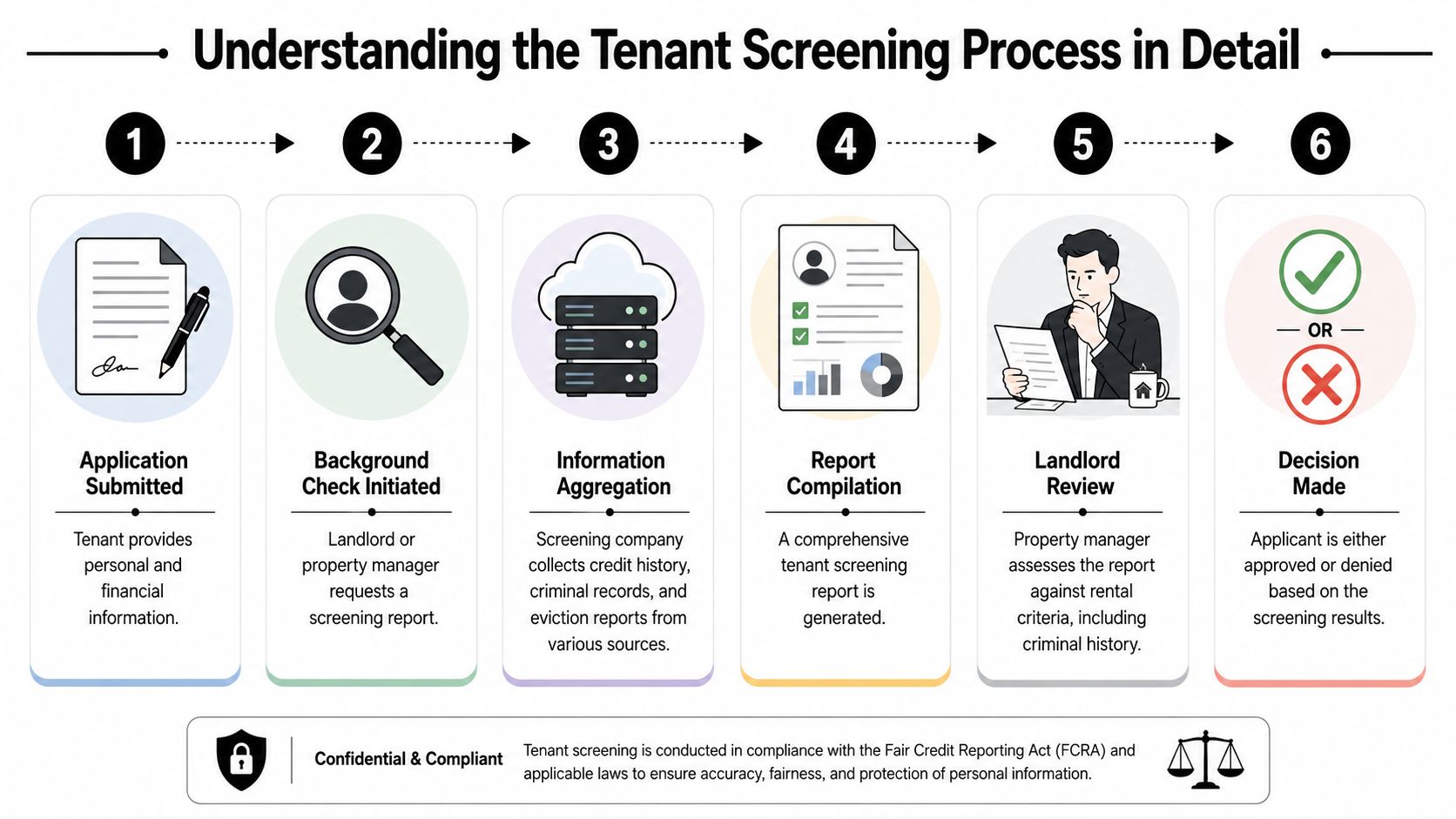
What happens behind the scenes
A typical tenant screening process looks like this:
| Stage | What happens | Why it matters |
|---|---|---|
| Application | You submit identifying, employment, and rental information | Errors here can create mismatched records |
| Screening request | The landlord orders a report | The landlord may use a third-party reporting company |
| Record pull | The company gathers credit, criminal, and eviction data | Your DWI may or may not appear depending on status and reporting |
| Report review | The landlord compares the report to internal criteria | This is where policy drives the outcome |
| Decision | Approval, conditional approval, or denial | A denial may trigger legal notice requirements |
If you want more context on visibility of charges and records, see this guide on whether DWI arrests are public records.
Arrest, conviction, and severity are not the same thing
Landlords and screening companies don't always treat every record the same way.
- Arrest without conviction often raises less concern than a conviction
- Misdemeanor DWI conviction may still hurt, especially if it's recent
- Felony DWI usually gets much harsher treatment from screening policies
That distinction matters because the first question isn't just whether you were arrested. It's whether the report shows a conviction, whether the data is current, and whether the landlord's criteria treat that record as disqualifying.
Texas guidance notes that convictions can be reported indefinitely under the FCRA, while arrest records are time-limited. The Fair Credit Reporting Act also requires landlords who deny an application based on a consumer report to provide an adverse action notice identifying the reporting agency and your right to dispute errors and request a copy of the report, as outlined in the Texas law library guidance on background checks and conviction restrictions.
The notice you should never ignore
If you get denied, don't just move on to the next listing.
Read the adverse action notice carefully. It should tell you:
- Which screening company supplied the report
- How to request a copy of the report
- How to dispute inaccurate information
Critical move: If the denial came from bad data, your fight is no longer just with the landlord. It's with the reporting company that produced the bad file.
That's the practical gap many overlook. They often assume the DWI doomed the application. Sometimes the actual problem is that the report was outdated, incomplete, or flat wrong.
Your Rights as a Renter Under Federal and Texas Law
A DWI record is not a protected class. That's the hard truth. A landlord generally can consider criminal history when deciding whether to rent to you.
What a landlord shouldn't do is treat every applicant with any criminal history the exact same way. Housing decisions have moved toward more individualized review, especially because fair-housing guidance has emphasized that arrest records alone are not enough to deny housing.
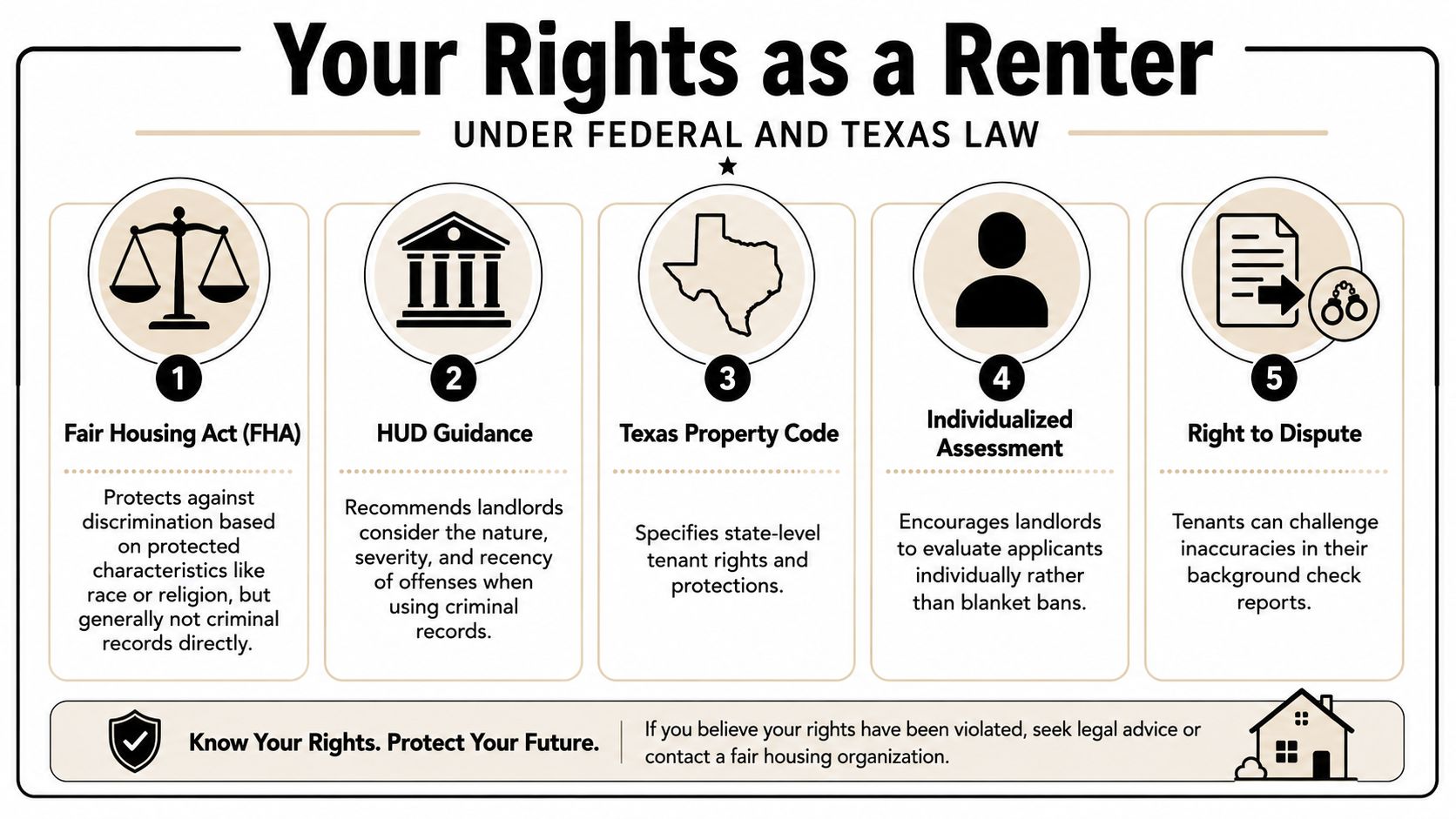
Individualized review matters
A conviction can be considered. An arrest by itself should not carry the same weight.
That's important because modern screening practices increasingly look at the full picture, including the age of the offense and evidence of rehabilitation. Older convictions usually carry less weight. Many landlords focus most on the prior 3 to 5 years, while a conviction from over 10 years ago is typically viewed more favorably than one from a few months ago, as discussed in this overview of whether a DUI conviction can prevent renting or getting a mortgage.
What you can push back on
You may not be able to force a landlord to approve you, but you can challenge a bad process.
Look closely at these issues:
- Arrest versus conviction. If the record reflects an arrest and not a conviction, that difference matters.
- Age of the offense. A stale offense should not be treated like a fresh one.
- Rehabilitation evidence. Completion of court conditions, treatment, or compliance efforts can help.
- Report accuracy. Wrong names, wrong counties, duplicate entries, and old status updates happen.
A landlord who uses screening should make a real decision based on the total circumstances, not lazily rely on a broad rejection formula.
What this means in plain English
If your DWI is recent, expect scrutiny. If it's older, resolved, and paired with stable income and a clean rental history, your odds improve.
Don't argue with a landlord in abstract legal terms. Give them a clean, documented reason to see you as low risk.
That's the practical use of your rights. Not courtroom theory. Advantage.
Proactive Strategies to Secure an Apartment with a DWI Record
If you sit back and hope the DWI won't come up, you're making the process harder than it needs to be. The right move is a proactive one.
A DWI conviction can matter in housing because it's tied to real criminal penalties. Texas explains that a first DWI conviction can carry up to 180 days in jail, a fine of up to $2,000, and a driver-license loss of up to one year, while a second offense can mean up to one year in jail, a fine of up to $4,000, and a license loss of up to two years, according to Texas impaired driving penalties. Landlords know that. They don't view a DWI as a paperwork issue. They view it as part of a broader risk picture.

Build an application that answers the landlord's real concern
A landlord isn't looking for perfection. The landlord is looking for predictability.
That means your application should answer the question, “Why am I safe approving this person?”
Use a package that includes:
- Proof of stable income so the landlord sees rent reliability first
- Strong rental references from prior landlords if you have them
- A short written explanation if the DWI is likely to appear
- Proof of completed requirements such as classes, probation terms, or other court-related obligations if applicable
- Character letters from employers, supervisors, or community contacts who know you
Keep the explanation short. Don't write a dramatic essay. State the issue, note the case status or resolution, and focus on current stability.
Choose your targets carefully
Not every property is worth your application fee.
Large apartment complexes often rely on rigid screening systems. Smaller owners and private landlords may have more room to use judgment. That doesn't mean every small landlord will say yes. It means you have a better chance of being treated like a person instead of a scorecard.
A smart approach looks like this:
- Ask whether the property uses third-party criminal screening.
- Ask whether they review applicants individually.
- Ask whether they distinguish between misdemeanors and felonies.
- Apply where the answers sound thoughtful, not automatic.
Clean the record when the law allows it
This is the strongest long-term move. If you're eligible, pursue record clearing or record sealing.
Two tools matter here:
- Expunction removes qualifying records from public view
- Order of nondisclosure seals qualifying records from most public background checks
If nondisclosure may be available in your case, this Texas DWI nondisclosure guide is a good starting point.
For some people, legal counsel becomes practical, not optional. The Law Office of Bryan Fagan, PLLC handles Texas DWI defense and post-case relief work such as record-related strategies tied to DWI cases, including guidance that may affect how future landlords see your history.
Attack bad screening data fast
If a denial was based on a background report, get the report.
Then check:
- Name matching errors
- Wrong case disposition
- Duplicate charges
- Outdated status reporting
- Records that belong to someone else
Smartest next step: Don't guess what the landlord saw. Get the actual report and verify every line.
That one move can change the entire conversation.
Why a Strategic DWI Defense Lawyer Is Your Strongest Ally
The cleanest way to protect your ability to rent is to avoid a damaging conviction in the first place.
That starts right after arrest. A lawyer can challenge the stop, the officer's observations, the field sobriety test, the breath or blood testing procedure, and whether police had legal grounds for the arrest. If the state's case weakens, the path to dismissal, reduction, or a better resolution gets stronger.
Early defense protects more than the court case
A first DWI in Texas may seem manageable when compared to more serious charges, but it can still affect housing, employment, and driving privileges. That's why a defense strategy has to address both tracks of the case:
- The criminal case, where the state tries to prove intoxication
- The ALR case, where your license can be suspended separately
A lawyer can request and prepare for the ALR hearing, evaluate police reports, obtain records, and preserve issues early. When people wait, they lose their advantage.
Lawyers matter after the case too
If you already have a conviction or arrest history, legal help is still useful. A lawyer can determine whether you may qualify for expunction or nondisclosure, identify timing issues, and prepare the filings correctly.
Many people make a mistake regarding this. They assume any DWI can be hidden. Texas law is more specific than that. Eligibility depends on how the case ended and what relief the law allows.
If your goal is to fight DWI Texas style, meaning aggressively and intelligently from the start, your legal strategy should cover the roadside stop, the license problem, the court case, and the future record issue. A seasoned Houston DWI lawyer sees all four.
Take Control of Your Future Today
A DWI can make renting harder in Texas. It does not make it hopeless.
If you remember one thing, remember this: apartment denials usually turn on screening reports and landlord policies, not panic, rumor, or what your cousin thinks happened to someone else. Your job is to get factual, get organized, and get ahead of the issue.
That means taking action now:
- Review what may appear on your record
- Apply strategically instead of blindly
- Demand the adverse action notice if you're denied
- Dispute inaccurate background check information
- Find out whether expunction or nondisclosure could keep the DWI from becoming a long-term housing problem
- Get legal help early if the criminal case is still pending
You do not need to approach this like you're begging for mercy. You need a plan.
A strong Texas DUI attorney helps you protect more than a courtroom result. The right strategy can protect your license, your record, and your ability to move into the next apartment without carrying this charge on your back forever.
If you're anxious about whether a DWI will block your housing, that anxiety won't improve by waiting. It improves when you know exactly what's on your record, exactly what your options are, and exactly what to do next.
If you're dealing with a DWI arrest, a rental denial, or questions about clearing your record, the Law Office of Bryan Fagan, PLLC offers free consultations to discuss your case and your options under Texas law. A confidential case evaluation can help you understand the charge, protect your license, assess expunction or nondisclosure possibilities, and build a strategy to protect your housing prospects.

