
A DWI arrest can be overwhelming, especially if college applications are already open, scholarship deadlines are close, or your family has spent years planning for the next step. For many students and parents, the first fear isn't even court. It's whether one night will wipe out admission offers, financial aid, and a carefully built future.
That fear is understandable. It's also not the whole story.
If you're asking can a DWI affect college admissions Texas, the honest answer is yes, it can. But in practice, the result usually depends on a smaller set of issues than people think. What the application asks matters. Whether the case stays an arrest or becomes a conviction matters. Whether the charge is a misdemeanor or a felony matters. So does how you respond right now.
A strategic Texas DWI defense attorney looks at more than the criminal case. The work is to protect your record, your license, your credibility, and your options, so one allegation doesn't become a permanent label.
A DWI Arrest Is Overwhelming But Not a Dead End
A student gets arrested after a school event, a weekend party, or a late-night drive home. By morning, the questions start coming fast. Will this show up on applications? Do I have to tell colleges? Should we wait and see what happens in court? Is everything ruined?
Usually, it isn't.
What hurts students most is often not the arrest alone. It's the chain reaction that follows when no one makes a plan. A missed deadline for a DWI license suspension hearing. A rushed guilty plea in a first DWI in Texas case without thinking about long-term school consequences. An application answer that is incomplete, misleading, or unnecessarily broad. Those mistakes can create problems that were avoidable.
Practical rule: The first goal is to keep a charge from becoming a conviction if the facts and law support a defense. The second goal is to control what must be disclosed, when it must be disclosed, and how it is explained.
That starts with understanding the Texas process. A DWI means driving while intoxicated. In Texas, the State can try to prove intoxication by showing a BAC, or blood alcohol concentration, at or above the legal limit, or by claiming you didn't have the normal use of your mental or physical faculties because of alcohol or drugs. A field sobriety test is the roadside set of tasks officers use to claim impairment, such as balance and eye-movement tests. Implied consent means that by driving in Texas, you have already agreed to provide a breath or blood specimen in certain circumstances after a lawful arrest. If you refuse, or if you fail a test, DPS can seek an administrative license suspension, often called an ALR action, which is separate from the criminal court case.
After an arrest, there are usually two tracks running at once:
- The criminal case in court, where the charge itself is fought.
- The ALR case, where the State may try to suspend your license.
Bond conditions may also apply. Court dates follow. Evidence has to be reviewed. In some cases, the defense challenges the traffic stop, the arrest, the testing method, or the officer's conclusions.
The important point is simple. A DWI is serious, but it is still a problem to manage. It is not an automatic end to college plans.
The Application Question How Colleges Discover a DWI
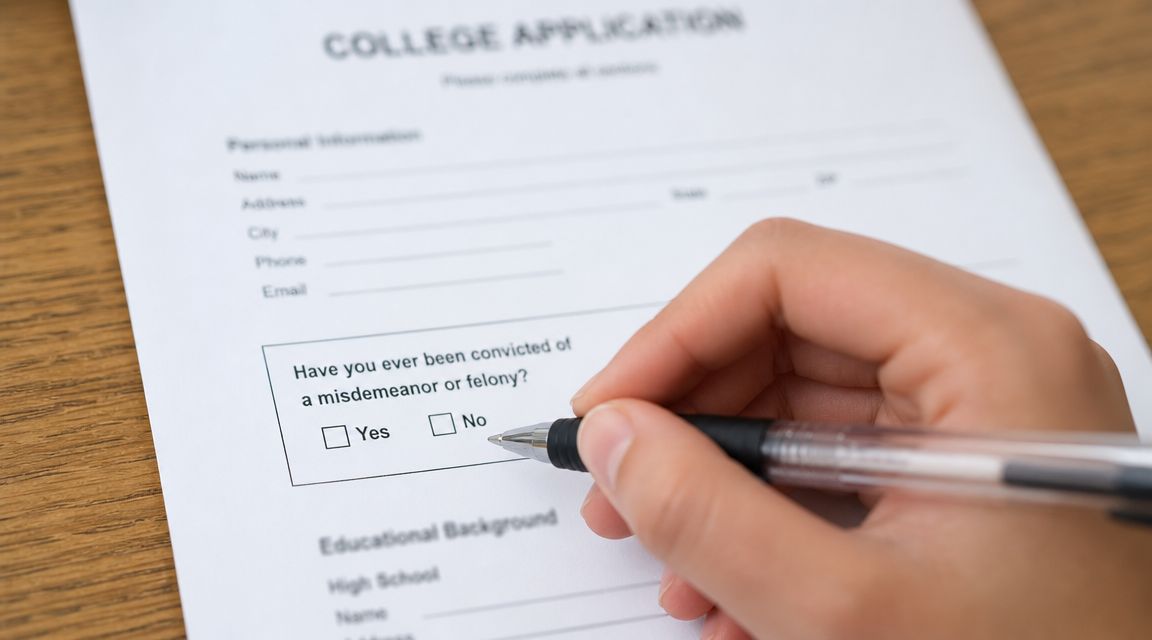
Most colleges don't discover a DWI through guesswork. They learn about it because the application asks, or because a later background review, conduct screening, scholarship review, or program check brings it to light.
What the application is really asking
Texas colleges commonly use criminal-history screening questions, and a DWI tends to matter most when a school or specific program explicitly requires disclosure of arrests or convictions. If a school asks about convictions, a false omission can be treated as misrepresentation that invalidates the application, while a disclosed DWI may lead to discretionary review instead of automatic rejection. The admissions risk is often highest in competitive majors and in graduate or professional programs that use conduct-based screening. Accurate disclosure only when required, paired with evidence of rehabilitation, is often the most useful approach, and schools may be more willing to overlook a misdemeanor DWI than a felony conviction, as discussed in this Texas college-application background check guide and in this Texas admissions analysis on DWI disclosure.
That means you should never assume every school asks the same question. One application may ask about convictions only. Another may ask about pending charges. A specialized program may have a separate conduct questionnaire. Athletics, campus housing, and scholarships may each use their own forms.
Why honesty beats clever wording
Students sometimes think the safest move is to say as little as possible, or to leave the answer blank and hope the school never checks. That is usually the worst strategy.
Admissions offices are not just screening for criminal conduct. They are also judging candor, judgment, and whether the applicant can follow instructions. A direct, accurate answer usually gives the school room to consider the whole file. A misleading answer turns the case into a character issue.
A disclosed problem can be reviewed. A false answer can destroy trust.
A better approach is disciplined and specific:
- Read the exact question: Don't answer a conviction question as if it asked about arrests.
- Match your answer to your legal status: If the case is pending, say that if the form requires it.
- Don't over-disclose: Extra details that were not requested can create confusion.
- Prepare supporting material: If the school allows an addendum, explain briefly what happened, what you've done since, and how the matter is being addressed.
This is one reason early defense work matters. The cleaner and more accurate your legal posture, the easier it is to answer applications without panic.
Arrest vs Conviction Why the Difference Matters for Your Application
An arrest is an accusation. A conviction is a legal finding of guilt. Colleges, scholarship committees, and licensing-related programs often treat those two things very differently.
That distinction is where defense strategy becomes practical, not theoretical.
Why the legal status changes the admissions picture
In Texas, whether a DWI affects college admissions often turns on the severity of the offense and whether the school asks about criminal history. A legal analysis focused on college admissions explains that many schools treat a misdemeanor DWI less harshly, while a felony DWI is much more likely to hurt acceptance chances. The same analysis warns that if an application asks about criminal history, the student must answer truthfully, and if the school later learns the applicant lied, the consequences can include immediate refusal, expulsion after enrollment, or even rescission of a degree, according to this Texas analysis of DWI charges and college admission consequences.
So when a family asks whether to "just plead and move on," the answer is often no. Speed is not the same thing as strategy.
If your lawyer can challenge the stop, the officer's observations, the field sobriety test, the breath result, the blood draw, or the chain of custody, that may affect whether the case is dismissed, reduced, or resolved in a way that changes what you later have to disclose. The same is true if the defense identifies weaknesses in probable cause or constitutional issues.
Severity matters more than many families realize
A misdemeanor DWI and a felony DWI do not carry the same admissions risk. A felony raises the stakes because schools often treat felony-level conduct as a more serious safety and judgment concern. It also creates more downstream issues with aid and program eligibility, which can matter even if general admission remains possible.
For that reason, one of the most important jobs of a Texas DUI attorney is to fight the classification of the case where the facts allow it, and to avoid outcomes that create a harsher record than necessary. Record-sealing options may also matter later, which is why this guide to nondisclosure after a Texas DWI can become part of the larger college strategy.
| Outcome | Impact on General Admission | Impact on Financial Aid | Disclosure Requirement |
|---|---|---|---|
| Arrest only | Depends on what the school asks and how the case is resolved | May be less direct than a conviction, but conduct reviews can still matter | Depends on the wording of the application |
| Misdemeanor conviction | Often reviewed case by case | Can affect scholarships or conduct-based aid rules | Must be disclosed when the application requires it |
| Felony conviction | More likely to create serious admissions trouble | Can threaten major aid opportunities and related eligibility | Usually carries the highest disclosure risk where asked |
The goal in many student cases is not just to survive court. It's to preserve the strongest truthful answer possible when the application is submitted.
What happens after the arrest in Texas
Students and parents also need a clear picture of process. After arrest, there may be booking, bond, release conditions, and notice of a possible ALR suspension. The ALR track deals with your license. The criminal track deals with the charge itself. They are related, but they are not the same case.
In the criminal case, your attorney reviews reports, video, test records, and witness issues. Depending on the facts, the defense may negotiate, litigate motions, or prepare for trial. Every one of those decisions can affect whether this stays an accusation or becomes a conviction.
Beyond Admission How a DWI Can Affect Financial Aid and Program Eligibility
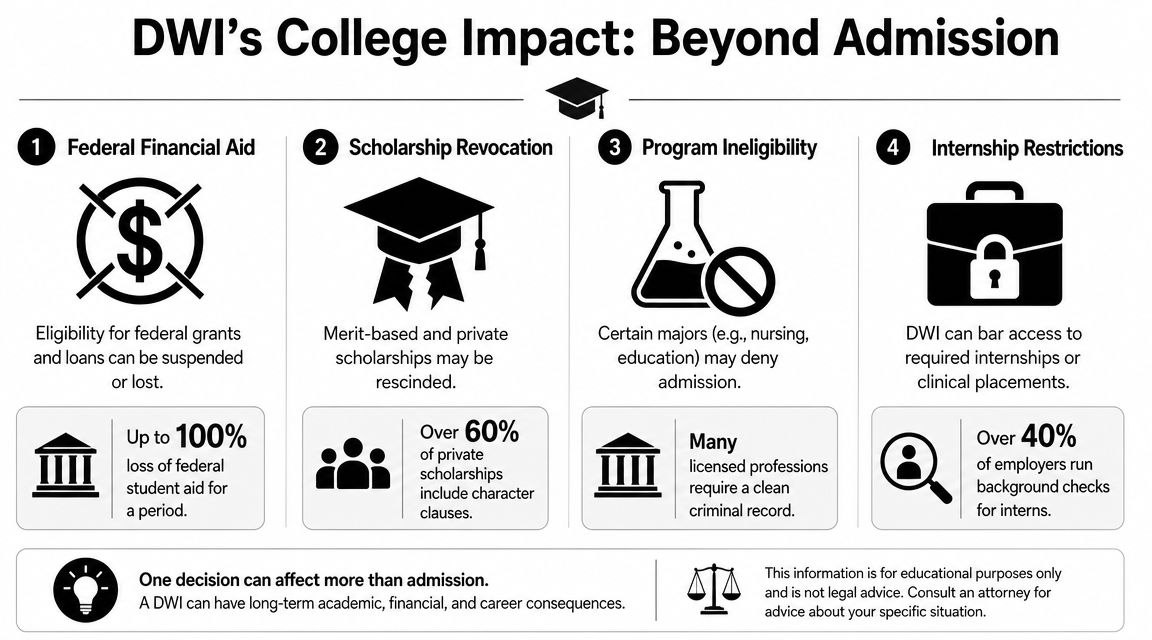
Families often focus on the acceptance letter. In reality, the harder problem may come after admission, when the school, the scholarship office, or a specific academic program reviews the student's record.
The financial problem can be more concrete than the admissions problem
A Texas-focused legal summary notes that felony convictions can make students ineligible for most financial aid programs, and another states that a felony DWI can jeopardize federal student aid and lead schools or scholarship providers to rescind aid. A broader academic report found that 90% of schools reported considering any felony conviction negatively, 75% considered a drug or alcohol conviction negatively, and about a quarter had at least some automatic bar to admission for criminal-justice-related records. The same report found that failing to disclose a criminal record increased the likelihood of denial or rescission, as explained in this Texas review of DWI effects on college applications and aid.
That is why a family may win one battle and still face another. A student may be admitted academically, but then lose a scholarship, fail a conduct review, or become ineligible for a required placement.
Programs don't all apply the same rules
Certain majors and professional tracks often use separate standards. Nursing, education, health-related programs, internships, clinical placements, student teaching, and other supervised placements may ask questions that general admissions never asked. Some programs are less concerned with the original arrest than with whether the student now presents a risk to patients, clients, minors, or partner institutions.
That means you should review more than the admissions office policy. Look at:
- Scholarship terms: Some awards require a clean conduct record.
- Department handbooks: Individual colleges within a university may impose extra screening.
- Placement rules: Internships or clinical sites may run their own background checks.
- Athletics and student conduct codes: Separate compliance systems can create another barrier.
A student can also benefit from reviewing a practical resource on DWI scholarship consequences in Texas before making decisions about pleas, disclosures, or transfer plans.
A college may say yes to admission while another office on campus says no to the money, the major, or the placement that makes the degree possible.
This is why defending a DWI is not just about fines or jail exposure. It is about preserving access to the full college path, including affordability and program completion.
Your Strategic Plan Steps to Protect Your College Future After a DWI
A student gets arrested on a Saturday night. By Monday morning, the family is asking the wrong first question. They ask whether college plans are over. The better question is what to do this week to keep one arrest from turning into an admissions problem later.
Panic creates avoidable damage. A plan protects options.
The right response after a student DWI in Texas is fast, organized, and honest about the stakes. College admissions offices do not expect perfection. They do pay attention to how a student responds to a problem, whether the case was defended carefully, and whether the application answers are accurate.

Step one is to protect the case early
Get defense counsel involved immediately after the arrest. Early work can preserve video, identify weaknesses in the stop, address testing issues, and keep short deadlines from being missed.
A Houston DWI lawyer or other local defense attorney should review the basis for the stop, the arrest decision, the officer's observations, the testing method, and the timeline. One early issue is often the driver's license. If an ALR suspension is in play, a hearing request may protect driving privileges and may also lock in testimony that helps the criminal defense.
That first phase matters because admissions strategy gets much easier when the criminal case is being handled carefully from the start.
Step two is to answer only the question on the form
Do not guess about what a school wants disclosed. Pull the exact application, scholarship form, housing paperwork, or program questionnaire and read the wording line by line.
A sound disclosure plan usually works like this:
Identify the trigger
Is the question about arrests, pending charges, convictions, school discipline, or something else?Match the answer to the current case status
A pending case is different from a dismissal. A reduction is different from a conviction.Use precise language
Keep the response factual. Cut excuses, emotional detail, and extra background that was never requested.
Students get into trouble here by overexplaining. They also get into trouble by minimizing. Accuracy is the goal.
Step three is to build mitigation before anyone asks for it
Waiting until a college requests clarification is a mistake. By then, the school is reacting to a concern instead of seeing a student who took the issue seriously from the beginning.
Start building a mitigation file now. That may include attendance records, counseling or treatment participation, alcohol education, work history, community service, and letters from adults who can speak credibly about judgment, maturity, and follow-through. The right mix depends on the student. A high school senior may need support from a principal, coach, or employer. A college student may be better served by a professor, academic advisor, or internship supervisor.
There is a trade-off here. Good mitigation can help with admissions and program review, but careless statements can hurt the legal defense. That is why the mitigation plan should be coordinated with defense counsel, not assembled casually.
Step four is to prepare the addendum with discipline
If a school gives space for an explanation, use it carefully. The best addenda are short, specific, and credible.
They usually do three things:
- State the case status clearly: pending, dismissed, reduced, or convicted
- Accept responsibility where appropriate: without making unnecessary admissions
- Show concrete correction: counseling, treatment, changed transportation habits, stronger decision-making, or other measurable steps
Short beats dramatic. Clear beats emotional.
Admissions readers are not looking for a polished speech. They are looking for signs that the student understands the issue, took corrective action, and is unlikely to repeat it.
Step five is to plan for record relief where the law allows it
Depending on how the case ends, expunction or nondisclosure may become part of the long-term plan. Those remedies do not apply in every case, and timing matters, but they can make a real difference for later background checks tied to school, housing, internships, and employment.
This is the larger point families often miss. The criminal case, the license issue, and the college process are connected. A smart defense strategy is not just about court dates. It is about protecting future applications, preserving eligibility where possible, and keeping one mistake from defining the next several years.
Why You Need a Houston DWI Lawyer on Your Side
A student DWI case is rarely just a student DWI case. It can affect license status, application disclosures, scholarship reviews, program eligibility, and future background checks. Each decision in the criminal case can ripple outward.
That is why waiting to "see what happens" is risky. By the time a college asks for clarification, the best opportunities may already be gone. The stop may not have been challenged. The ALR deadline may have passed. A plea may have created a record that was avoidable. An application answer may have boxed the student into a worse position.
A lawyer's role is not limited to arguing in court. In the right case, counsel helps challenge breath or blood evidence, attack weak field sobriety evidence, review whether the officer had probable cause, prepare for an ALR hearing, evaluate trial risk, and think through downstream issues like disclosure, sealing, and school-related consequences.
If you're dealing with a first DWI in Texas, or a more serious allegation, legal help gives you structure when everything feels uncertain. A Texas DUI attorney can help you separate what must be disclosed from what doesn't, what can be fought from what must be managed, and what steps will protect your college future.
DWI and College Admissions Common Questions Answered
Do I have to tell a college about a DWI arrest if I haven't been convicted
Only if the application asks for arrests or pending charges. Some schools ask only about convictions. Others use broader language. Read each question exactly as written and answer truthfully.
If my case is dismissed, can the school still care
It can, depending on the school's question and timing. A pending case may have required disclosure when you applied, even if it was later dismissed. A dismissal still matters because it is different from a conviction and may place you in a much better position.
Will a juvenile record be treated the same way
Not always. Juvenile matters, sealed records, and adult criminal records can be treated differently. The key is to review the exact record status and the wording of the school's question before answering.
Can a misdemeanor DWI keep me out of college in Texas
Not automatically. Schools often review misdemeanor cases more flexibly than felony cases. The bigger issues are usually what the form asks, whether the answer is truthful, and what evidence you can present showing growth and stability.
What if I already submitted an application and answered incorrectly
Don't ignore it. In many cases, the better move is to get legal advice quickly and evaluate whether a correction should be made. Silence can make the problem worse if the school later treats the omission as dishonesty.
Do out-of-state colleges look at this differently
They can. Every school sets its own questions and review process. If you're applying outside Texas, use the same rule. Read the exact question, match the answer to the legal status of the case, and don't assume one school's approach will match another's.
If you're worried about how a DWI could affect college plans, scholarships, or your child's future, talk to a defense team that understands both the courtroom issues and the life consequences. Law Office of Bryan Fagan, PLLC offers free consultations for Texans facing DWI charges. You can get a clear review of the case, the license issues, and the practical steps to protect admissions, aid, and long-term opportunities.