
A DWI arrest can be overwhelming — but you don’t have to face it alone. Amid the stress and uncertainty, one of the biggest worries is what this will do to your auto insurance. It’s a valid concern. The moment you’re charged, your insurance rates are at risk of skyrocketing.
But here’s something crucial to understand right away: the biggest financial hits—the massive premium hikes and special insurance requirements like an SR-22—are tied to a conviction, not just an arrest. With a strategic legal defense from an experienced Houston DWI lawyer, those devastating outcomes are far from guaranteed.
A DWI Arrest Is Overwhelming, But You Have Options
Facing a DWI arrest in Texas can feel like your world is spinning out of control. Suddenly, you’re dealing with the legal system, and on top of that, the financial fallout, especially for your car insurance, can seem overwhelming. This guide is here to cut through the confusion, explain your rights, and show you what to expect.
We'll break down how a DWI charge truly affects your insurance rates, define key terms like the SR-22, and explain the long-term financial sting. More importantly, we'll lay out the practical, strategic steps you can take—starting right now—to protect your future and fight the charge.
Understanding the Immediate Aftermath and Your Rights
The first few days after a DWI arrest are a blur of questions and anxiety. You're probably worried about keeping your license, the potential penalties, and how this will disrupt your life. It's critical to remember that you have rights at every single stage, from the roadside stop to your day in court.
One of the most time-sensitive parts of this process is the Administrative License Revocation (ALR) hearing. This is a civil proceeding, completely separate from your criminal DWI case, that determines the fate of your driver's license. You have only 15 days from your arrest to request this hearing. If you miss that deadline, you automatically lose the chance to fight the DWI license suspension, which can trigger insurance headaches long before a criminal conviction even happens.
Why Your Legal Strategy Is Your Best Insurance Policy
The link between your DWI defense and your future insurance premiums couldn't be more direct. Insurance companies see a DWI conviction as a giant red flag for high-risk behavior, and they'll use it to justify skyrocketing your rates. But a skilled Houston DWI lawyer knows how to challenge the state's case against you and fight DWI Texas charges.
A conviction is not a foregone conclusion. An experienced legal team can build a strong defense aimed at minimizing the very consequences that lead to higher insurance rates and long-term financial strain.
A solid defense can open up several paths that protect your driving record and, by extension, your wallet:
- Case Dismissal: This is the ideal outcome—the charges get dropped entirely.
- Reduced Charges: Your attorney might negotiate the DWI down to a lesser offense, like reckless driving, which insurance companies view much more favorably.
- Not Guilty Verdict: Winning your case at trial means the conviction never hits your record in the first place.
Each of these outcomes helps you dodge that "high-risk" label that insurers are waiting to apply to your policy. By focusing on your legal defense now, you are actively fighting to control the future cost of your auto insurance.
The Financial Shockwave of a Texas DWI Conviction
One of the first questions on anyone's mind after a DWI arrest is about the financial fallout. You’re probably wondering, "How much is my insurance going to go up?" The answer, unfortunately, is often a shock to the system.
Insurance companies see a DWI conviction as a massive red flag. It’s the kind of thing that instantly gets you re-categorized from a standard driver to a high-risk driver. This isn't just some internal label; it’s a trigger for painful premium hikes that can strain your budget for years. Your insurer’s logic is simple: a DWI on your record means you're statistically more likely to be in a future accident, making you a much bigger financial risk for them to cover.
Putting Numbers to the Premium Spike
The financial hit isn't a small one. National data paints a pretty grim picture of how badly a conviction can hurt your wallet. According to one recent analysis, car insurance rates skyrocket by an average of 67% after a first DWI conviction.
Some studies place the average increase even higher—at a staggering 101%, forcing drivers to shell out an extra $2,467 per year. In Texas, where premiums are already on the rise, a DWI conviction can force you into expensive high-risk policies and require you to file a special SR-22 form for three years or more. You can explore more about drunk driving statistics and their financial impact.
To give you a clearer picture, here’s a look at what some major providers might charge after a single DWI conviction in Texas.
Estimated Monthly Premium Increase After a First DWI in Texas
This table shows sample monthly full-coverage auto insurance premium increases from major providers after a single DWI conviction, illustrating the immediate financial impact.
| Insurance Provider | Average Monthly Premium (Clean Record) | Estimated Monthly Premium (After DWI) | Monthly Increase |
|---|---|---|---|
| Progressive | $185 | $215 | +$30 |
| State Farm | $150 | $290 | +$140 |
| Geico | $140 | $295 | +$155 |
| USAA | $120 | $280 | +$160 |
Note: These figures are estimates for a sample driver profile and can vary widely based on individual circumstances.
As you can see, the monthly increase can be substantial, quickly adding thousands of dollars to your annual expenses for the exact same coverage.
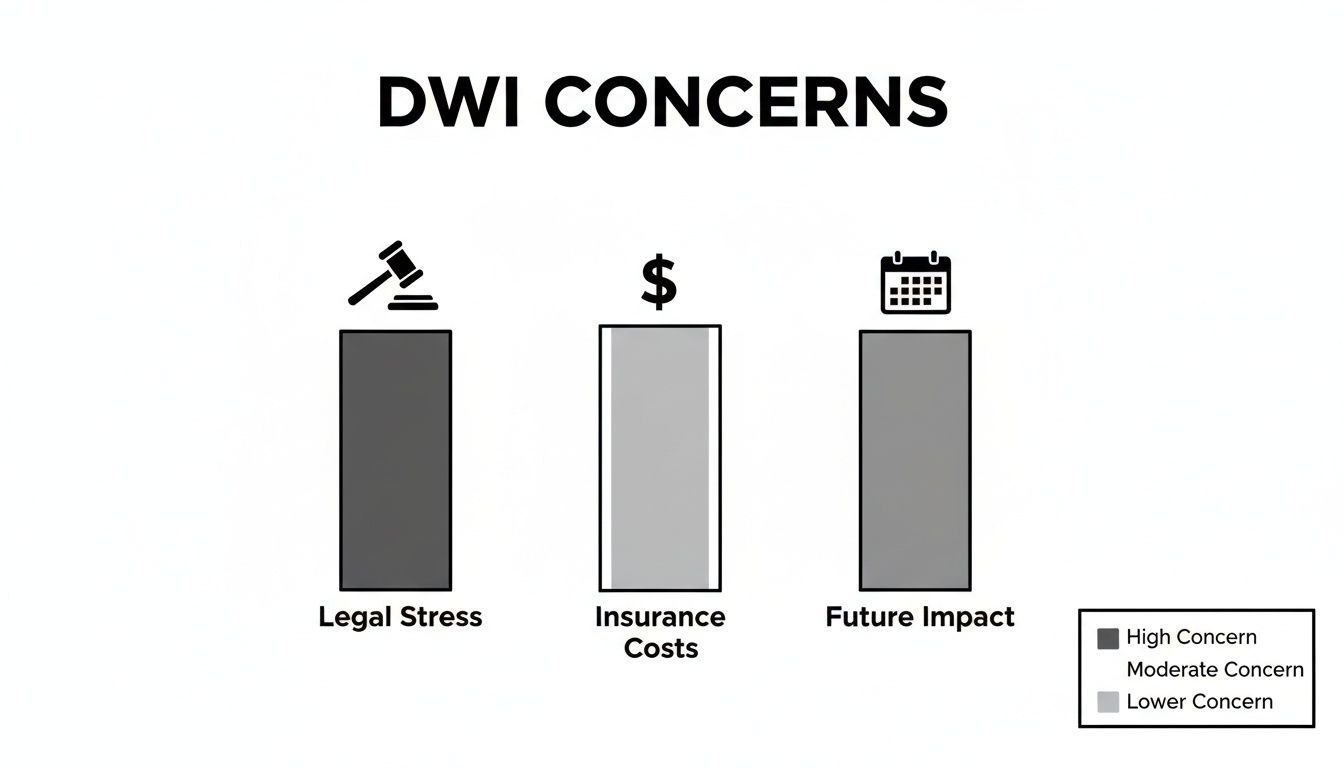
While the legal stress is often the most immediate worry, it’s the long-term financial pain from insurance hikes that often becomes the most significant burden.
Why a Conviction Is the Tipping Point
It’s absolutely critical to understand that these steep financial penalties are tied directly to a conviction—the very outcome a skilled Houston DWI lawyer works tirelessly to prevent. An arrest is not a conviction. You have the right to fight the charges, challenge the evidence, and question every aspect of your arrest in court.
Your best defense against crippling insurance rates is a strong legal defense against the DWI charge itself. Preventing the conviction is the most effective way to protect your financial future.
Without a conviction on your record, your insurance company has no legitimate basis to reclassify you as a high-risk driver and jack up your rates. This is why acting fast to secure experienced legal help isn’t just about protecting your freedom and your license—it’s a crucial financial decision.
Every step your attorney takes, from challenging the initial traffic stop to questioning the administration of field sobriety tests, is designed to weaken the prosecution's case. Each successful challenge moves you further away from a conviction and the financial shockwave that follows. By investing in your defense now, you are actively working to avoid years of inflated insurance premiums, potentially saving yourself thousands of dollars down the road.
What Is the SR-22 Requirement in Texas?
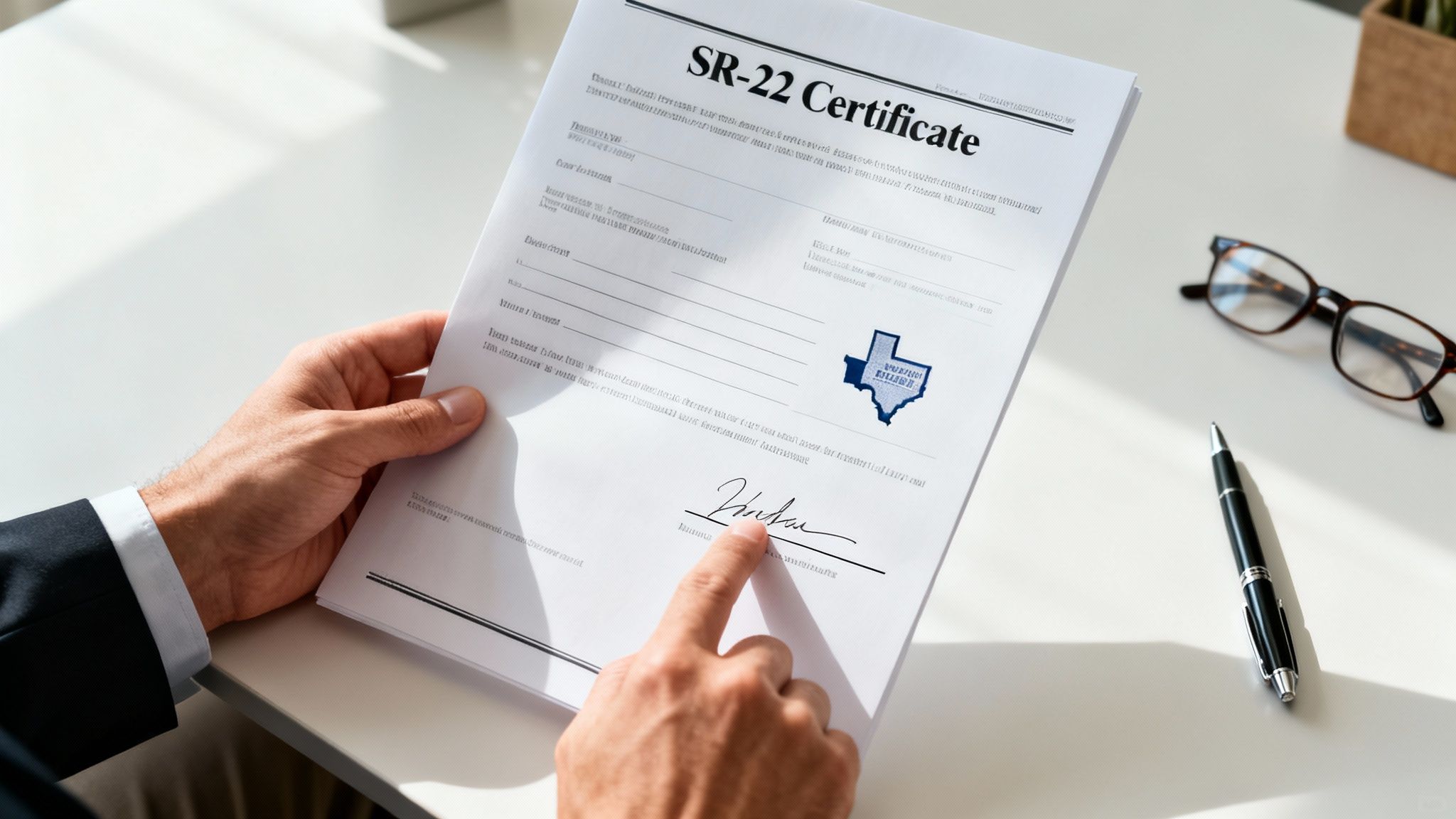
After a DWI arrest, you'll almost certainly hear the term "SR-22," and it’s a source of major confusion. Let's clear it up right now. An SR-22 is not an actual insurance policy you can buy.
Think of it as a special report card that your insurance company files for you with the Texas Department of Public Safety (DPS). It’s officially called a "Certificate of Financial Responsibility," and it serves one purpose: to prove you’re carrying the state-mandated minimum liability insurance.
Basically, the DPS is asking your insurer to vouch for you, confirming you have active coverage. A DWI is one of the most common triggers for this requirement. It’s the state’s way of keeping a closer watch on drivers it now considers high-risk, making sure they stay insured.
How the SR-22 Process Works
Navigating the SR-22 process can feel complicated, but it breaks down into a few straightforward steps. The most important thing to know is that you can’t file this form yourself—it has to come from a licensed insurance provider.
Here’s a step-by-step look at what you can expect:
- Receive the Order: After a DWI-related license suspension or as a condition of getting your license back, the court or the DPS will officially notify you that you need an SR-22.
- Contact Your Insurer: You have to tell your current auto insurance company about the requirement. Be prepared for bad news. Some standard carriers don't offer SR-22 filings and might even choose to drop your policy at renewal time.
- Find a Willing Provider: If your current insurer says no, you’ll need to shop for a new policy with a company that works with high-risk drivers. These providers are familiar with the process and can handle it quickly.
- Pay the Filing Fee: Your insurance company will charge a small, one-time fee to file the SR-22 certificate with the DPS. This fee is usually around $25 and is separate from your actual insurance premium.
- Maintain Continuous Coverage: This is the most critical part. You're required to keep the SR-22 on file and your insurance policy active, without any gaps, for a set period—usually two years in Texas.
Any lapse in your insurance, even for a day, will trigger an immediate alert from your insurer to the DPS. That will result in a swift re-suspension of your driver's license, digging you into an even deeper legal and financial hole.
Why Continuous Coverage Is Non-Negotiable
The state of Texas takes the SR-22 requirement very seriously. The whole system is built on making your insurer responsible for telling the authorities the moment you fail to meet your financial obligations.
An SR-22 filing makes your insurance company a gatekeeper for your driving privileges. A missed payment or policy cancellation automatically sounds the alarm with the Texas DPS, leading to an immediate license suspension.
This is why managing your policy responsibly is so important. Set up automatic payments, mark renewal dates on your calendar, and stay in touch with your insurance agent. Understanding the costs involved is the first step toward managing them. To get a better handle on the numbers, you can learn more about Texas DUI SR-22 insurance costs and how to budget for them.
Ultimately, the SR-22 is a direct consequence of a DWI conviction or license suspension. While knowing the process helps you deal with it, the best strategy is always to prevent the conviction in the first place. A successful defense from an experienced Houston DWI lawyer can help you avoid this entire headache, saving you from the stress, expense, and strict oversight that an SR-22 brings.
How Long a DWI Impacts Your Insurance Rates
The financial sting of a DWI doesn’t end with court fines and legal fees. Think of it as a long-term anchor tied to your wallet, dragging down your finances for years through sky-high auto insurance premiums. Even after the legal battle is over, that conviction sits on your driving record, and your insurance company won't forget it anytime soon.
This isn’t a quick fix or a one-year problem. For Texas drivers, a DWI conviction will haunt your auto insurance rates for a long, long time, easily costing you thousands of extra dollars before it finally fades.
Understanding the Insurer's Look-Back Period
Insurance companies have long memories. When they set your premiums, they don't just look at the last few months; they use what's called a "look-back" period to size up your risk level. For a serious offense like a DWI, they look back pretty far.
In Texas, most insurance carriers will dig into your driving history for at least three to five years. Some are even more thorough, extending that window to seven or even ten years. For that entire time, the DWI will be the single biggest factor in calculating your rates, keeping you firmly planted in the high-risk category. What that means in plain English is you'll be paying a whole lot more for the exact same coverage, year after year.
A DWI conviction is not a single financial event; it's a multi-year penalty imposed by your insurance provider. Every premium payment for the next three, five, or even seven years will serve as a reminder of the conviction's lasting financial impact.
The Compounded Cost Over Time
That first jaw-dropping premium increase is just the opening act. The real financial damage comes from the compounding effect of those inflated rates over the entire look-back period. An extra couple hundred bucks a month doesn't sound like a catastrophe until you realize it adds up to thousands per year.
A DWI doesn't just spike your rates temporarily; it locks you into elevated costs for years. This is especially painful for Texas families already dealing with rising premiums across the board. That conviction slaps a "high-risk driver" label on you that can stick around long after your license is reinstated, forcing you to pay 65-101% more in the long run. In a market like Texas, where average premiums can already top $3,000, a DWI can make insurance feel completely unaffordable.
This long-term financial drain is exactly why investing in a strong legal defense from day one is so critical. The only guaranteed way to sidestep this multi-year financial penalty is to avoid the conviction in the first place.
How a Strong Legal Defense Shortens the Timeline
The timeline for how long a DWI will wreck your insurance rates is directly tied to the outcome of your criminal case. This is where an experienced Texas DUI attorney becomes your most valuable player. A strategic defense isn't just about avoiding jail time; it’s about protecting your financial future from this long-term fallout.
Here are a few legal outcomes that can dramatically shorten—or even eliminate—the impact on your insurance:
- Case Dismissal: If your attorney gets the charges dropped entirely, there’s no conviction. Nothing gets reported to your insurer, and your rates stay safe. It's as if it never happened.
- Charge Reduction: Getting a DWI negotiated down to a less serious offense, like reckless driving, is a huge win. Insurance companies view it far more favorably and you can often avoid the most severe rate hikes.
- Expunction: If you're eligible to have your record expunged, the arrest and charge are legally wiped clean. This erases it from your public record, preventing insurers from ever using it against you down the road.
Each of these outcomes shortens the financial pain. For a comprehensive overview, explore our guide on the duration of a DWI's insurance impact. Fighting the charge today is the single best strategy for clearing a path back to financial stability and affordable insurance tomorrow.
Proactive Steps to Minimize Your Insurance Increase
After a DWI arrest, it’s easy to feel powerless, like you're just waiting for the other shoe to drop—especially when it comes to your insurance company. But this is the time to be proactive, not passive. You have more say in your financial future than you might think.
While the legal side of things plays out, there are concrete steps you can take right now to prepare for the insurance fallout and hopefully soften the blow. What you do in the coming weeks can make a huge difference in the rates you'll be paying for years.

Finding the Right Coverage
Here’s the thing: not all insurance companies see a DWI the same way. Your current provider might see you as a massive liability, but other insurers specialize in covering drivers who need a second chance. Don’t wait for that dreaded renewal notice to find out your policy is being canceled or your premiums have tripled.
Get ahead of the problem by researching your options now. Start shopping for quotes from insurers who work with high-risk drivers and are familiar with the SR-22 filing process. You don't have to switch immediately, but gathering this intel empowers you to make a smart, informed decision when the time comes. Exploring your options for affordable insurance after a Texas DUI is a great place to start.
Exploring Potential Discounts and Mitigation Efforts
Even with a DWI on your record, you aren't completely out of options for lowering your premium. Insurance companies are in the business of managing risk. Any action you take to show you're a more responsible driver now can work in your favor.
Think about discussing these steps with potential insurance providers:
- Defensive Driving Courses: Voluntarily completing a state-approved defensive driving course is a tangible sign of your commitment to safer habits. Many insurers will offer a small but meaningful discount for it.
- Ignition Interlock Device (IID): If an IID is installed in your vehicle—whether by court order or your own choice—insurers see it as a major mitigating factor. It proves you physically cannot drive under the influence, which dramatically lowers their risk.
- Adjusting Your Coverage: This might be a good time to take a hard look at your policy. You could consider raising your deductible or trimming non-essential coverage to make your premium more manageable, at least for a while.
But let's be clear. The single most impactful strategy for protecting your auto insurance rates has nothing to do with insurance companies at all. It's about hiring an experienced Houston DWI lawyer to fight the charge itself.
The Ultimate Strategy: Your Legal Defense
While shopping for quotes and taking courses are smart tactics, they only treat the symptoms. The root cause of a massive insurance hike is a DWI conviction. That means the most powerful move you can make is to invest in a strong legal defense aimed at preventing that conviction in the first place.
An experienced DWI attorney does more than just show up for you in court; they work to dismantle the prosecution's case piece by piece. They can challenge the legality of the initial traffic stop, question the accuracy of breath or blood tests, and negotiate for outcomes that keep your record clean.
A successful defense can lead to:
- A complete dismissal of the charges.
- A reduction to a lesser offense like reckless driving.
- A "not guilty" verdict at trial.
Any of these outcomes can stop the conviction from ever hitting your driving record. If there's no conviction, your insurer has no grounds to label you "high-risk." This is how you stop the insurance nightmare before it even begins.
When you're staring down a DWI charge in Texas, the immediate legal trouble is only half the story. The other half is the financial storm brewing on the horizon, ready to hit your auto insurance premiums for years to come. But here's the critical thing to remember: a charge is not a conviction. You have the power to fight back before the insurance nightmare even begins.
The absolute worst time to think about your insurance is when that renewal notice lands in your mailbox, showing a premium that's doubled or tripled. By then, the damage is done. Your options have shrunk, and you're stuck in damage control mode. The real fight starts now.
Your Best Defense Against Sky-High Insurance Rates Starts Today
The single most powerful tool you have to protect yourself from years of crippling insurance costs is a strong legal defense. It’s that simple. Think of your DWI defense as a financial firewall.
Every move an experienced Houston DWI lawyer makes—from dissecting the reason for the traffic stop to challenging the accuracy of a breath or blood test—is a direct strike against the foundation of the state's case. A win in the courtroom is a win for your wallet.
You don't have to figure this out on your own. Your first and most important step can be a free consultation to start building a defense that protects more than just your license—it protects your financial stability for the next decade.
If your case is dismissed or you're found not guilty, the conviction never hits your record. That means your insurance company has no legal basis to label you a "high-risk driver" and jack up your rates. This isn't just about damage control; it's about preventing the damage entirely.
Take the First Step: Request a Free Consultation
The financial fallout from a DWI conviction is far too severe to leave to chance. At The Law Office of Bryan Fagan, PLLC, we understand the critical connection between the courtroom battle and your long-term financial health. We are here to provide the aggressive, strategic defense you need to protect your rights and minimize the consequences.
Contact us today to request a free consultation and case evaluation. Let us dig into the details of your arrest and show you how we can fight to protect every part of your life, from your freedom to your auto insurance rates.
Common Questions About Texas Auto Insurance After a DWI
A DWI arrest sends a shockwave through your life, and the aftershocks often hit your finances the hardest—especially your auto insurance. You’re suddenly dealing with a whirlwind of questions and a whole lot of uncertainty. Let's cut through the noise and get straight to the facts about what happens next.
Will My Insurance Company Find Out Immediately?
This is probably one of your first thoughts, and it’s a source of major anxiety. The short answer is no, not usually. Your insurance company isn't going to get a text alert the moment you're arrested.
Insurers typically discover a DWI in one of two ways:
- At Renewal Time: When your policy is up for renewal, your insurer will pull your official driving record. If you’ve been convicted by then, it’ll be right there in black and white, triggering a massive rate hike or even a notice that they won't renew your policy.
- Through a DMV Report: Even before a conviction, an administrative license suspension can flag your file. This happens on a different timeline than your criminal case and can be an early warning sign for your insurance company.
Here’s the key takeaway: an arrest is not a conviction. That gap between the arrest and the final court date is a critical window of opportunity. It's the time you have to build a strong legal defense aimed at preventing the DWI from ever hitting your permanent record.
Can I Get Insurance with a Suspended License?
Yes, you can, but it’s not as simple as just calling up an agent. If the Texas Department of Public Safety (DPS) suspends your license, they’ll almost certainly require you to file an SR-22 Certificate of Financial Responsibility before you can legally drive again.
Think of an SR-22 as a "leash" your insurance company holds. It's not insurance itself, but a form they file with the state guaranteeing you have at least the minimum required liability coverage. To get one, you have to find an insurer willing to take on a high-risk driver and file the form on your behalf.
Even if you don’t own a car anymore, you might need a "non-owner" policy to satisfy the SR-22 requirement and get your license back. It’s a mandatory step on the road to reinstatement.
Should I Switch Insurance Companies?
That’s a strategic call, and the answer really depends on your specific situation. Don't be surprised if your current, long-time insurer either drops you or jacks up your premiums to a truly unaffordable level. Loyalty doesn't count for much once you're labeled "high-risk."
This is a time to be proactive. Start shopping around with insurance companies that specialize in high-risk policies. It might seem counterintuitive, but you can often find better rates with them than you'll get from your current provider after they re-evaluate your policy. Getting a few quotes costs you nothing and gives you a clear-eyed view of your options. Just be careful not to make any sudden moves without understanding how it fits into your overall legal strategy.
How Does a Lawyer Help Lower My Insurance Costs?
This is the most important question of all, because the answer is simple: a skilled Houston DWI lawyer is your best—and really, your only—weapon against catastrophic insurance hikes. The connection is direct and powerful. Sky-high premiums, SR-22 requirements, and policy cancellations are all triggered by one thing: a conviction.
The entire goal of a strong DWI defense is to prevent the conviction in the first place. A successful outcome—like a case dismissal, a "not guilty" verdict at trial, or getting the charge reduced to something non-alcohol-related like reckless driving—means the high-risk label never gets attached to your record.
By challenging the traffic stop, the breath or blood test, and every piece of the prosecution's evidence, your attorney works to keep your driving record clean. A clean record gives your insurer zero justification to hit you with the severe financial penalties that come with a DWI. We're not talking about saving a few bucks; we're talking about saving you thousands upon thousands of dollars for years to come.
A DWI charge puts your financial stability at risk, but you don't have to face it alone. The team at The Law Office of Bryan Fagan, PLLC is ready to build the strategic defense you need to protect your license, your record, and your future. Request your free case evaluation today by visiting us at https://texasduilawfirm.com.