
A DWI arrest can be overwhelming, but you don't have to face it alone.
If you were stopped in Austin, taken to jail, handed paperwork, and then sent home with more questions than answers, that reaction is normal. Individuals often don't know what happens next. They don't know whether they should worry more about court, their driver's license, their job, or what to say to family.
The first thing to understand is simple. A DWI arrest creates two separate problems at the same time. One is the criminal case, where the state tries to prove you were driving while intoxicated. The other is the administrative license case, often called the ALR process, where the state can try to suspend your license even if the criminal case hasn't been resolved yet.
That split confuses a lot of people. It also creates the biggest early mistake. Someone focuses only on the court date and misses the license deadline. A strategic defense starts by treating both tracks seriously from day one.
Facing a DWI in Austin? You Are Not Alone
A lot of clients call after one of the longest nights of their lives. They were driving home from dinner, a concert, or a work event. An officer said they were weaving, asked if they'd been drinking, and then everything sped up. Flashing lights. Questions on the roadside. Tests they didn't fully understand. A ride to booking. A release hours later with papers in hand and no clear plan.
If that sounds familiar, take a breath. An arrest is serious, but an arrest is not a conviction. There is still room to challenge the stop, the testing, the officer's conclusions, and the way the case was built.
Austin is a busy legal market, and choosing counsel can feel difficult because there are 1,115 licensed criminal defense attorneys serving the area, according to Avvo's Austin criminal defense attorney directory. That number doesn't mean every lawyer handles DWI cases the same way. It means you need someone who understands how these cases are fought in practice, not just processed.
One of the most useful places to start is learning how to build a strong DWI defense in Austin. When you understand the moving parts, the situation becomes less mysterious and more manageable.
Practical rule: In the first days after a DWI arrest, clarity matters more than panic. Focus on deadlines, documents, and getting legal advice before you make assumptions about your case.
The right austin criminal defense attorney helps you slow the process down, separate the criminal case from the license case, and make smart decisions instead of rushed ones.
What an Austin DWI Lawyer Actually Does for You
A DWI defense lawyer does far more than stand beside you in court. In a Texas DWI case, your attorney is handling two problems at once. One is the criminal charge. The other is the threat to your driver's license through the ALR process. Those tracks run side by side, and each one has deadlines, evidence issues, and chances to challenge what happened.
That dual-track structure confuses many people at first. It helps to picture it as two cases growing out of the same arrest. One asks whether the state can prove a crime. The other asks whether the state can suspend your license. A strong defense looks at both from day one.

Your lawyer examines the stop from the first minute
Every case begins with police contact, and the details matter. An officer needs a lawful reason to stop your car, and the officer also needs a valid basis to keep investigating for DWI.
Your lawyer studies questions such as:
- Why the stop happened: Was there a clear traffic violation, or only a vague description of driving behavior?
- How the detention expanded: Did the officer have enough facts to turn a traffic stop into a DWI investigation?
- What was said and when: Were your statements voluntary, or did the questioning create legal issues?
A problem at the beginning can affect everything that follows. If the stop was weak or the detention went too far, your lawyer can use that issue to challenge evidence and limit what the prosecutor may rely on.
Your lawyer tests how the evidence was created
In many DWI cases, the state's presentation sounds simple. A prosecutor may point to officer observations, field sobriety tests, a breath result, a blood result, or video. Your lawyer's job is to slow that down and examine how each piece was produced.
BAC means blood alcohol concentration. It is a measurement the state uses to argue intoxication. A reported number can matter in both the criminal case and the license case, but the number by itself does not answer every legal question. Your lawyer looks at timing, machine maintenance, blood-draw procedure, lab handling, officer training, and whether the result matches the full picture.
Field sobriety tests also cause confusion. These roadside exercises are not pass-fail school tests. They are officer-administered tasks that depend on instructions, surface conditions, lighting, footwear, nerves, age, injuries, and many other factors. A lawyer reviews whether the officer gave proper directions, whether the conditions were fair, and whether the conclusions in the report match the video.
Your lawyer protects your license while defending the charge
Many DWI guides stop too early. The court case gets attention because it carries the criminal penalties, but the ALR case can affect your ability to drive long before the criminal case is resolved. That is why defense work often starts with immediate action on the license side, including Texas DWI license defense and the ALR process.
Your attorney may:
- Request the ALR hearing on time so you keep the chance to contest a suspension.
- Gather police reports, affidavits, and related records that may help in both cases.
- Question the arresting officer under oath and preserve testimony that can later be useful in court.
- Look for gaps between the officer's report, video, and hearing testimony that can strengthen the defense.
That last point matters more than many people realize. An ALR hearing is not only about the license. It can also become an early window into the state's evidence.
Good DWI defense work is usually built piece by piece. A timeline that does not fit, a test procedure that was not followed, or an officer statement that changes can shape the outcome.
Your lawyer helps you choose the safest path based on facts
Every case calls for judgment. Some cases should be challenged through pretrial motions. Some may be resolved through negotiation that reduces risk. Some should be tried. The right choice depends on the evidence, the judge, the prosecutor's position, your record, your license concerns, and your goals outside the courtroom.
A lawyer helps you make those decisions with a clear view of both tracks. If a choice in the criminal case could affect your license, you should know that early. If testimony in the ALR hearing may help the court case, you should know that too. Strategy works best when both fronts are handled together rather than treated as separate problems.
The Law Office of Bryan Fagan, PLLC handles DWI defense, ALR hearings, test challenges, and related criminal matters across Texas, including Austin. In practical terms, that means clients can get help assessing the court case and the driver's license risk at the same time.
The DWI Case Journey in Texas Step by Step
At first, a DWI case can feel like one problem with one court date. In Texas, it is usually two problems running at the same time. One is the criminal case. The other is the administrative license case, often called the ALR process. If you only focus on court and ignore the license track, you can lose ground before your defense is fully underway.
That is why it helps to see the process as a timeline, not a single event. Each stage answers a different question. What happened during the stop? Was the arrest legal? What evidence does the state have? What happens to your license while the criminal case is still pending?
A simple visual can help:
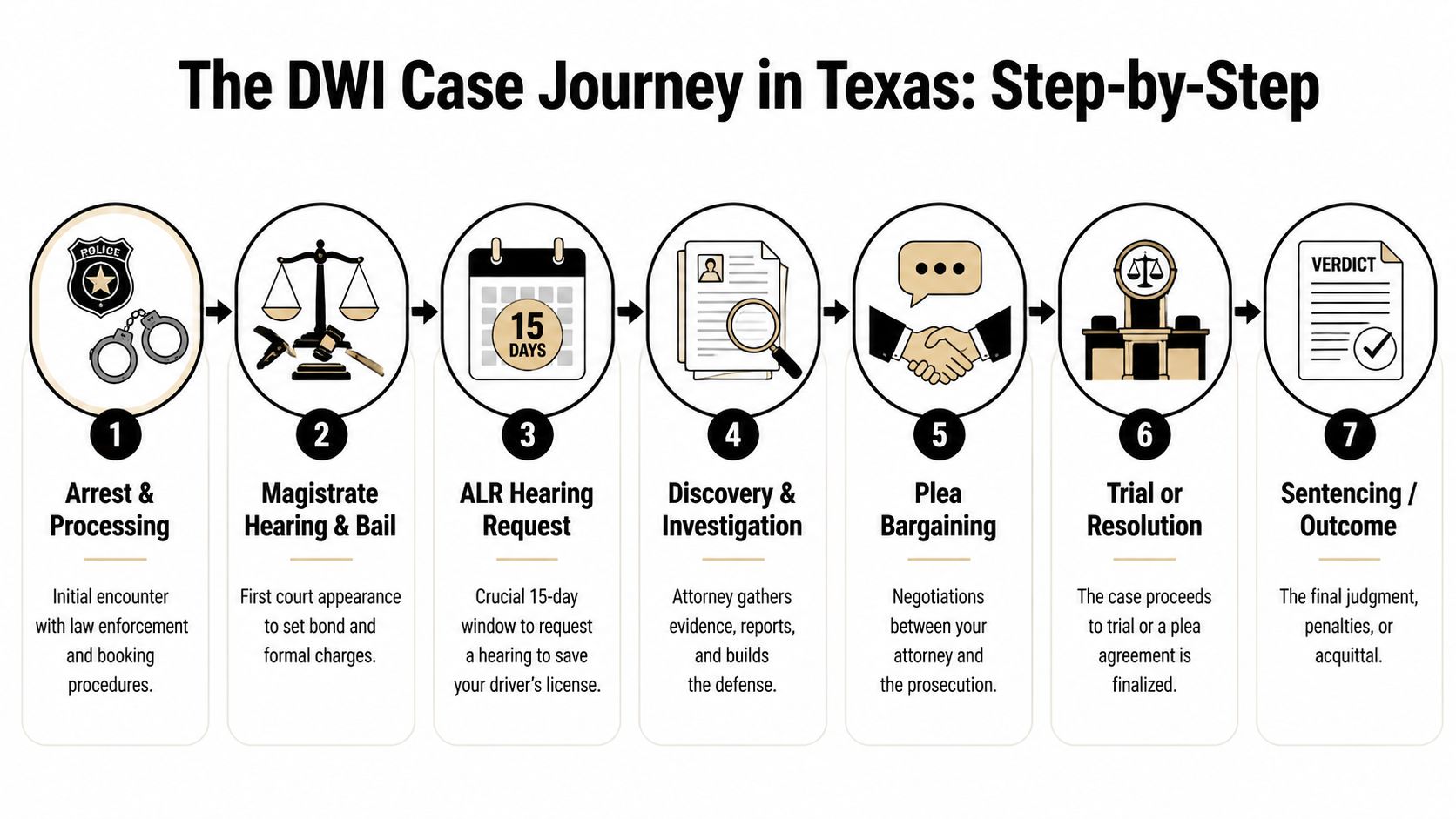
Arrest and processing
The process usually starts with the traffic stop, roadside investigation, arrest, and booking. You may be photographed, fingerprinted, and given papers about bond, release conditions, and your driver's license status.
This moment feels overwhelming for a reason. You are being asked questions, given forms, and making decisions while stressed and tired. Many people leave jail knowing they were arrested but not understanding what deadlines have already started.
One early point that causes confusion is implied consent. In Texas, driving on public roads means you are treated as having agreed to provide a breath or blood sample in certain situations after a lawful DWI arrest. Refusing a test can lead to a license suspension effort. Taking a test can give the prosecution evidence to use in court. Either choice can affect both tracks of the case.
Magistrate hearing and bond
Soon after the arrest, a magistrate may address the charge, bond, and release conditions. You may hear terms such as no-alcohol conditions, ignition interlock, travel limits, or reporting requirements.
This hearing is about the rules you must follow while the case is pending. It can shape your daily life right away. A missed condition can create new problems that have nothing to do with whether the DWI charge is provable.
The parallel license case starts fast
One of the biggest mistakes in DWI cases is treating the driver's license issue as a side matter. It is a separate case with its own deadline, its own hearing, and its own consequences.
A good way to picture it is two trains leaving the station at the same time. One train is the criminal prosecution in court. The other is the state's attempt to suspend your license through the administrative process. They are connected by the same arrest, but they do not run on the same schedule.
Missing the driver's license deadline does not stop the criminal case. It usually means you are now fighting the court case while also dealing with a license suspension that might have been challenged earlier.
Here's a short video that helps illustrate the stakes and process in a Texas DWI case:
Discovery and investigation
After the immediate crisis passes, the defense work becomes more methodical. Discovery is the process of getting evidence from the prosecution. That may include offense reports, dash cam and body cam video, breath or blood test records, lab paperwork, and witness information.
A case often starts to look very different from the arrest narrative. An officer may describe strong signs of intoxication, but the video may show a calm and steady driver. A test result may look damaging at first, but the timing, maintenance records, or blood draw procedures may raise questions.
Your lawyer may examine:
- Police reports: Do the written observations stay consistent from start to finish?
- Body cam and dash cam footage: Do the videos match the officer's description of driving, balance, speech, and field sobriety testing?
- Testing records: Were breath or blood procedures handled correctly, and can the state prove that?
- Timeline issues: How much time passed between driving, arrest, and chemical testing?
- Witnesses and context: Was there fatigue, injury, anxiety, or another explanation for what the officer thought he saw?
The ALR hearing can also help here. Testimony given in that hearing may lock an officer into details early, which sometimes becomes useful later if the story changes in court. That is one reason experienced DWI defense treats both tracks as part of one strategy.
Negotiation and possible resolution
Many DWI cases end before trial, but they do not resolve by luck. They resolve because the defense found a legal weakness, a proof problem, or a practical reason for the state to reconsider its position.
Sometimes that means filing motions to challenge the stop, arrest, or testing process. Sometimes it means showing the prosecutor that the evidence has gaps. Sometimes it means negotiating a result that reduces the damage to your record, your license situation, or both.
A fair resolution starts with a clear reading of the evidence, not panic and not false optimism.
Trial or final outcome
If the case is not dismissed or resolved through negotiation, it may go to trial. At trial, the prosecution has to prove the charge with admissible evidence and credible witnesses. The defense can challenge the stop, the investigation, the testing, and the officer's conclusions.
The final result may be a dismissal, a reduced charge, a negotiated plea, an acquittal, or a conviction. What matters is that the case unfolds in stages, and each stage creates a new chance to protect your future.
That is the practical roadmap. Handle the criminal case carefully. Handle the ALR case just as quickly. In many Austin DWI cases, the best defense starts by recognizing that the fight is happening on both fronts from day one.
Texas DWI Penalties and How We Fight Them
You get home after a DWI arrest, set the paperwork on the counter, and ask the question every client asks first. What am I facing?
That question has two parts in Texas. One is the criminal charge. The other is the threat to your license. This section focuses on the criminal penalties, but a smart defense looks at both tracks at the same time because the pressure from one often affects the other.
Texas DWI penalties depend on the charge level, the facts the state alleges, and whether there are prior convictions. The range can widen fast. A high BAC allegation, a prior DWI, an accident, or a child passenger can change the exposure. The key is to read the case carefully instead of treating the arrest paperwork as the final word.
Texas DWI penalties at a glance
| Offense Level | Jail Time | Maximum Fine | License Suspension |
|---|---|---|---|
| First-time DWI Class B misdemeanor | Up to 180 days | Up to $2,000 | Can lead to suspension |
| First-time DWI with BAC 0.15% or higher Class A misdemeanor | Up to 1 year | Up to $6,000 | Can lead to suspension |
| Second DWI | Penalties increase from a first offense | Higher exposure than a first offense | Can lead to suspension |
| Third or subsequent DWI | Felony-level exposure | Higher exposure than a first offense | Can lead to suspension |
Under Texas law, a first-time DWI is generally charged as a Class B misdemeanor. If the state alleges a BAC of 0.15% or higher, the charge can be filed as a Class A misdemeanor. Repeat allegations can raise the case to a much more serious level, including felony exposure.
A chart helps, but charts can also create panic. They show the ceiling, not the likely outcome in every case. Defense work is about testing whether the state can prove the version of events it wrote down.
First offense does not mean simple
Many first-time clients assume the prosecutor will offer no room to fight because there is no prior history to explain away. The opposite is often true. First-offense cases regularly turn on details the officer may have interpreted too confidently.
To convict, the state still has to prove intoxication with admissible evidence. That may involve driving facts, officer observations, field sobriety testing, breath or blood evidence, and video. If one part is weak, the whole case can become harder to prove.
Possible pressure points include:
- The stop: Did police have a lawful reason to pull the car over?
- The investigation: Were the officer's observations clear, or were they shaped by fatigue, nerves, weather, footwear, injury, or a medical issue?
- The testing: Were breath or blood procedures followed correctly, and does the result match the timeline?
If you are dealing with the aftermath of being arrested for DWI in Texas, those questions matter early, not months later.
A high BAC allegation is evidence, not the end of the case
A BAC allegation over the enhancement threshold scares people because it sounds precise. Precision on paper is not the same thing as reliability in court.
Chemical testing works like a chain. If one link is weak, collection, maintenance, timing, labeling, storage, interpretation, or the legal foundation for admission, the defense has something real to examine. A reported number also has to fit the timeline. Driving happened at one point. Testing happened later. That gap can matter.
So the defense does not stop at, "What was the result?" We ask, "How was the result produced, preserved, and explained to a jury?"
Repeat DWI charges call for a tighter plan
A second or third DWI is not just a bigger version of a first case. It is a different kind of problem. Prosecutors often take a harder position. Bond conditions can be stricter. The risk to work, family routines, and long-term record consequences usually grows.
That is why strategy has to be layered. Your lawyer may be fighting the current stop, examining the testing, reviewing whether prior convictions are usable for enhancement, and protecting your license position at the same time. It is one defense plan with two active fronts.
Penalties outside the courtroom matter too
Clients often focus on jail and fines first because those are the most obvious threats. Real life usually gets disrupted somewhere else first.
A DWI can affect your ability to drive to work, pick up your children, keep a professional license, maintain insurance at a reasonable cost, or stay eligible for certain jobs. For some people, the immediate question is not, "Will I go to jail?" It is, "How do I keep my week from falling apart?" A good defense takes those practical consequences seriously.
How we fight the state's case
A strong defense usually comes from several smaller challenges that add up. Picture a prosecutor trying to build a table. If the legs are uneven, the whole thing wobbles. DWI cases can work the same way.
Common defense themes include:
Questioning the reason for the stop
If the traffic stop was not legally justified, later evidence may be open to challenge.Testing the officer's conclusions
Reports often sound cleaner than roadside reality. Video, body camera footage, weather, lighting, footwear, age, injury, and anxiety can all affect what an officer thought he saw.Examining field sobriety testing
These exercises are standardized, but real-world administration is not always consistent. Small deviations can matter.Reviewing breath or blood evidence closely
Collection methods, machine maintenance, chain of custody, lab procedures, and the timing of the sample can all become defense issues.Comparing reports to video and records
If the paperwork and the footage tell different stories, credibility becomes a live issue.Using criminal and license strategy together
What happens in the ALR process can produce testimony, lock in timelines, and reveal weaknesses that help the court case. That parallel track is not a side issue. It is often one of the first chances to pressure the state's evidence.
The bottom line is simple. Penalties are serious, but they are not self-executing. The state has to prove its case, and your defense should challenge that proof from every workable angle.
The Critical 15-Day Window for Your ALR Hearing
You get out of jail, your phone is full of messages, and the first court date feels like the next big problem. Meanwhile, a second case has already started ticking. It involves your driver's license, and it can move faster than the criminal charge.
The Administrative License Revocation, or ALR, process is separate from your DWI prosecution. One track deals with criminal allegations in court. The other deals with whether the state can suspend your license. If you treat the license case as an afterthought, you can lose ground before your criminal defense has even begun.

What starts the ALR case
In Texas, the ALR process usually starts after a DWI arrest if the officer says you refused a breath or blood test, or if the state claims your test result was over the legal limit. You generally have 15 days from the date of arrest to request a hearing. Miss that window, and the suspension process usually continues without that early chance to challenge it.
That is why people who were arrested for DWI in Texas often need legal help right away, not weeks later when the criminal court date gets closer.
Why this deadline causes so much confusion
Clients often assume one judge will sort out everything at once. That would be simpler, but that is not how this works. The criminal case and the ALR case run on parallel tracks, with different rules, different deadlines, and different goals.
A good comparison is a house with two separate leaks. You cannot fix the roof and ignore the plumbing just because the water showed up on the same day. A DWI arrest creates the same kind of two-front problem. Court is one front. Your license is the other.
Why the ALR hearing matters beyond your license
The ALR hearing can help protect your ability to drive. It can also give your defense team an early opportunity to examine the state's version of events under oath.
That matters.
At the hearing, your lawyer may challenge questions such as:
- Why the stop happened: Was there a lawful reason to pull you over?
- What the officer observed: Do the stated facts support the arrest decision?
- How the test request was handled: Were the warnings and procedures given correctly?
- Whether the records line up: Do the report, timeline, and other documents match each other?
Those issues do not exist in a vacuum. Testimony from the ALR process can expose weak spots, pin down timelines, and reveal inconsistencies that later help in the criminal case. That is the dual-track strategy many people miss at the start.
What happens if you wait
Waiting can cost you options. If no hearing is requested in time, the state may move ahead with the license suspension process, and your lawyer loses one of the earliest chances to question the officer and preserve useful testimony.
For many clients, the practical effect hits before anything happens in criminal court. Driving to work becomes harder. Getting children to school gets more complicated. Daily life starts tightening around a deadline that passed quickly.
The safest approach is to treat the ALR case as an immediate defense priority alongside the criminal charge. In many DWI cases, the first strong move is not made in the courtroom where the charge is pending. It is made by acting fast on the license side while building the court defense at the same time.
Questions to Ask Before Hiring a DWI Defense Attorney
Hiring a lawyer can feel strange if you've never needed one before. You're expected to make a major decision while stressed, embarrassed, and worried about the future. A good consultation should reduce that pressure, not add to it.
The best approach is to ask direct questions and listen for direct answers.
Ask who will actually handle your case
Some firms advertise heavily but pass the work to someone you never met. You should know who will appear in court, who will answer strategy questions, and who will manage deadlines.
Ask it plainly. Will you be the attorney handling my case, or will someone else take over after I sign?
That question matters because DWI cases often turn on details. The lawyer who hears your full story early is usually better positioned to spot issues later.
Ask how they handle the two-track problem
A smart consultation should address both the criminal case and the driver's license case. If the conversation focuses only on the court date and ignores the license issue, that's a warning sign.
You can ask:
- How do you handle the ALR deadline: Do you request hearings as part of your DWI representation?
- How do you investigate the stop: Do you review video, reports, and testing procedures?
- How do you approach negotiation versus trial: What facts usually influence that decision?
Ask about local familiarity
An austin criminal defense attorney should understand local court practices, filing expectations, and the pace of Travis County DWI cases. Local familiarity doesn't mean shortcuts. It means fewer surprises.
You want someone who can explain what usually happens in Austin courtrooms in plain English, and who won't leave you guessing about next steps.
Ask about communication
A free consultation should give you a sense of how the relationship will work. Do they answer questions clearly? Do they explain terms without talking down to you? Do they give you a roadmap, or only sales language?
A few useful questions are:
- How often will I get updates
- Who should I call if I'm confused about a court setting or bond condition
- What documents should I gather right away
- What should I avoid doing while the case is pending
Ask about niche risks if you hold a CDL
This point matters more than many firms admit. GBA Firm's discussion of CDL-related DWI issues notes that commercial drivers can face permanent disqualification under federal regulations, and that these hybrid state-federal issues often require specialized counsel.
If you drive commercially, ask specific questions, not general ones. Have you handled CDL-related DWI cases? How do you approach the overlap between Texas rules and commercial driver consequences? What immediate steps do you recommend to protect my livelihood?
If your job depends on driving, "general DWI help" may not be enough. Your lawyer should understand what a conviction or license action can do to a commercial career.
What a useful free consultation should feel like
You should leave with more clarity than you had when you walked in. Not false promises. Not a guaranteed result. Clarity.
A solid consultation usually helps you understand the allegations, the urgent deadlines, the likely process, and the first actions that protect your position. If a lawyer can explain a complicated DWI case in plain language, that's often a good sign they'll be able to explain your options in court as well.
Schedule Your Free Consultation with The Law Office of Bryan Fagan
A DWI case can make your world feel smaller overnight. You may be worried about court, your license, your family, your record, or whether one bad night will follow you for years. Those concerns are real, but they are not the end of the story.
The key is to act early and act strategically. In Austin DWI cases, that means treating the criminal charge and the ALR license fight as two separate fronts that both need attention. When you understand that dual-track process, the next steps become clearer. Protect your rights. Preserve your license options. Start building your defense before deadlines close doors.
If you're looking for a Houston DWI lawyer, a Texas DUI attorney, or help with a first DWI in Texas, the same core principle applies. Early legal advice can change how the case unfolds. It can also give you back some control at a time when everything feels uncertain.
A confidential consultation gives you a place to ask questions, get answers in plain language, and understand what can be done in your specific situation. You don't have to figure this out alone.
If you're ready to protect your license, your record, and your future, contact Law Office of Bryan Fagan, PLLC for a free consultation. Our team helps Texans facing DWI charges understand the process, respond to urgent deadlines, and build a strategic defense with clarity and confidence.