
A DWI arrest can be overwhelming — but you don’t have to face it alone. If you’ve been arrested for DWI in Texas, your world is probably spinning. Amidst the chaos, there's one thing you absolutely cannot ignore: you only have 15 days from your arrest to request an Administrative License Revocation (ALR) hearing.
Failing to meet this deadline means your driver's license will be suspended automatically. This isn't just a procedural step; it's your first chance to fight back, protect your ability to drive, and start building a strong defense with a skilled Houston DWI lawyer.
What Happens When You Are Arrested for DWI in Texas

From the sight of flashing lights in your rearview mirror to the disorienting reality of a jail cell, a DWI arrest is an intimidating experience. It's easy to feel overwhelmed and powerless, but this is a moment for strategy, not panic.
Understanding what's happening—and why—is the first step toward regaining control. This arrest does not have to define your future. With a strategic legal plan from an experienced Texas DUI attorney, you can navigate this process, protect your rights, and work toward the best possible outcome. Let's replace anxiety with knowledge and map out your path forward.
The Initial Stop and Investigation
It all starts with a traffic stop. An officer needs a valid reason, known as "reasonable suspicion," to pull you over. This could be a clear traffic violation like speeding or something as minor as a broken taillight or weaving within your lane.
Once you’re pulled over, the officer's focus shifts to looking for signs of intoxication—slurred speech, the smell of alcohol, or fumbling for your license. These observations, combined with your performance on any field sobriety tests, are what they will use to establish "probable cause" for a DWI arrest.
An arrest is not a conviction. It is simply the beginning of a legal process. An experienced Houston DWI lawyer can challenge every piece of evidence, from the legality of the initial stop to the accuracy of chemical test results, to fight your DWI in Texas.
Key Terms You Need to Know
During the stop and arrest, you'll hear a lot of legal jargon. Understanding these terms is crucial to protecting your rights.
- Blood Alcohol Concentration (BAC): This measures the percentage of alcohol in your bloodstream. For most drivers in Texas, the legal limit is 0.08%. For commercial drivers, the limit is much stricter at 0.04%.
- Implied Consent: Under Texas law, by driving on a public road, you have automatically agreed to provide a breath or blood sample if lawfully arrested for DWI. Refusing this chemical test has its own consequences, including an administrative license suspension.
- Field Sobriety Tests (FSTs): These are roadside exercises—like the walk-and-turn or one-leg stand—that officers use to gauge impairment. These tests are notoriously subjective and often difficult to perform even when sober. Their reliability can be strongly challenged in court.
- Administrative License Suspension: This is a civil penalty separate from your criminal case. If you refuse a chemical test or provide a sample over the legal limit, the Texas Department of Public Safety (DPS) will try to suspend your license. You have only 15 days to request a hearing to fight this DWI license suspension.
Whether you were in a friend's driveway or a grocery store parking lot, you can still be arrested for DWI. Texas law applies to any "public place," which courts have broadly interpreted. This is just one of many nuances that makes having a knowledgeable Texas DUI attorney so critical.
The moment you are arrested for a DWI, two separate legal processes begin. One is the criminal case, which could lead to fines or jail time. The other is the administrative case, which directly threatens your driver's license.
To help you keep track of what matters most, here’s a summary of your immediate priorities.
Immediate Actions After a Texas DWI Arrest
| Action or Deadline | Why It's Critical for Your Case | Do This Within |
|---|---|---|
| Request an ALR Hearing | You must do this to challenge the automatic suspension of your driver's license. It is also our first chance to gather evidence and question the officer. | 15 Days of Arrest |
| Document Everything | Write down every detail you can remember about the stop, tests, and arrest while it's fresh. This is vital evidence for your defense. | 24-48 Hours of Release |
| Consult a DWI Attorney | An experienced attorney can immediately handle the ALR request, start building your defense strategy, and guide you through the bond and trial process. | Immediately |
Facing both a criminal charge and a license suspension is daunting. With immediate, strategic action, you can put yourself in the best position to fight both.
The First 24 Hours: Your Game Plan After a DWI Arrest

The moments after you’re released from jail bring a mix of relief and stress. You’re home, but now what? The steps you take in the next day are some of the most critical for your case. Acting with a clear plan can protect your rights, while common mistakes can cause serious damage.
Your first practical tasks are to post bond to get out of jail and locate your car. You’ll want to retrieve your vehicle from the impound lot quickly, as daily storage fees add up fast. Once that’s handled, your most important job begins.
Document Everything While It’s Still Fresh
Your memory is an invaluable asset. Grab a notebook or open a document and write down every single detail you can recall about the arrest. Don’t filter anything—what seems unimportant could be a game-changer for your defense.
- Before the Stop: Where were you coming from? What did you eat and drink in the last 24 hours? Be specific.
- The Traffic Stop: What reason did the officer give for pulling you over? What were the road and weather conditions? What questions were you asked?
- Your Conversation: What did you say? What did the officer say? Did they ask about any medical problems that could affect your balance or speech?
- The Tests: Where did the field sobriety tests happen? Was it a flat, well-lit surface, or a dark, sloped shoulder? Did you take a breath or blood test?
- The Arrest & Aftermath: What happened once you were in handcuffs? Were you read your Miranda rights?
This detailed account gives your attorney a roadmap to find inconsistencies in the police report and challenge the prosecution's story.
Critical Mistakes to Sidestep After Your Release
What you don’t do right now is just as important as what you do. The most important rule: Stay silent about your case. Don't discuss the details with anyone except your lawyer. Anything you say or write can be used against you.
This means absolutely no:
- Posting on social media about the arrest.
- Texting friends or family a play-by-play of what happened.
- Calling your boss to "explain" things before speaking to an attorney.
It’s natural to want to vent, but you must protect yourself. Keep the details confidential until you've spoken with a qualified Houston DWI lawyer. For a more detailed guide, you can also review our comprehensive DUI post-arrest checklist in Texas.
The single biggest mistake is waiting too long to act. You only have 15 days from your arrest to request an Administrative License Revocation (ALR) hearing. If you miss this deadline, your license will be automatically suspended.
The Two Battles You're Now Fighting
When you’re arrested for DWI in Texas, you enter two separate legal battles simultaneously.
The Criminal Case: This is the criminal charge of Driving While Intoxicated, handled in criminal court. The outcome determines fines, potential jail time, and whether you’ll have a criminal record. Our goal is to fight for a dismissal, a reduction of the charge, or a "not guilty" verdict.
The Civil Case (ALR): This is the Administrative License Revocation (ALR) proceeding. It’s a separate civil case handled by the Texas Department of Public Safety (DPS) to decide whether to suspend your driver's license.
You can win your criminal DWI case but still lose your license in the ALR hearing, and vice versa. This is why it’s critical to contact a Texas DUI attorney on day one. We can ensure the 15-day ALR deadline isn't missed and start building a powerful defense on both fronts right away.
Texas DWI Penalties Explained
If you've been arrested for a DWI in Texas, you need a clear, honest picture of what you're facing. The penalties can be severe, but an arrest is not a conviction. Understanding the stakes shows why building a strategic defense is so critical.
Texas uses a tiered system where penalties get steeper with each offense. A recent Texas DWI recidivism report showed that over 31% of DWI arrests were repeat offenders, which is why prosecutors often push for harsh consequences. However, these penalties are what the state can seek—not what they will automatically get.
Penalties for a First DWI in Texas
For most people, a first DWI in Texas is a Class B Misdemeanor, assuming your BAC was under 0.15%.
A conviction could mean:
- Fines: Up to $2,000.
- Jail Time: A mandatory minimum of 72 hours and up to 180 days.
- License Suspension: From 90 days to one year.
If your BAC was 0.15% or higher, the charge is elevated to a Class A Misdemeanor, doubling the potential fine to $4,000 and increasing possible jail time to one year.
Consequences for a Second DWI Offense
A second DWI offense is automatically a Class A Misdemeanor, regardless of your BAC.
A second conviction can bring:
- Fines: Up to $4,000.
- Jail Time: A minimum of 30 days and up to a full year.
- License Suspension: Between 180 days and two years.
A judge will also likely require an Ignition Interlock Device (IID) in your vehicle—a breathalyzer you must blow into before your car will start.
These are the maximum potential penalties. An experienced DWI defense attorney can negotiate for lesser consequences, such as probation instead of jail time, or challenge the evidence to seek a dismissal.
Felony DWI and Other Enhanced Charges
A third DWI arrest is automatically a third-degree felony, a life-altering event.
A felony DWI conviction can lead to:
- Fines: Up to $10,000.
- Prison Time: Between 2 and 10 years in a state prison.
- License Suspension: Up to two years.
- A Permanent Felony Record: This can strip you of rights like voting or owning a firearm and create huge obstacles to employment and housing.
A DWI can also become a felony on a first offense if a child under 15 is in the car (State Jail Felony) or if the DWI leads to an accident causing serious injury (Intoxication Assault) or death (Intoxication Manslaughter).
Beyond Fines and Jail: The Hidden Consequences
A DWI conviction brings collateral consequences that disrupt your life long after fines are paid.
These hidden penalties include:
- Career Damage: A DWI can trigger a review by your professional licensing board (nurses, pilots, etc.), risking your career.
- Financial Strain: You'll face court costs, probation fees, and soaring car insurance premiums for years.
- Personal and Social Stigma: A criminal charge can strain relationships and affect your community reputation.
These far-reaching consequences are exactly why you must fight a DWI charge. Our firm offers a complete guide to Texas DWI penalties to help you understand what’s at stake and why a strong defense is essential.
How to Fight a DWI License Suspension
After a DWI arrest, many people focus only on the criminal charge. But an immediate threat is the fight to keep your driver's license in the Administrative License Revocation (ALR) process. This is a separate civil action run by the Texas DPS that moves much faster than your criminal case.
The Clock Is Ticking: Your 15-Day Lifeline
You have exactly 15 days from your arrest to request an ALR hearing to challenge the automatic suspension of your license. This is a non-negotiable deadline.
If you miss it, the suspension is automatic and typically begins 40 days after your arrest.
- For refusing a breath or blood test, the suspension is 180 days.
- For providing a sample over the 0.08 BAC legal limit, the suspension is 90 days.
Missing the 15-day ALR deadline is a damaging mistake. You don’t just give up your license; you surrender a golden opportunity to gather crucial evidence for your criminal defense.
This is why getting a DWI lawyer involved immediately is so important. We file the ALR request on your behalf, ensuring it's done correctly and on time, which protects your driving privileges while we build your case.
Turning the ALR Hearing into a Strategic Weapon
An experienced DWI attorney sees the ALR hearing as our first and best chance to go on the offensive. This hearing allows us to put the arresting officer under oath and cross-examine them about every detail of your arrest long before the criminal trial.
We ask the tough questions:
- What was the specific, lawful reason for the traffic stop?
- Were the field sobriety tests administered exactly according to national standards?
- Was there enough probable cause for an arrest?
- Can they prove the breathalyzer was properly calibrated?
The officer's sworn testimony is recorded. We use that transcript to find inconsistencies with their police report and challenge their testimony later. Sometimes, the officer fails to appear, which can result in an automatic win for us, preventing the license suspension. To learn more, see our guide on the Texas ALR hearing process.
This flowchart shows how quickly the consequences of a DWI conviction can escalate.
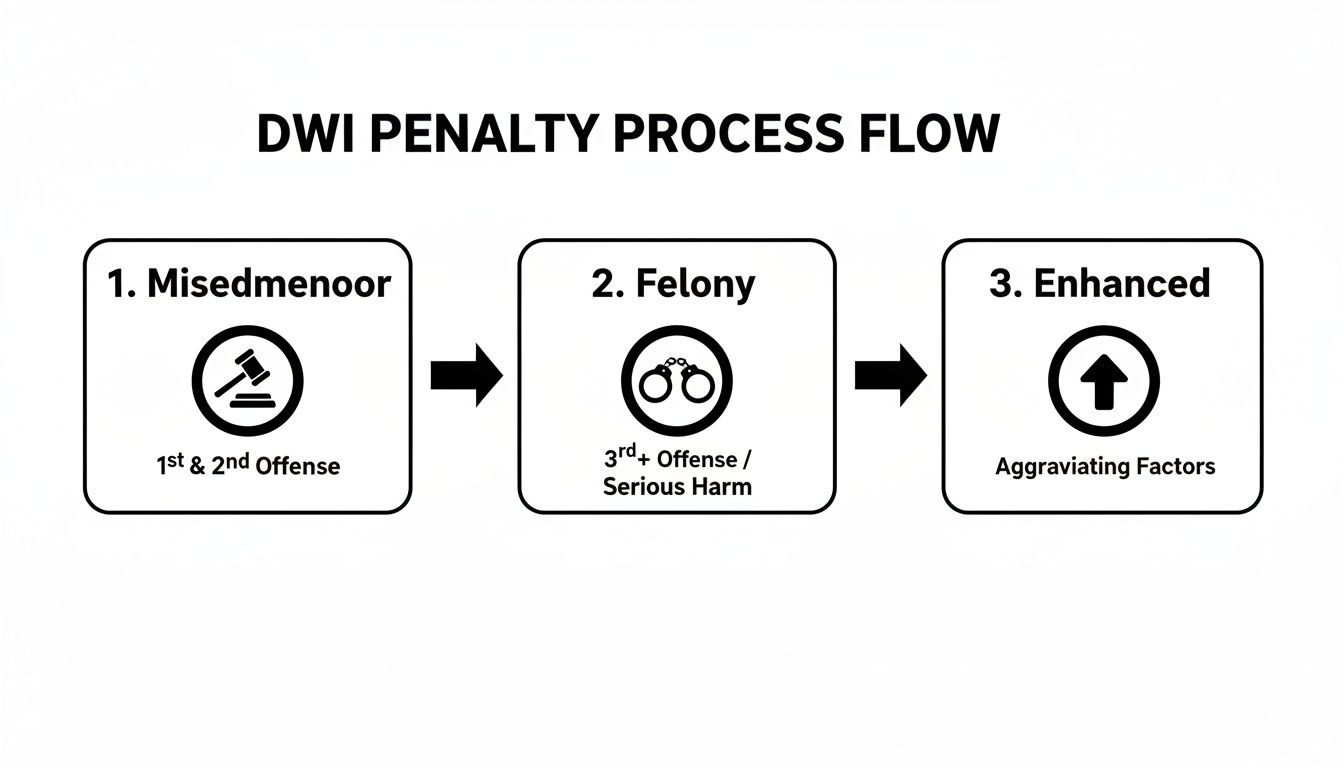
As you can see, what starts as a misdemeanor can rapidly become a felony, making a strong early defense essential to protect your future. The ALR hearing is a critical fact-finding mission that often forms the foundation of a winning defense.
How We Build a Winning DWI Defense Strategy
An arrest is an accusation, not a conviction. When you hire The Law Office of Bryan Fagan, PLLC, you get a team that methodically deconstructs the prosecution's case. We build a defense on strategy, evidence, and exposing every weakness in the state's argument.
A winning DWI defense often starts by challenging the legality of the traffic stop. An officer must have "reasonable suspicion"—a specific, articulable reason to believe you broke a law. If we can show the stop was illegal, any evidence gathered after that moment, including test results, can be thrown out, often leading to a complete dismissal.
Questioning Every Piece of Evidence
A prosecutor's case is typically built on three pillars: the officer's observations, field sobriety tests, and chemical test results. Each is a potential weak point we can attack.
For example, an officer will almost always note "bloodshot, glassy eyes." But allergies, fatigue, or contact lenses can cause the same thing. We don't let these subjective observations stand unchallenged. We force the prosecution to prove those symptoms are exclusively tied to alcohol.
How to Fight a Breath Test Result
A breath or blood test result over 0.08 BAC might feel like a slam dunk for the prosecution, but it’s far from it. This scientific evidence is only as good as the machines and procedures used.
For breath tests using the Intoxilyzer 9000, we investigate:
- Calibration records: Was the device recently and properly calibrated?
- Maintenance history: Does it have a known history of errors?
- Operator certification: Was the officer certified to operate the machine?
For blood tests, the chain of custody is everything. Was the skin properly sanitized? Was the vial stored correctly? Was the sample labeled properly? A single error can contaminate the sample and render the result scientifically worthless.
Challenging Field Sobriety Test Results
The Standardized Field Sobriety Tests (SFSTs) are notoriously unreliable. They are essentially roadside gymnastics that many sober people would fail even in perfect conditions. We put the administration of these tests under a microscope.
The National Highway Traffic Safety Administration (NHTSA) has strict rules for how these tests must be performed. We ask:
- Were the instructions read verbatim?
- Was the test done on a flat, dry, well-lit surface?
- Did the officer consider your age, weight, or medical conditions?
For example, an officer asks our client to perform a balance test on a sloped, gravel shoulder next to a highway with cars flying by. It’s easy to argue that any sober person would have trouble in that situation, creating powerful reasonable doubt for a jury.
Dismissal rates in Harris County are around 10-15%, and another 30-40% of cases are reduced to lesser charges. In total, 40-50% of cases are resolved without a DWI conviction, and the acquittal rate in district court is about 54.88%. These local DWI statistics reveal the power of a strong defense. Our goal is to create overwhelming reasonable doubt by challenging the stop, discrediting the tests, and questioning the science.
Your Next Step: Protecting Your Future
Navigating a DWI charge in Texas is challenging, but it is not impossible. While the state sees over 90,000 DWI arrests each year, the numbers also tell a story of hope. In major counties, 30-55% of these cases end in non-conviction outcomes, which proves a solid defense can change everything. You can see a full breakdown in this in-depth look at Texas DWI statistics.
The moments after an arrest are overwhelming. But remember, this situation does not define you, and you have the power to fight for a positive outcome.
Now that you have the information, the most important thing you can do is take action. We’re here to help. Reach out to The Law Office of Bryan Fagan, PLLC for a free, no-obligation consultation. Our team is known for its strategic and professional approach to defending Texans across Houston and the state. Making that call is the first step toward regaining control. Don't wait—the sooner you call, the better.
Common Questions After a Texas DWI Arrest
After a DWI arrest, questions start flooding in. Getting clear answers is the first step toward taking back control. Here are some of the most frequent concerns we hear.
The Breathalyzer Dilemma: Did I Make the Right Choice?
Deciding whether to take a breathalyzer is a tough, split-second call. Under Texas’s “implied consent” law, you’ve technically agreed to provide a breath or blood sample if lawfully arrested. Refusing brings an automatic license suspension, typically 180 days for a first offense.
However, if you provide a sample over the 0.08% limit, you've handed the prosecution powerful evidence. A refusal, while triggering a suspension (which we can fight for you at an ALR hearing), starves the state of that evidence. A skilled attorney can build a strong defense regardless of your choice.
Can My DWI Charge Actually Be Reduced or Dismissed?
Absolutely. An arrest is an accusation, not a conviction. A successful defense starts with a review of every detail.
Was the initial traffic stop legal? Were the field sobriety tests administered incorrectly? Was the breathalyzer properly calibrated? Any of these issues can create a crack in the prosecution's case.
When we find a critical error and get evidence thrown out, the prosecutor’s confidence often wavers. This opens the door for negotiation, potentially leading to a reduced charge like reckless driving or a complete dismissal.
Will This Arrest Show Up on a Background Check?
Yes, a DWI arrest and conviction will become part of your criminal record, visible on background checks for jobs, housing, and professional licenses.
However, if your case is dismissed or you are found not guilty, you may be eligible for an expunction. This legal process orders the destruction of all records related to your arrest, as if it never happened. In other cases, like completing deferred adjudication, you might qualify for an order of non-disclosure to seal the record from public view. The best way to protect your record is to fight the charge aggressively now.
A DWI arrest can feel like the end of the world, but it doesn’t have to be. The decisions you make now are crucial for protecting your license, your record, and your future. At The Law Office of Bryan Fagan, PLLC, our team is here to defend Texans with the strategic and professional support you deserve. Don't wait to get the answers you need.
Request your free case evaluation from The Law Office of Bryan Fagan, PLLC and let's start building your defense today.