 Skip to content
A DWI arrest can be overwhelming—but you don’t have to face it alone. So when a judge orders you to wear an ankle monitor that detects alcohol, it’s easy to feel stressed and uncertain about the future. You probably have a million questions running through your mind, starting with what this device is and how it will impact your life.
This device, often a SCRAM (Secure Continuous Remote Alcohol Monitor), is a common condition for bond or probation in Texas DWI cases. Its purpose is to ensure sobriety by continuously checking for alcohol through your skin. Understanding how it works—and its flaws—is the first step in building a strong defense for your case. At The Law Office of Bryan Fagan, PLLC, we're here to explain the process, protect your rights, and help you regain control.
Facing A DWI Arrest: Understanding The Alcohol Ankle Monitor
Hearing a judge order you to wear an alcohol-detecting ankle monitor adds a heavy layer of stress to an already difficult situation. It can feel like a punishment before you’ve even had your day in court. But knowing why it was ordered is the first step toward regaining some control. At The Law Office of Bryan Fagan, PLLC, our job is to pull back the curtain on this process, protect your rights, and build a defense that accounts for every piece of evidence—including data from this device.
Think of the ankle monitor as an automated, 24/7 breathalyzer that tests your sweat instead of your breath. Its main purpose isn't to punish you; it's to enforce a court-ordered sobriety requirement while your case is pending. For many Texas judges, these devices are an alternative to keeping someone in jail, allowing them to keep their job and live at home.
Why Was I Ordered To Wear One?
A Texas judge doesn't order an alcohol ankle monitor in every DWI case. It's typically reserved for situations that the court views as higher risk. The monitor is a tool judges use to feel confident about public safety while you are out on bond. You may be required to wear one if:
- You are facing charges for a second or subsequent DWI.
- Your case involves a high Blood Alcohol Concentration (BAC), usually 0.15 or greater. A BAC is the measure of alcohol in your bloodstream.
- The DWI incident involved an accident or injury, which could lead to more serious charges like Intoxication Assault.
- It's a mandatory condition for getting an occupational driver's license during an Administrative License Revocation (ALR) hearing. An ALR hearing is a separate civil process to determine if your driver's license will be suspended.
Facing a DWI charge can feel isolating, but you are not just another case number to us. We see the person behind the charge, and our goal is to help you navigate the legal system with confidence and a clear strategy.
These devices are everywhere now. The global market for electronic monitoring, which heavily features alcohol detection, shows just how integrated this technology has become in our justice system. The market was projected to jump from $2.18 billion in 2023 to $2.35 billion by 2026, with North America being the biggest user. This trend makes it critical to have an experienced Houston DWI lawyer who knows the technology inside and out—and more importantly, knows how to challenge it. You can learn more about the growth of this technology and its market trends.
At The Law Office of Bryan Fagan, PLLC, we believe knowledge is power. The more you understand about how an ankle monitor that detects alcohol works—and its significant limitations—the better equipped we are to build a strong defense. We're here to answer your questions, fight every piece of questionable evidence, and protect your future.
How Transdermal Alcohol Monitoring Actually Works
It sounds like something out of a sci-fi movie—an ankle bracelet that can tell if you’ve had a drink. But the technology behind it isn't magic. Think of it like a breathalyzer for your skin, one that’s always on duty. Understanding how it works is the first step toward defending yourself against a potential violation.
When you drink alcohol, your body works hard to get rid of it. While your liver does most of the heavy lifting, about 1% of the alcohol you consume is released directly through your breath, urine, and sweat. That tiny amount escaping through your skin is exactly what these ankle monitors are designed to detect.
The Step-By-Step Detection Process
These devices, often called SCRAM (Secure Continuous Remote Alcohol Monitor) bracelets, don't just guess. They follow a strict, automated schedule, usually testing the vapor on your skin every 30 minutes. It's a constant, silent check-in, 24/7.
Here's how that process breaks down:
- The Pump: A tiny pump inside the bracelet whirs to life, pulling in a sample of the air and perspiration vapor sitting right on your skin.
- The Sensor: This sample is sent across an electrochemical fuel cell. If alcohol vapor is present, it triggers a chemical reaction that generates a very small electrical current.
- The Measurement: The device measures the strength of that electrical current. A stronger current means more alcohol was detected. This data is then recorded with a timestamp.
To make sure you're the one wearing the device and not trying to trick it, the monitor also has sensors that track skin temperature and proximity. Any attempt to take it off or block the sensor will trigger an immediate tamper alert.
Below is a quick breakdown of the most common features you'll find in a SCRAM device.
SCRAM Device Features and Functions
| Feature | Function | What This Means for You |
|---|---|---|
| Electrochemical Fuel Cell | Detects the presence of ethanol (alcohol) vapor. | This is the core technology that identifies alcohol consumption. |
| Transdermal Pump | Pulls a sample of air and sweat from the skin's surface. | Ensures the device is testing you, not the air around you. |
| Automated Testing | Takes readings at regular intervals (e.g., every 30 minutes). | Provides a continuous, around-the-clock monitoring record. |
| Temperature Sensor | Confirms the device is being worn against human skin. | Prevents you from removing the device or putting it on an object. |
| Proximity Sensor | Detects if anything is placed between the device and your skin. | Attempts to block the sensor will be recorded as a tamper. |
| Data Storage & Transmission | Records all readings and sends them to a monitoring center. | The device itself doesn't issue a violation; it only collects the data. |
Understanding these features is key, as each one can be a point of failure—or a point of defense—in a violation hearing.
From Data Collection To Violation Report
The ankle monitor itself doesn’t make any judgments. It's simply a data-gathering tool, storing test results and tamper alerts throughout the day. At specific times, it connects to a base station in your home to upload all this information to a central monitoring company.
The infographic below shows a simplified view of how this monitoring fits into the DWI process.
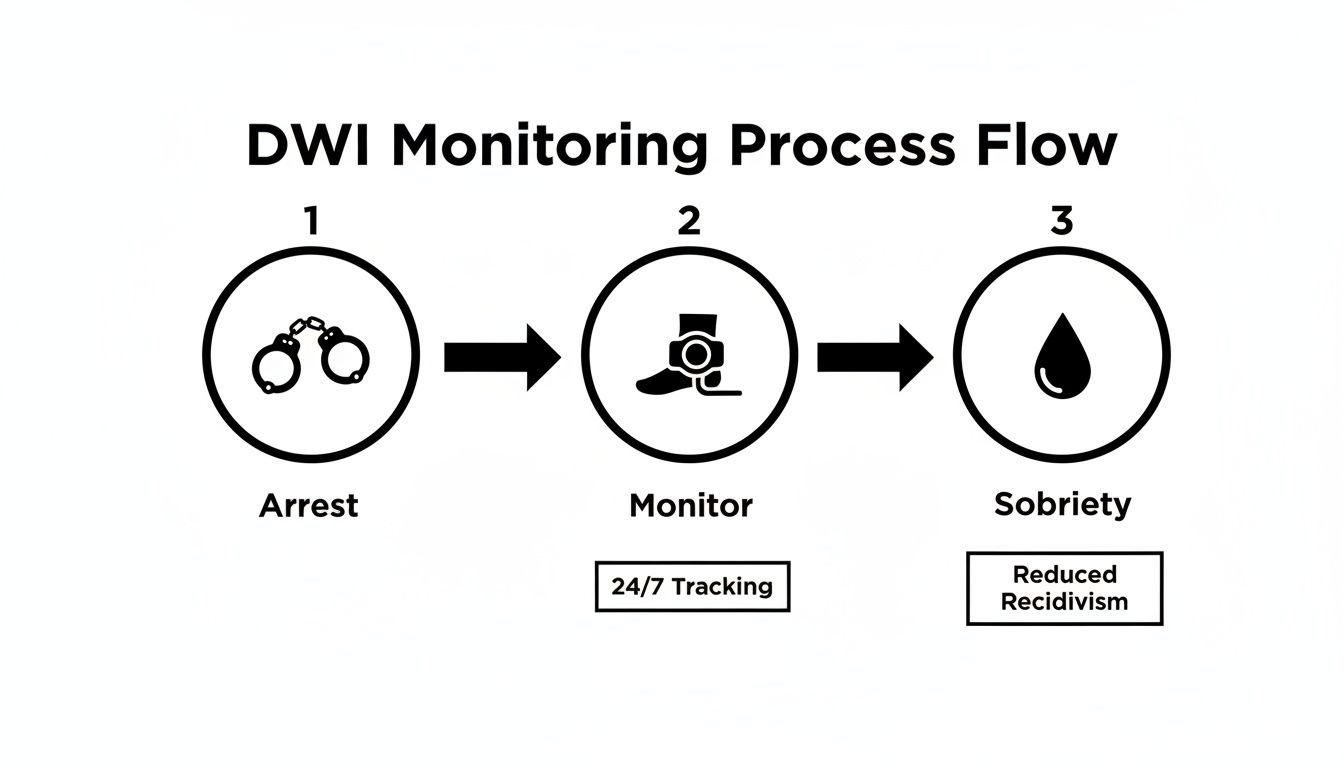
Once the data is uploaded, it’s not a judge or your probation officer who reviews it first. It’s an analyst at a private company. They use proprietary software to look for patterns—spikes and curves in the data—that their algorithms interpret as a drinking event. If they decide a reading is positive, they generate a violation report and forward it to the court.
This is a critical point: the report that could send you to jail is based on a private company's interpretation of data from a machine that can be flawed. This is where an experienced DWI lawyer is vital. We know how to challenge the science, question the data, and hold these companies accountable for their "infallible" technology.
This industry has seen significant growth, with a compound annual growth rate somewhere between 3.5% and 7.3%. As the tech becomes more common, so do the challenges to its reliability. For a deeper look at industry trends, you can discover more about the trends in electronic monitoring. While this skin-based testing is different from breath testing, understanding the science behind both can be helpful. For more on that, you can read our article on how long alcohol stays on your breath.
Bond Conditions And Sobriety Orders
When you’re released from jail after a DWI arrest, it’s usually on bond. To stay out of jail until your case is over, a judge sets specific conditions of bond—rules you have to live by. For certain DWI cases, one of those rules can be complete abstinence from alcohol, enforced by an ankle monitor that detects alcohol.
The Texas Code of Criminal Procedure gives judges wide latitude to impose any condition they think is needed to keep the community safe. An alcohol monitor is often viewed as a more practical choice than keeping someone locked up, allowing them to get back to work and be with their family.
Judges are far more likely to order this kind of continuous monitoring in cases they see as higher-risk. This usually includes situations like:
- Repeat DWI Offenses: If you have a prior DWI conviction on your record, a judge will almost certainly require some type of alcohol monitoring for a second or subsequent charge. It’s nearly standard practice.
- High Blood Alcohol Concentration (BAC): A BAC of 0.15 or higher is a major red flag for the court. This automatically bumps a first-time DWI to a more serious Class A misdemeanor, and judges often order a monitor to prevent another incident.
- Felony DWI Charges: Any case involving serious bodily injury (Intoxication Assault) or a fatality (Intoxication Manslaughter) will almost always come with a sobriety order enforced by an ankle monitor. The stakes are simply too high.
A judge’s order for an ankle monitor may feel like a judgment, but it is also an opportunity. Complying with the order demonstrates responsibility, which can be a valuable asset as we negotiate with prosecutors and advocate for you in court.
Using The Ankle Monitor As A Strategic Tool
While having an ankle monitor strapped to you is definitely a restriction, agreeing to wear one can be a smart, proactive move in your defense. It’s not just about following a court order—it can become a bargaining chip that helps you achieve other critical goals, especially when it comes to keeping your driver's license.
One of the most immediate hits from a DWI arrest is a potential DWI license suspension. You only have a short window to request an Administrative License Revocation (ALR) hearing to fight it. At this hearing, we can often negotiate for an occupational driver's license (ODL), which lets you drive for work, school, and other essential needs.
- Example: Imagine a commercial driver in Houston gets arrested for his first DWI in Texas. He absolutely needs to drive to keep his job. His attorney suggests they proactively offer to have him wear an ankle monitor. When they get to the ALR hearing, this offer shows the judge he's taking sobriety seriously, making it much easier for the judge to grant the ODL.
By showing the court you're committed to staying sober, you give the judge a powerful reason to trust you with driving privileges again. It flips the script, turning the monitor from a punishment into a key that can unlock a vital piece of your freedom. For an in-depth look at these requirements, check out our comprehensive guide on DUI alcohol monitoring in Texas.
How to Fight a False Violation Alert
That sinking feeling when you get a violation alert from your ankle monitor is immediate and intense. It’s easy to panic, but the most important thing to remember is this: an alert from a machine is just an allegation. It is not proof, and it’s definitely not a conviction.
These systems are far from perfect. As experienced DWI defense attorneys, we know exactly where their weaknesses lie and have many ways to fight DWI Texas violation claims.

The very first thing you need to do is call an experienced Houston DWI lawyer. Don't wait. The prosecutor can use that single report to file a motion to revoke your bond, and time is absolutely critical. Acting fast lets us get out in front of the allegation and start building the defense you need.
Understanding False Positives And Environmental Alcohol
One of the biggest flaws of an ankle monitor that detects alcohol is its simple, one-track mind. The sensor is built to detect ethanol, but it can’t tell the difference between the alcohol in a beer you drank and the alcohol in the hairspray you used this morning.
This is what’s known as a false positive. It’s a situation where the monitor flags you for a violation even though you haven’t had a single drop to drink. This happens more often than you’d think, which is why documenting your exposure to common products is a core part of a strong defense.
Everyday items can easily trigger a false alert:
- Hygiene Products: Colognes, perfumes, aftershave, hairspray, and many body lotions contain alcohol.
- Cleaning Agents: Glass cleaners, industrial solvents, and sanitizing wipes often have high alcohol content.
- Health Products: Hand sanitizers are the most common culprit, but rubbing alcohol and some mouthwashes can also cause issues.
- Foods: Even certain foods like kombucha, some sauces, or desserts made with alcohol extracts can lead to a false reading.
If you get a violation notice, your first job is to immediately write down a detailed list of every single product you used or were near around the time of the alleged event. This simple log can become one of the most powerful pieces of evidence we use to dismantle the monitor's report.
A violation report is just one piece of data, and it doesn't tell the whole story. Our job is to fill in the gaps, present the complete picture to the court, and show that a machine's reading does not outweigh your documented actions and credibility.
Scrutinizing The Device And Its Data
Beyond environmental mix-ups, the monitoring device itself is often the source of the error. A good DWI attorney will never take the monitoring company’s report at face value. We demand and dig into every piece of documentation, looking for the procedural shortcuts and inconsistencies that can get a false report thrown out.
Key areas we investigate include:
- Calibration and Maintenance Records: Was the device even working correctly? We hunt for missed calibration appointments, gaps in the maintenance logs, or a history of previous malfunctions that tell a story of unreliability.
- Chain of Custody: Who touched the data? We trace the data's path from the moment it left your ankle monitor to the second it landed in front of the judge, ensuring its integrity wasn't compromised.
- Data Interpretation: The raw data is often just a squiggly line on a graph until an analyst—using the company's own software—decides it looks like a drinking event. We challenge that interpretation, especially when the data doesn't fit the classic pattern of alcohol consumption.
This table breaks down how we distinguish between a legitimate violation and a potential false positive triggered by other factors.
Alcohol-Containing Products vs. Consumed Alcohol
The data curve tells a story, and often, it's a story of innocence. A quick spike from hand sanitizer looks very different from the slow burn-off of a few beers.
| Source of Alcohol | How the Monitor Might React | Defense Strategy |
|---|---|---|
| Ingested Alcohol | Produces a characteristic data curve with a sharp rise, a plateau, and a gradual decline over several hours. | Focus on BAC, metabolism rates, and potential errors in the reading itself. |
| Environmental Exposure | Often causes a rapid, sharp spike with an equally rapid drop-off, which is not typical of a drinking event. | Provide logs of product use, witness statements, and expert testimony on sensor cross-reactivity. |
| Ketosis/Medical Issues | Certain metabolic states, like ketosis from a strict diet or diabetes, can produce endogenous alcohols (like isopropanol) that may trigger a fuel cell sensor. | Present medical records and expert testimony to explain the physiological source of the alert. |
Challenging a false violation from an ankle monitor that detects alcohol requires a strategic, evidence-based approach. It’s about dissecting the technology, questioning the procedures, and presenting a logical, alternative explanation that the court can understand. You do not have to let a machine's mistake dictate your future.
If you're facing a violation alert, your freedom is on the line. Don’t wait for the situation to get worse. Contact The Law Office of Bryan Fagan, PLLC for a free, confidential case evaluation. We are ready to stand up for you, challenge the so-called evidence, and protect your rights.
Your Rights And Responsibilities While Being Monitored
Living with an ankle monitor isn't just about following the rules—it's about proactively protecting yourself from the kind of simple mistakes that can land you back in jail. You have to be meticulous. Think of this period as your first opportunity to show the court you’re serious about sobriety and to build a rock-solid defense.
The court and the monitoring company have strict requirements for a reason. When you follow them perfectly, you remove all doubt about your compliance and give us the high ground. We're your partners in this, and clear, constant communication is the most powerful tool we have.
Best Practices For Staying Compliant
When you're wearing an ankle monitor that detects alcohol, your awareness of your surroundings has to be on high alert. Innocent, everyday activities can suddenly become huge risks, but a smart strategy will help you navigate them without a single misstep.
Here are the essential "do's" you need to live by:
- Do Keep a Detailed Log: Document everything. Seriously, everything. Write down the products you use, from mouthwash and cologne to household cleaners. Note every time you go somewhere with strong fumes, like a nail salon or an auto body shop. This log can be your best defense against a false positive.
- Do Attend All Appointments: Never, ever miss a maintenance check or data download with the monitoring company. These are mandatory, and skipping one is an automatic red flag for the court.
- Do Communicate Immediately: If you think you were exposed to environmental alcohol or if the device starts acting up, call your lawyer right away. Don't wait for a violation notice. The sooner we know, the faster we can get ahead of it.
Actions To Absolutely Avoid
Just as important as knowing what to do is knowing exactly what not to do. The court has zero tolerance for certain behaviors, viewing them as deliberate attempts to cheat the system. These actions can lead to your bond being revoked and even land you with new criminal charges.
You must never:
- Don't Tamper with the Device: Do not try to take the monitor off, submerge it in water, or block the sensor. These devices are built with tamper-detection technology that will instantly alert the monitoring company. They will know.
- Don't Consume Any Alcohol: This one is obvious, but it’s the most critical rule. A single drink is a direct violation of the court's order. It’s not worth the risk.
- Don't Ignore Device Alerts: If your ankle monitor beeps or vibrates, it's telling you something important—usually that the battery is low or it's lost connection. Deal with it immediately by following the company's instructions. Ignoring it looks like you're trying to hide something.
Your behavior while on this monitor sends a direct message to the judge. Perfect compliance is your strongest shield against false accusations and shows you respect the process.
Managing a continuous alcohol monitor is a heavy responsibility, but you don't have to carry it alone. By following these guidelines and staying in close contact with your legal team, you can get through this without any issues. This proactive approach stops small mistakes from blowing up your entire case and lets us stay focused on fighting the DWI charge itself. Understanding the full scope of court-ordered testing is key, and you can read more about what to expect with a drug test for probation to get a bigger picture.
Common Questions About Alcohol Ankle Monitors In Texas
After a DWI arrest, your head is probably swimming with questions and a whole lot of uncertainty. That feeling only gets worse when a judge orders you to wear an alcohol-detecting ankle monitor. What does it do? What happens if it goes off? Who pays for it?
You’re not alone in asking these things. We hear these questions from clients every single day. Let's cut through the confusion and get you some straight answers so you know exactly what you’re up against.
How Much Does An Alcohol Ankle Monitor Cost In Texas?
One of the first things people want to know is, "Who's paying for this thing?" The answer, unfortunately, is almost always you. The court puts the financial responsibility for the device squarely on the defendant’s shoulders, and it’s not just a one-time fee. This is an ongoing expense that can really start to add up.
You're typically looking at two main costs:
- A one-time setup fee: This covers getting the device installed and activated. Expect to pay between $50 and $100 upfront.
- A daily monitoring fee: This is the big one. It's a recurring charge that usually runs $10 to $15 per day for as long as you're required to wear the monitor.
Do the math, and you'll see that can easily become $300 to $450 a month, sometimes more. This financial strain is a real part of your DWI case, and it’s something we can discuss during your free case evaluation. We’ll look at the big picture and figure out how to manage these costs as part of your overall defense.
Can A SCRAM Monitor Detect Drug Use?
This is a critical question we get all the time. The standard SCRAM (Secure Continuous Remote Alcohol Monitor) device is built for one job and one job only: to detect alcohol consumed by testing the vapor from your skin. That means it cannot detect other drugs like marijuana, cocaine, or opioids.
But don't get a false sense of security. A judge who orders a SCRAM monitor as a condition of your bond or probation very often orders separate drug testing at the same time. It's a common one-two punch.
An ankle monitor alert is an allegation, not a conviction. It is crucial to remember that this technology is imperfect, and we are here to challenge any report that wrongly accuses you. Your sobriety and freedom are our top priorities.
These other tests can include:
- Random Urinalysis (UA): This is the most common. You might have to call a hotline every day and show up for a urine test with very little notice.
- Drug Patches: You wear a patch on your skin that collects sweat over several days. It's then sent to a lab to be tested for a wide range of controlled substances.
- Hair Follicle Tests: This test can look back much further, sometimes detecting drug use up to 90 days in the past.
Our firm has deep experience defending every kind of DWI case, whether it involves just alcohol, controlled substances, or a combination of both.
What Happens If I Get A Violation Report While On Bond?
Getting a violation alert is a serious problem that demands an immediate, strategic response. If the monitoring company flags you for a "confirmed drinking event" or a tamper alert, the prosecutor will be notified. Their next move is often to file a Motion to Revoke Bond.
This is exactly what it sounds like. It’s a legal request for the judge to cancel your bond and send you back to jail to wait until your DWI case is over. If this motion is filed, a warrant will be issued for your re-arrest, and you’ll find yourself back in front of the judge for a bond revocation hearing. This is not a situation you want to handle on your own.
You must contact your Houston DWI lawyer the second you learn about a potential violation. We need to get ahead of it. We'll immediately demand all the data from the monitoring company and start combing through it for the errors and inconsistencies that we know exist. Our job is to build a defense for that hearing, fight the violation report, and keep you out of jail.
Is It Possible To Get The Ankle Monitor Removed Early?
Yes, getting an ankle monitor that detects alcohol taken off early is definitely possible. But it's not something the court just hands out. It has to be earned through a solid track record of perfect compliance.
After several months of proven sobriety—with zero violations or tamper alerts—your attorney can file a formal motion with the court. This motion will ask the judge to end the monitoring requirement early.
In that motion, we will argue that you’ve clearly demonstrated your commitment to sobriety and are no longer a risk that requires constant electronic supervision. Your perfect compliance record is the most powerful evidence we have. We can help you figure out the right time to make this request and frame the argument in a way that gives you the best shot at success.
A DWI charge in Texas is a major challenge, but you don't have to face it by yourself. At The Law Office of Bryan Fagan, PLLC, our experienced DWI attorneys are ready to defend your rights, question every piece of evidence, and walk you through each step of this overwhelming process.
Your future is too important to leave to chance. Request a free and confidential case evaluation today to learn how our strategic approach can protect your freedom and your driving privileges.

