 Skip to content
A DWI arrest can be overwhelming—but you don’t have to face it alone, especially when the stakes are this high. A 3rd offense DWI in Texas isn't just another legal hurdle; it's a third-degree felony. This serious classification brings mandatory minimum penalties, including potential prison time of 2 to 10 years and fines up to $10,000. Unlike a misdemeanor, a third DWI conviction creates a permanent felony record that can't be sealed or expunged. Understanding the gravity of the charge is the first step toward building a powerful defense to protect your future.
What Happens When You Face a Third DWI Charge in Texas
A DWI arrest is always a stressful experience, but when it’s your third, the legal landscape changes completely. What was once a misdemeanor charge now carries the full weight of a felony prosecution.
Here at The Law Office of Bryan Fagan, PLLC, we understand the uncertainty and concern you're feeling. Our goal is to empower you with clear, straightforward information and a strategic plan. A strong defense always begins with knowledge of your rights and options.
Facing a 3rd offense DWI in Texas means you’ve entered a much more serious legal arena. The state treats repeat offenses with extreme severity, and prosecutors are far less willing to offer the kind of plea bargains you might have seen with a first DWI in Texas. The entire process becomes more complex, and the stakes are exponentially higher.
The Immediate Legal Shift to a Felony
The most critical change is the automatic upgrade to a felony. Under Texas Penal Code §49.09, a third DWI is classified as a third-degree felony, regardless of the specific circumstances of your arrest. This classification triggers a new set of potential penalties that go far beyond what you may have experienced with prior misdemeanor charges.
To help you understand what’s on the table, here is a quick reference guide to the statutory penalties.
Quick Guide to Texas 3rd DWI Penalties
This table provides a snapshot of the potential consequences you face with a third-degree felony DWI conviction in Texas.
| Penalty Category | Potential Consequence |
|---|---|
| Criminal Classification | Third-Degree Felony |
| Prison Sentence | 2 to 10 years in the Texas Department of Criminal Justice (TDCJ) |
| Maximum Fine | Up to $10,000, plus court costs and fees |
| Driver's License Suspension | 180 days to 2 years |
| Ignition Interlock Device | Mandatory installation on your vehicle |
| Permanent Record | A lifelong felony conviction that cannot be expunged or sealed |
| Civil Rights Impact | Loss of the right to vote (while incarcerated) and own a firearm |
These penalties represent the legal framework, but the real-world impact—on your job, your family, and your freedom—is often much greater.
Why a Strategic Defense is Non-Negotiable
With such severe penalties on the line, the prosecution will pursue your case aggressively, examining every detail from your prior convictions to the evidence gathered in this arrest. This is precisely why you cannot afford to navigate this complex legal process alone.
It's easy to feel like a felony charge is an impossible mountain to climb, but remember this: an arrest is not a conviction. Even with third offenses, strong defense strategies exist that can challenge the charge or significantly minimize the consequences.
An experienced Houston DWI lawyer does more than just represent you in court. We provide the strategic guidance needed to analyze the state's case piece by piece. We will investigate the initial traffic stop, scrutinize how the field sobriety tests were administered, and challenge the accuracy of any blood or breath tests. Building an effective legal strategy starts now, and our team is ready to provide the confident, assertive defense you deserve.
Understanding Felony DWI Penalties and Consequences
When you're facing a third DWI charge in Texas, the charge is no longer a misdemeanor—it’s a third-degree felony under Texas Penal Code §49.09. This isn't just a change in terminology; it triggers a set of severe penalties designed to be far harsher than anything you may have experienced before. The state prosecutes these cases with maximum intensity, and a conviction carries life-altering consequences. Understanding the full scope of what you're up against is the first step toward building a defense to protect your freedom.
From County Jail to State Prison
The most significant change with a felony DWI is the potential for a state prison sentence. While a first or second offense might result in time in a county jail, a conviction for a 3rd offense DWI in Texas carries a potential sentence of 2 to 10 years in the Texas Department of Criminal Justice (TDCJ). This means serving time in a state prison—a far more serious environment.
Even if you receive probation, Texas law often requires a mandatory minimum jail stay as a condition. This is sometimes called "shock probation," and it ensures that even a probated sentence for a third DWI involves some time behind bars.
The Financial Burden of a Felony Conviction
The financial impact of a felony DWI extends far beyond the courtroom. A conviction can result in a fine of up to $10,000, but that number is just the beginning. It's crucial to understand that the fine is only one piece of the puzzle. A host of other expenses quickly pile up, including:
- Court Costs and Fees: These administrative charges can easily add hundreds, if not thousands, of dollars to your total bill.
- Annual State Surcharges: For three years after a conviction, the Texas Department of Public Safety will impose hefty annual surcharges on your driver's license, often between $1,500 and $2,000 per year.
- Community Service Hours: Texas law mandates 160 to 600 hours of community service, a significant time commitment that can interfere with your job and family life.
These direct costs create a substantial financial strain, compounding the stress of the legal process.
Texas Has No Lookback Period
A common misconception is that old DWI convictions eventually "fall off" your record. In Texas, that's not true. Texas has a "no lookback period," meaning any prior DWI conviction—whether it was five, ten, or even thirty years ago—can be used to elevate a new charge to a felony.
This lifetime lookback provision is one of the harshest aspects of Texas DWI law. It means the past never truly disappears and can resurface to create severe consequences for a new arrest.
This rule underscores why fighting every single DWI charge is so critical. A conviction from decades ago can be the deciding factor that turns a new arrest into a fight for your freedom. According to Texas Penal Code §49.09, a third offense DWI is classified as a third-degree felony. Learn more about the most current DWI charges in Texas for 2025.
The Lifelong Impact of a Felony Record
Beyond prison time and fines, a felony conviction leaves a permanent stain on your record. In Texas, a felony DWI conviction can never be sealed or expunged. It will appear on background checks for the rest of your life.
This permanent record creates lifelong barriers, affecting your ability to:
- Find Employment: Many employers are hesitant to hire individuals with felony convictions.
- Secure Housing: Landlords often run background checks, and a felony can lead to denial of a rental application.
- Maintain Professional Licenses: Fields like nursing, law, and real estate may revoke or suspend your license.
- Own a Firearm: As a convicted felon, you will lose your right to legally own a gun.
These collateral consequences can be just as devastating as the formal penalties. Facing this reality reinforces why you need an experienced Houston DWI lawyer to fight the charge and protect your future.
Your First 48 Hours: Protecting Your Rights After an Arrest
After a third DWI arrest, the clock starts ticking. The actions you take—or fail to take—in the next 48 hours can significantly impact both your criminal case and your driving privileges. It's a critical window, and you must act with purpose. Feeling overwhelmed is normal, but you are not powerless. Your first and most important step is to contact a Texas DWI lawyer who can guide you through this process.
The 15-Day Deadline You Absolutely Cannot Miss
One of the most urgent issues is the Administrative License Revocation (ALR) process. This is a separate civil proceeding that determines the fate of your driver's license. You have only 15 days from the date of your arrest to request an ALR hearing. If you miss this deadline, the Texas Department of Public Safety (DPS) will automatically suspend your license for up to two years.
This 15-day deadline is non-negotiable. Missing it means you lose your best chance to fight the automatic suspension of your driving privileges. An experienced attorney can file this request for you, ensuring this critical step is not overlooked.
This process is triggered by Texas's implied consent law. By driving on a Texas road, you automatically agree to provide a breath or blood sample if lawfully arrested for DWI. Refusing that test or providing a sample with a Blood Alcohol Concentration (BAC) of 0.08% or higher initiates the ALR suspension.
Understanding the Bonding Process
After your arrest, you will be taken to jail for booking. To be released, you'll need to post bond, which is set by a judge. For a felony DWI, the bond amount will be significantly higher than for a misdemeanor. An attorney can help navigate this process by appearing at a magistration hearing on your behalf, arguing for a reasonable bond amount, and connecting you with a reputable bail bondsman if needed. Getting out of jail allows you to actively participate in your own defense.
This image shows just how seriously the penalties climb with a third DWI conviction.
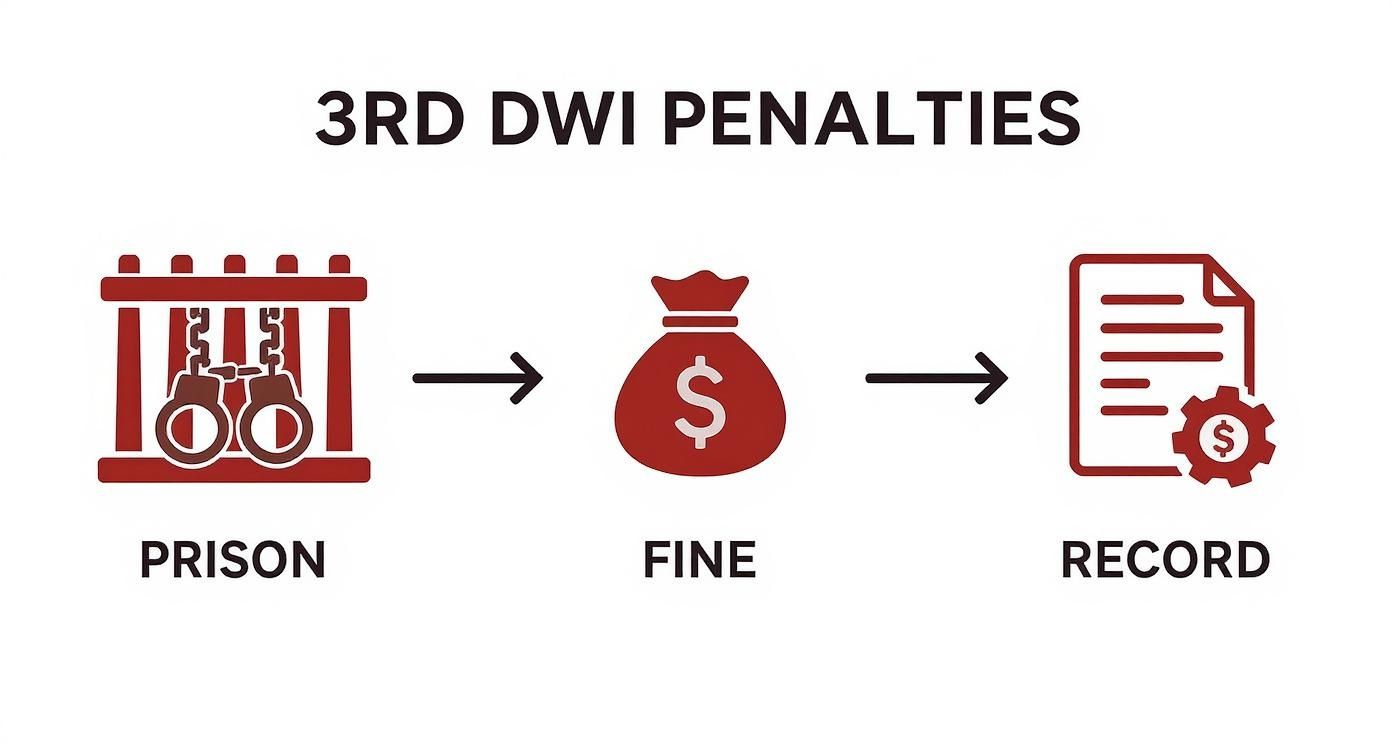
As you can see, the consequences skyrocket from potential prison time and heavy fines to the life-altering burden of a permanent felony record.
Why Your First Call Should Be to a DWI Lawyer
The most important step you can take after being arrested for a 3rd offense DWI in Texas is to contact an experienced attorney immediately. The prosecution is already building its case, and critical evidence has a short shelf life.
A skilled Houston DWI lawyer will get to work by:
- Preserving Evidence: Requesting police dashcam footage, 911 recordings, and maintenance logs for the breathalyzer before they are deleted.
- Contacting Witnesses: Interviewing anyone who saw you before the arrest to gather facts that may not be in the police report.
- Representing You in All Proceedings: Handling your ALR hearing request, representing you at bond hearings, and developing a defense strategy from day one.
You should never try to face a felony charge on your own. A powerful defense starts the moment you're arrested.
How to Navigate Your License Suspension and ALR Hearing
Losing your driver's license is often one of the first and most disruptive consequences of a DWI arrest. The Administrative License Revocation (ALR) process is a separate civil action that runs parallel to your criminal case, and for a 3rd DWI offense in Texas, the stakes are high. It's important to understand that you can win your criminal case and still have your license suspended, or vice versa.
The Purpose of the ALR Hearing
An ALR hearing is not a criminal trial. Its sole purpose is for the Texas Department of Public Safety (DPS) to determine if it has the legal right to suspend your license. The state's burden of proof is much lower here than in a criminal court.
The prosecutor only needs to show that:
- The officer had reasonable suspicion to pull you over.
- The officer had probable cause to believe you were driving while intoxicated.
While this makes the ALR hearing a challenge, it's a fight worth having. Winning can prevent a lengthy suspension and provide your attorney with a valuable preview of the state’s case, exposing potential weaknesses early on.
Potential Suspension Periods for a Third Offense
For a third DWI, the DWI license suspension period is severe. With two or more prior DWI-related incidents on your record, you face a license suspension of up to two years. This is why you must act quickly to request an ALR hearing within the 15-day window. An experienced Texas DWI lawyer can manage this process to ensure all deadlines are met. To learn more, you can review the complete Texas ALR hearing process in our guide.
Obtaining an Occupational Driver's License
Even if your license is suspended, you may still have options. It is often possible to obtain an Occupational Driver's License (ODL), also known as an "essential needs" license. An ODL grants you limited permission to drive for specific, necessary purposes, such as:
- Traveling to and from work.
- Attending school or educational programs.
- Handling essential household duties like grocery shopping or taking children to school.
Obtaining an ODL requires petitioning the court and proving that a full suspension would cause an undue hardship for you and your family. An attorney can help you prepare a compelling petition and advocate for your driving needs.
The True Financial and Personal Cost of a Felony DWI

The official penalties for a 3rd offense DWI in Texas—prison time and thousands in fines—are severe, but the true cost of a felony conviction extends far beyond the courtroom. The financial and personal burdens can follow you for years, affecting every aspect of your life. Understanding the full scope of what’s at stake is why a strategic defense is essential not just to stay out of jail, but to protect your financial future.
Deconstructing the Financial Burden
The official $10,000 maximum fine is just the starting point. A felony DWI conviction triggers a cascade of mandatory fees, surcharges, and program costs. The total financial impact of a third DWI offense can easily exceed $50,000 when you account for legal fees, fines, court costs, mandatory alcohol programs, increased auto insurance, and lost income. For a deeper look, see our guide on DWI fines in Texas.
Here’s a breakdown of where the money goes:
- Court Costs and Legal Fees: Administrative charges separate from your fine.
- Annual DPS Surcharges: An annual fee paid to the Texas Department of Public Safety for three years, often totaling between $4,500 and $6,000.
- Ignition Interlock Device (IID): Installation, monthly leasing, and calibration can cost over $1,000 per year.
- Probation Fees: Monthly supervision fees paid for the entire term of probation.
- Mandatory Education Programs: You must enroll in—and pay for—a state-approved DWI intervention program.
The Long-Term Economic Damage
The financial pain doesn't end when the last court-ordered payment is made. The long-term economic damage from a felony record can impact your earning potential for life.
A felony conviction is a permanent red flag for employers, landlords, and insurance companies. It creates financial obstacles that can prevent you from building a stable future long after you've served your sentence.
Your auto insurance premiums will likely skyrocket, as insurers will label you a high-risk driver. A felony record can also lead to significant lost income, as many companies have policies against hiring convicted felons. This creates a lasting barrier to your career and financial security.
The Personal and Reputational Costs
Beyond the financial impact, a felony DWI conviction takes a profound personal toll. It can strain relationships, damage your professional reputation, and limit your personal freedoms. The label of "convicted felon" follows you everywhere. This is why we fight so hard to protect our clients. An aggressive defense from an experienced Houston DWI lawyer is the best tool you have to protect your freedom and your future.
Building a Strong Defense to Fight Your DWI Charge
When you’re facing a felony DWI charge, it's easy to feel defeated. But remember: an arrest is not a conviction. The state has the burden of proving its case beyond a reasonable doubt, and a skilled DWI lawyer knows how to find weaknesses in the prosecution's arguments. Every piece of evidence must be legally obtained. A powerful defense involves scrutinizing every action the arresting officer took.
Here at The Law Office of Bryan Fagan, PLLC, we believe in empowering you with knowledge. When you understand how we can challenge the state's case, you regain a sense of control. A well-built defense can lead to reduced charges, a dismissal, or a not-guilty verdict at trial.
Challenging the Traffic Stop and Arrest
The entire case begins with the traffic stop. An officer must have reasonable suspicion—a clear, specific reason to believe you violated a traffic law—to pull you over. If the stop was illegal, any evidence gathered afterward, including field sobriety tests and chemical samples, could be suppressed.
We investigate by asking critical questions:
- Did the officer have a legitimate reason to initiate the stop?
- Was the stop a pretext to look for a DWI?
- Does the officer’s dashcam video support their report?
If the stop was invalid, we file a Motion to Suppress. Winning this motion can dismantle the prosecution's case, often leading to a dismissal.
Attacking Breath and Blood Test Results
A Blood Alcohol Concentration (BAC) reading over 0.08% may seem conclusive, but chemical tests are far from perfect. Both breathalyzers and blood tests are prone to errors that can produce inaccurate results.
An experienced DWI attorney knows that a number on a machine doesn't tell the whole story. We scrutinize the science and procedure behind every test, because your freedom should never depend on faulty data or human error.
Common issues we investigate include:
- Improper Machine Calibration: Breathalyzers require regular, precise maintenance. We review service logs to ensure the machine was working correctly.
- Breaks in the Chain of Custody: A blood sample must be handled perfectly from collection to testing. Any gap in the chain of custody can compromise the sample's integrity.
- Medical Conditions: Health issues like acid reflux (GERD) or diabetes can cause false positives on a breath test.
Challenging the "science" is a core part of building a strong defense to fight DWI Texas. Our mission is to create reasonable doubt about the state's key evidence. For more information, you can explore the different options available to avoid jail for a 3rd DWI in Texas in our detailed guide.
Common Questions We Hear About a 3rd DWI
When you're facing a third DWI charge, you likely have urgent questions. Here are answers to some of the most common concerns we hear from clients in your position.
Can I Get Probation for a 3rd DWI in Texas?
Obtaining probation, or "community supervision," for a third-degree felony DWI is challenging. While technically possible, prosecutors almost always push for state prison time. Even if a judge grants probation, Texas law often requires a mandatory minimum of 10 days in jail as a condition. Securing a probation sentence requires a powerful, strategic defense that presents compelling reasons for the court to grant you that opportunity.
Will I Have to Get an Ignition Interlock Device?
Yes, an ignition interlock device (IID) is almost always mandatory at this stage. You will likely be ordered to install one as a condition of your bond. If you receive probation or are granted an Occupational Driver's License, the IID will be a non-negotiable requirement.
Can a 3rd DWI Charge Be Sealed or Expunged?
No. In Texas, a felony DWI conviction is permanent. It cannot be expunged or sealed through an order of non-disclosure. The conviction will appear on background checks for the rest of your life, impacting job opportunities, housing applications, and professional licenses. This is why it is so critical to fight the charge from the very beginning. Avoiding a conviction is the only way to protect your future. An experienced Texas DUI attorney is essential to this fight.
A felony charge puts everything you've worked for on the line, but you don't have to face this fight alone. The skilled attorneys at The Law Office of Bryan Fagan, PLLC are ready to build the strategic, aggressive defense you need to protect your rights and your future. For a free and confidential case evaluation to discuss your options, contact us today.

