
A third DWI arrest in Texas can be overwhelming, leaving you to feel like your life is spiraling out of control. But you don't have to face it alone. A 3rd DWI offense in Texas is not just another charge; it is automatically classified as a third-degree felony. This is a serious escalation from prior misdemeanor charges and comes with significantly harsher penalties. Understanding what this means is the first step toward protecting your freedom and your future.
The High Stakes of a Third DWI in Texas

When you are arrested for a third DWI, the entire legal landscape shifts. The state no longer views this as a simple mistake but as a pattern of behavior that requires severe consequences. This jump from a Class A misdemeanor (for a second offense) to a felony means you face a much more aggressive prosecution and a completely different set of penalties that could impact your freedom, your family, and your career for years to come.
However, an arrest is not a conviction. Having an experienced Houston DWI lawyer in your corner is absolutely critical at this stage. Your attorney’s role is to protect your rights, scrutinize every piece of evidence, and guide you through this intimidating process with a clear, strategic defense.
Understanding the Felony Classification
The most significant change with a third DWI charge is its automatic classification as a third-degree felony. This occurs regardless of the specific details of your arrest—such as your blood alcohol concentration (BAC)—as long as the prosecution can prove you have two prior DWI convictions on your record.
So, what does a felony charge really mean for you?
- Permanent Criminal Record: A felony conviction is a permanent mark on your record. Unlike some misdemeanors, it cannot be easily sealed or expunged, creating a lifelong barrier on background checks for employment, housing, and loans.
- Loss of Civil Rights: In Texas, convicted felons lose fundamental rights. This includes the right to vote while incarcerated and on parole, and the permanent loss of the right to own a firearm.
- Severe Penalties: The potential for spending years in a state prison and paying crippling fines skyrockets compared to misdemeanor charges.
Texas DWI Penalties Explained
The potential consequences of a third DWI conviction are life-altering. The table below outlines the penalties a judge can impose, giving you a clear picture of what is at stake.
Third DWI Offense in Texas at a Glance
| Penalty Category | Potential Consequence |
|---|---|
| Criminal Charge | Third-Degree Felony |
| Prison Sentence | 2 to 10 years in a Texas state prison |
| Fines | Up to $10,000 |
| Driver's License Suspension | 180 days to 2 years |
| Annual Surcharges | Up to $2,000 per year for 3 years to maintain your license |
| Ignition Interlock Device | Mandatory installation on your vehicle is required |
| Community Service | Up to 1,000 hours may be ordered by the court |
| Probation | Up to 10 years with strict, court-ordered conditions |
| Other Consequences | Loss of voting rights, firearm rights, and professional licenses |
Facing these penalties can feel hopeless, but it is crucial to understand that every case has a defense. A skilled Texas DUI attorney will challenge everything from the legality of the initial traffic stop to the validity of the breath or blood test.
One of the most critical facts to know is that Texas has no "lookback period" for DWI offenses. This means a conviction from 10, 20, or even 30 years ago still counts toward elevating your current charge to a felony. To learn more, read about the most common penalties for a DWI in Texas and see how the state approaches these serious charges.
Being charged with a felony DWI does not mean your case is hopeless. It means you need a defense team that understands the high stakes and knows how to fight DWI Texas charges effectively. From questioning the traffic stop to challenging breath or blood test results, there are numerous ways to defend your case.
At The Law Office of Bryan Fagan, PLLC, we provide the strategic, assertive defense you need. We will meticulously review every detail of your arrest to build the strongest case possible. Your future is on the line, and our goal is to protect it.
How a Third DWI Charge Becomes a Felony
Facing a third DWI charge feels different because it is different. The legal system in Texas fundamentally changes its approach, elevating what would have been a misdemeanor into a serious, life-altering felony. Understanding how this happens is the first step toward building an effective defense against the severe consequences that follow.
The shift from misdemeanor to felony is a legal process known as enhancement. The prosecution uses your prior DWI convictions as building blocks to "enhance," or increase the severity of, the current charge. They will present evidence of your past convictions to the court, arguing that this new offense demands a much stronger penalty.
The Dangerous Myth of the "Lookback Period"
One of the most common and dangerous misconceptions is that old DWI convictions eventually "expire" or fall off your record. Many other states do have a "lookback period"—usually seven to ten years—after which a prior offense can't be used to enhance a new one.
This is absolutely not the case in Texas.
Texas has no lookback period for DWI offenses. A conviction from 15, 25, or even 40 years ago can be used to elevate a new charge to a third-degree felony. It does not matter if that conviction happened in another county or even another state. If the prosecution can prove it, it counts against you.
This lifetime lookback rule is what makes a third DWI in Texas so uniquely perilous. It underscores just how critical it is to have a strategic defense that challenges every single piece of the prosecution's evidence—including the validity of those old convictions.
How Prosecutors Build Their Felony Case
To secure a felony conviction for a third DWI, the prosecutor must prove two separate things:
- You committed the current DWI offense. This involves evidence such as the reason for the traffic stop, your performance on field sobriety tests, and the results of any breath or blood tests.
- You have two prior, final DWI convictions. The prosecutor cannot simply state you have them; they must provide legally sufficient proof, which can sometimes be more complex than it sounds.
An experienced Texas DWI attorney will scrutinize the paperwork for those prior offenses, looking for procedural errors, jurisdictional problems, or proof that you were not properly represented by a lawyer. If a prior conviction cannot be legally proven in court today, it cannot be used to enhance your charge to a felony.
Aggravating Factors That Can Complicate Your Case
While two prior convictions are all it takes to trigger a felony charge, other circumstances—known as aggravating factors—can lead to even harsher penalties. These factors give prosecutors more leverage and can influence how a judge or jury views your case.
Key aggravating factors to watch for include:
- A High Blood Alcohol Concentration (BAC): A BAC of 0.15% or higher automatically elevates even a first DWI in Texas to a more serious Class A misdemeanor. In a felony case, a high BAC signals to the court that a more severe punishment is warranted.
- Having a Child Passenger: If a child under 15 was in your vehicle when you were arrested, you could face a separate charge of a state jail felony for child endangerment, in addition to the felony DWI.
- Causing an Accident with Injury or Death: If the alleged DWI led to an accident causing serious bodily injury, the charge becomes Intoxication Assault, a third-degree felony. If someone died, it becomes Intoxication Manslaughter—a second-degree felony carrying a potential prison sentence of up to 20 years.
Understanding how these elements stack against you is vital. Every detail matters, and every detail is an opportunity for a skilled defense. At The Law Office of Bryan Fagan, PLLC, our job is to deconstruct the state’s case piece by piece. We challenge the traffic stop, the sobriety tests, the chemical evidence, and the legal proof of prior convictions to protect your freedom.
Navigating the Criminal Court Process
After the shock of an arrest for a 3rd DWI offense in Texas, you are suddenly thrown into a complex and intimidating court system. The process can feel overwhelming, but understanding what to expect can demystify the journey and empower you to take an active role in your own defense. Here is a step-by-step guide on what happens after a DWI arrest.
This is a structured process where key decisions are made that can impact your freedom long before a verdict is ever reached.
The First Steps: Arraignment and Bond
Your first official court appearance is the arraignment. Here, the judge will formally read the charges against you—in this case, a third-degree felony DWI—and you will enter a plea. Your lawyer will advise you to plead "not guilty." This is standard procedure and gives your legal team the time needed to review the evidence and start building your defense.
At the same hearing, the judge will set your bond, which are the terms of your release from jail. Because you are facing a felony, these conditions are often much stricter than for a misdemeanor.
You can almost always expect the court to order:
- An Ignition Interlock Device (IID): A device wired into your car’s ignition that requires a clean breath sample before the engine will start.
- Regular Check-ins: You will likely have to report to a probation officer or pre-trial services agent on a consistent basis.
- Total Abstinence from Alcohol: You will be strictly prohibited from consuming any alcohol while your case is pending.
Pre-Trial Motions and Plea Negotiations
Once you are out on bond, the real legal work begins. Your defense attorney will immediately file for discovery, a formal request for all the evidence the state has against you. This includes police reports, body camera footage, and the results of any breath or blood tests.
Your lawyer will meticulously review this evidence, looking for weaknesses in the prosecutor's case. This leads to pre-trial motions—formal requests asking the court to challenge the legality of the state's actions. For example, a motion might argue that the initial traffic stop was illegal or that the breathalyzer machine was not calibrated correctly. A successful motion can get crucial evidence thrown out, sometimes leading to a complete dismissal of your case.
At the same time, your attorney will likely engage in plea negotiations with the prosecutor to see if a favorable deal can be reached without going to trial, like getting the felony charge reduced to a misdemeanor. This is much tougher with a third DWI, but it is not impossible with a strong, well-prepared defense.
A strong defense isn’t just about what happens in the courtroom. It’s about the strategic work done behind the scenes—challenging every piece of evidence and leveraging every procedural rule to protect your rights.
The following flowchart illustrates how prior offenses escalate, turning a third arrest into a serious felony.
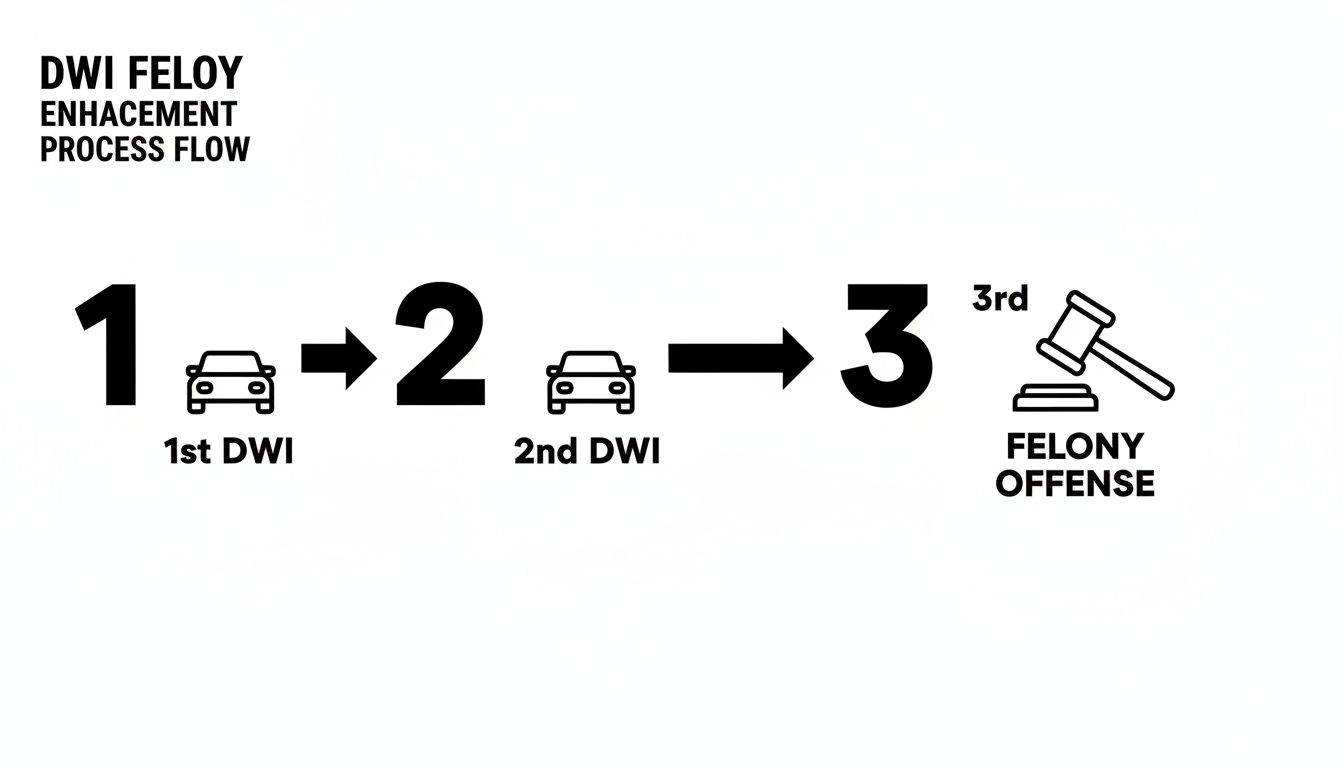
As the visual shows, each DWI conviction builds on the last, legally transforming what might have been a misdemeanor into a life-altering felony case.
Facing Trial and Sentencing
If you and your attorney cannot reach a plea agreement, your case will head to trial. You have the right to a trial by jury, where 12 members of the community must unanimously agree on your guilt "beyond a reasonable doubt."
If a conviction occurs, the case moves to sentencing. The penalties for a third-degree felony are severe: a prison sentence of 2 to 10 years and a fine up to $10,000. The odds are steep; statistics show the vast majority of DWI arrests end in a plea or conviction. For instance, one state report showed 83,088 DWI charges resulted in 33,476 guilty pleas and 23,258 convictions, while only a small fraction were dismissed. You can review these numbers in the official Texas crime statistics and reports.
Facing this process alone is not an option. You need an aggressive advocate in your corner. At The Law Office of Bryan Fagan, we are prepared to challenge the prosecution’s case at every step and fight for the best possible outcome for you.
Protecting Your Right to Drive: The ALR Hearing

When you're facing a 3rd DWI offense in Texas, the felony charge is only one part of the battle. While the criminal case proceeds through the court system, a second, more urgent fight is already underway: the fight to save your driver’s license. This process is called an Administrative License Revocation (ALR), and it moves much faster than your criminal case.
The Critical 15-Day Deadline for Your ALR Hearing
The clock starts ticking the moment you are arrested. You have exactly 15 days to request an ALR hearing and challenge the automatic suspension of your license. This is one of the most critical deadlines in your entire case.
If you miss this 15-day window, you automatically forfeit your right to fight the DWI license suspension. Your license will be suspended, no questions asked. There are no extensions.
This is why your first call should be to an experienced DWI lawyer. An attorney can immediately file the necessary paperwork to meet the deadline and secure your right to a hearing while you focus on your criminal defense.
Key Terms: Implied Consent, BAC, and Administrative License Suspension
The entire ALR system is built on a legal doctrine known as implied consent. This law means that by driving on a Texas road, you have already agreed to provide a breath or blood sample if lawfully arrested for DWI. Your Blood Alcohol Concentration (BAC) is the percentage of alcohol in your bloodstream; the legal limit in Texas is 0.08%. If you refuse a test or fail it (BAC ≥ 0.08%), an administrative license suspension is automatically triggered.
How you respond to a test request directly impacts the ALR process:
- Failing a Chemical Test: If your BAC is 0.08% or higher, the Texas Department of Public Safety (DPS) will move to suspend your license.
- Refusing a Chemical Test: Refusing to provide a breath or blood sample often results in even more severe administrative penalties. Your refusal itself is grounds for a lengthy license suspension.
For a third DWI, a refusal can trigger a license suspension for up to two years. Understanding the unique procedures of this administrative fight is vital. You can learn more about these hearings in our guide on the State Office of Administrative Hearings in Texas.
The table below breaks down the potential consequences and the crucial first step you must take.
DWI License Suspension Timelines and Actions
| Scenario | Potential Suspension Period (3rd Offense) | Action Required |
|---|---|---|
| Failed Chemical Test (BAC ≥ 0.08%) | Up to 1 year | Request an ALR Hearing within 15 days of arrest. |
| Refused Chemical Test | Up to 2 years | Request an ALR Hearing within 15 days of arrest. |
As you can see, regardless of the scenario, that 15-day deadline is everything.
What Happens at an ALR Hearing
An ALR hearing is a civil proceeding, not a criminal trial. An attorney representing the DPS will argue for your license suspension before an Administrative Law Judge. The DPS only needs to prove two things: the officer had reasonable suspicion to stop you and probable cause to arrest you, and you either refused a chemical test or failed one.
This hearing is your attorney's first opportunity to cross-examine the arresting officer under oath. It is a chance to find weaknesses in the state's case that can be invaluable in your criminal defense later. Even if the suspension is upheld, the hearing is a crucial intelligence-gathering mission.
Securing an Occupational Driver's License
If your license is suspended, your attorney can petition the court for an Occupational Driver’s License (ODL). An ODL, or essential need license, gives you limited driving privileges for necessary trips during your suspension, such as driving to work, school, and essential household duties. Getting an ODL involves proving a real need to the court and often requires you to install an ignition interlock device. The legal team at The Law Office of Bryan Fagan can navigate this process for you, helping you stay on the road while we fight your DWI charges.
Building a Strategic DWI Defense
After an arrest for a 3rd DWI offense in Texas, it is easy to feel that the outcome is already decided. However, an arrest is just the beginning of the legal process. The prosecution carries the entire burden of proving its case beyond a reasonable doubt, and a skilled defense attorney knows exactly where to look for weaknesses.
A strong defense is about methodically taking apart the state’s case. Every action, from the moment an officer first noticed your vehicle until you were booked, is governed by strict legal procedures. Your future could hinge on finding and leveraging the cracks in the prosecution's case.
Questioning the Initial Traffic Stop
The entire case rests on the legality of the traffic stop. A police officer cannot pull you over on a hunch. They must have a reasonable suspicion that you have either committed a traffic offense or are involved in criminal activity.
This is often the first and most powerful area to mount a defense. If your lawyer can prove the officer had no legitimate reason to stop you—for example, you were pulled over for "weaving" but never actually left your lane—then all evidence collected afterward could be suppressed. A win here can get your case dismissed entirely.
Common justifications for a stop include:
- Speeding or driving unusually slow
- Failure to stay in a single lane
- Running a stop sign or red light
- An equipment violation, like a burned-out taillight
How to Fight a Breath Test Result and Field Sobriety Tests
The evidence gathered on the roadside is the core of the state's case, but it is far from perfect. Both field sobriety tests (FSTs) and chemical tests have potential for error, and a smart defense strategy focuses on exposing every flaw.
Field Sobriety Tests, such as the walk-and-turn or one-leg stand, are not scientific measures of impairment. They are coordination tests that many sober people find difficult due to age, medical conditions, physical limitations, or nervousness. Your attorney can challenge how the officer administered these tests and argue that your performance was not a reliable sign of intoxication.
Likewise, breath and blood tests are not infallible.
A number from a machine does not automatically equal guilt. Breathalyzers require constant, precise calibration to work correctly, and blood samples must be handled under a strict chain of custody to be considered valid. Any mistake in these procedures can make the results inadmissible in court.
We can fight to expose critical issues such as:
- Improperly calibrated or maintained breathalyzer machines
- Test administrators who lacked proper training or certification
- Contaminated blood samples
- Gaps in the legal chain of custody for the evidence
Understanding what the state must prove is empowering. You can learn more about the evidence needed for a DWI conviction in Texas in our detailed guide.
Negotiating for a Favorable Outcome
While the ultimate goal is always a complete dismissal, building a strong defense also creates powerful opportunities for negotiation. When your attorney successfully finds holes in the prosecutor's evidence, their confidence in winning a felony conviction at trial diminishes.
This leverage can open the door to a charge reduction, potentially getting the felony DWI reduced to a misdemeanor or a non-DWI-related offense. These negotiations are especially important in counties with large DWI caseloads. For example, a public summary reported 83,088 DWI charges in Texas in 2020, with Harris County alone seeing over 12,000 in recent years. This volume often means prosecutors are more open to negotiating cases where their evidence is weak.
Ultimately, a strategic defense is about creating doubt. By challenging the stop, the tests, and the integrity of the evidence, a skilled DWI lawyer can fight to protect your freedom and work toward the best possible resolution for your case.
The Lifelong Impact of a Felony Conviction
The consequences of a third DWI conviction extend far beyond the courtroom. While the thought of prison and fines is terrifying, it is the long-term effects of a felony record—often called "collateral consequences"—that can truly alter the course of your life.
This is about understanding exactly what is at stake and why a powerful legal defense is critical to protecting your future. A felony conviction in Texas is a permanent label that follows you everywhere.
Permanent Changes to Your Civil Rights
The most immediate and permanent impacts are on your basic civil liberties. Once you are convicted of a felony in Texas, you could face:
- Loss of Firearm Rights: Under both Texas and federal law, a convicted felon permanently loses the right to purchase or possess a firearm.
- Loss of Voting Rights: You lose your right to vote while in prison and on parole. You only regain it after fully completing your sentence, including any supervision.
- Inability to Serve on a Jury: Convicted felons are disqualified from serving on a jury in Texas.
Professional and Personal Obstacles
Beyond your civil rights, the practical, day-to-day challenges of living with a felony record are immense. It creates barriers to rebuilding your life long after your case is over. Every background check for a job, an apartment, or a professional license becomes a major hurdle.
A felony conviction is a permanent red flag on your record. It can make securing stable employment, finding a place to live, and maintaining your professional standing incredibly difficult for the rest of your life.
This is especially true if you are a licensed professional like a nurse, pilot, real estate agent, or teacher. A felony can trigger an automatic review by your licensing board, which could end your career. For non-U.S. citizens, a felony conviction for a 3rd DWI offense in Texas can have devastating immigration consequences, including deportation.
Fighting the charge from day one is paramount because the options for clearing your name later are almost nonexistent. While some misdemeanors might be eligible for non-disclosure (sealing), felony convictions generally are not. You can learn more in our guide to Texas DWI record removal laws, which explains the limited circumstances under which a record can be cleared.
The lifelong impact of a felony conviction reinforces why a strategic, aggressive defense is a necessity. At The Law Office of Bryan Fagan, PLLC, our entire focus is on protecting your future from these devastating and permanent consequences.
Got Questions About a Third DWI? We Have Answers.
When you're facing a third DWI charge, you will have many questions. The uncertainty can be overwhelming. Below, we have answered some of the most common and urgent questions we hear from clients in your situation.
Is prison time guaranteed for a third DWI in Texas?
Not necessarily, but the risk is very real. A conviction for a third DWI, a third-degree felony, carries a potential prison sentence of 2 to 10 years. While a judge can grant probation (community supervision), it is much harder to secure for a felony compared to a misdemeanor. In some cases, a judge might order a short period of jail time as a condition of probation. An experienced DWI attorney's job is to fight for alternatives to prison, but you must be prepared for the possibility of incarceration.
Will an old DWI from another state count against me?
Yes, it absolutely will. This is a critical point many people miss. Texas has no "lookback period," meaning a DWI conviction from any point in your past can be used to enhance a new charge. This is not limited to Texas convictions. If you have a DWI from another state, prosecutors can use it against you as long as the out-of-state crime is legally similar to a Texas DWI.
Is it possible to get a third DWI felony dropped to a misdemeanor?
It is a tough fight, but it is possible. This is where a skilled DWI defense lawyer is essential. They will analyze the prosecution's case for any weakness. Was the traffic stop illegal? Was the breath or blood test administered improperly? Were your rights violated? If your attorney can successfully challenge key evidence, they can build the leverage needed to negotiate with the prosecutor, which can sometimes lead to the felony charge being reduced to a lesser offense.
What should I look for when hiring a DWI lawyer?
When facing a felony, a general criminal defense lawyer is not enough. You need a specialist. Look for an attorney or firm that focuses on DWI defense and has a proven track record of handling felony DWI cases in your area. They should immediately understand the high stakes and know that filing for your ALR hearing is priority number one. A good DWI lawyer will have a clear, strategic plan for defending your case from day one.
A third DWI charge is a threat to your entire future, but it is not a fight you have to face alone. At The Law Office of Bryan Fagan, PLLC, our team is ready to build the strategic, aggressive defense you need to protect your rights and your freedom. We offer free, confidential case evaluations to review your case and explain your options. Contact us 24/7 to take the first step toward getting your life back.