Skip to content
A DWI arrest can be overwhelming, but you don’t have to face it alone. When you hear the term "3rd Degree DWI," it's crucial to understand that you are no longer dealing with a simple misdemeanor. This is a felony charge, and the stakes are significantly higher.
This escalation, typically triggered by a third DWI offense, fundamentally changes the legal landscape of your case. The conversation shifts from potential county jail time to the possibility of state prison and fines that can climb as high as $10,000. With so much on the line, understanding your rights and building a strategic defense is not just an option—it's a necessity.
Understanding a Felony DWI Charge in Texas


After an arrest, the first and most critical step is to understand the specific charge you're facing. This knowledge is the bedrock of building a powerful defense designed to protect your future.
In Texas, the primary factor that elevates a DWI from a misdemeanor to a felony is your prior record. A first or even a second DWI serves as a serious warning from the legal system. However, a third arrest crosses a critical legal threshold, automatically upgrading the charge to a third-degree felony. This isn't just a change on paper; it's a profound shift in how the state will prosecute your case and the severity of the potential consequences.
What Elevates a DWI to a Felony?
The most common reason for a 3rd degree DWI charge is having two prior DWI convictions on your record. It doesn’t matter where those convictions occurred—any state counts. Furthermore, Texas has no "lookback period," meaning a DWI from decades ago is still considered a prior conviction. This "three strikes" approach is why Texas law treats a third offense with such gravity.
However, prior convictions aren't the only path to a felony charge. Certain aggravating circumstances can elevate even a first-time DWI to a felony:
- DWI with a Child Passenger: If you are arrested for DWI with a passenger under the age of 15, the charge is automatically a state jail felony.
- Intoxication Assault: Causing serious bodily injury to another person while driving intoxicated is a third-degree felony.
- Intoxication Manslaughter: If a fatality occurs in an accident where you were driving while intoxicated, the charge becomes a second-degree felony.
To help clarify these distinctions, here is a quick overview of how Texas classifies DWI offenses.
Texas DWI Penalties Explained
This table breaks down the classification of DWI offenses in Texas, helping you understand how charges escalate from a first DWI in Texas to a serious felony.
| DWI Offense | Typical Classification | Primary Factor for Escalation |
|---|---|---|
| 1st Offense | Class B Misdemeanor | No priors, no aggravating factors |
| 2nd Offense | Class A Misdemeanor | One prior DWI conviction |
| 3rd Offense | 3rd Degree Felony | Two prior DWI convictions |
| DWI with Child Passenger | State Jail Felony | Passenger under 15 years old |
| Intoxication Assault | 3rd Degree Felony | Causing serious bodily injury |
| Intoxication Manslaughter | 2nd Degree Felony | Causing a fatality |
The circumstances of your arrest play a significant role in determining the severity of the charge. The legal system treats these cases with extreme seriousness due to public safety concerns. Drunk driving remains a persistent issue, with statistics showing that in the U.S., about 31% of all traffic-related deaths involve an alcohol-impaired driver.
It is critical to understand when a DWI becomes a felony in Texas to fully grasp what is at stake in your situation.
The Consequences of a Felony DWI Conviction
A conviction for a 3rd degree DWI goes far beyond the immediate penalties imposed by a court. It creates shockwaves that can impact every area of your life long after the case concludes. Understanding these potential consequences is the first step toward building a defense that protects your future.
The statutory penalties for a third-degree felony DWI in Texas are severe. A conviction means you face two to ten years in a state prison and a fine of up to $10,000. These are the standard sentencing guidelines, not just worst-case scenarios.
In addition, your freedom to drive is at risk. A conviction triggers a driver's license suspension that can last for up to two years. For most people, this creates significant challenges in getting to work, caring for family, and maintaining a normal life.
The Hidden Penalties of a Felony Record
The official sentence is just the beginning. The collateral damage from a felony DWI conviction can be just as devastating, creating long-term barriers that many people never anticipate.
A felony on your record is a permanent label that changes how the world sees you. These "hidden penalties" can feel like a life sentence of their own:
- Loss of Professional Licenses: Careers that require a professional license—such as nursing, real estate, or law—can be jeopardized. A felony conviction can lead to suspension or revocation, effectively ending the career you’ve worked so hard to build.
- Employment and Housing Hurdles: Employers and landlords almost always conduct background checks. A felony conviction will appear, often leading to automatic rejection for job opportunities and housing applications.
- Loss of Civil Rights: As a convicted felon in Texas, you forfeit some fundamental rights. You lose the right to own or possess a firearm, your right to vote is suspended until you complete your sentence, and as our guide explains, you may also face challenges with your eligibility to serve on a jury after a felony DWI in Texas.
A felony conviction is more than just a legal classification; it's a permanent label that can close doors to future opportunities. Protecting your record is just as important as protecting your freedom.
These long-term impacts are precisely why mounting a powerful legal defense is so critical. An experienced Houston DWI lawyer isn't just fighting to keep you out of jail. They're fighting to protect your career, your rights, and your future. The goal is to challenge every potential consequence, from prison time to the permanent stain of a felony record. Facing stakes this high on your own is a risk you simply can't afford to take.
Your Step-by-Step Guide to the Legal Process
When you’re facing a 3rd degree DWI charge, the Texas legal system can feel like an intimidating labyrinth. This section provides a clear map, breaking down each critical stage from your arrest to building your defense. Understanding this process is the first step toward regaining control.
From Arrest to Your First Court Appearance
The process begins the moment you are arrested. You will be taken to a police station for booking, which involves fingerprints, a mugshot, and paperwork. Soon after, you will have an arraignment—your first official court appearance before a judge.
At the arraignment, the judge will formally inform you of the felony charge and set your bond. Bond is a financial guarantee that you will attend all future court dates. A skilled Houston DWI lawyer can make a significant difference here by arguing for a reasonable bond amount, making your release from jail more attainable.
This initial phase is often a blur of stress, but the steps taken here lay the groundwork for your entire case.
The Critical 15-Day Deadline for Your License
As soon as you are arrested for a DWI, a separate clock starts ticking on your driving privileges. You have exactly 15 days to request an Administrative License Revocation (ALR) hearing. This is a civil proceeding, completely separate from your criminal DWI charge, that determines whether your driver’s license will be suspended.
If you miss this 15-day window, your license is automatically suspended. Requesting an ALR hearing is your chance to fight the DWI license suspension and also gives your attorney a valuable opportunity to question the arresting officer under oath long before your criminal trial. It is a crucial early step in your defense.
The infographic below illustrates the serious consequences of a felony DWI, reinforcing why every step in your defense matters.

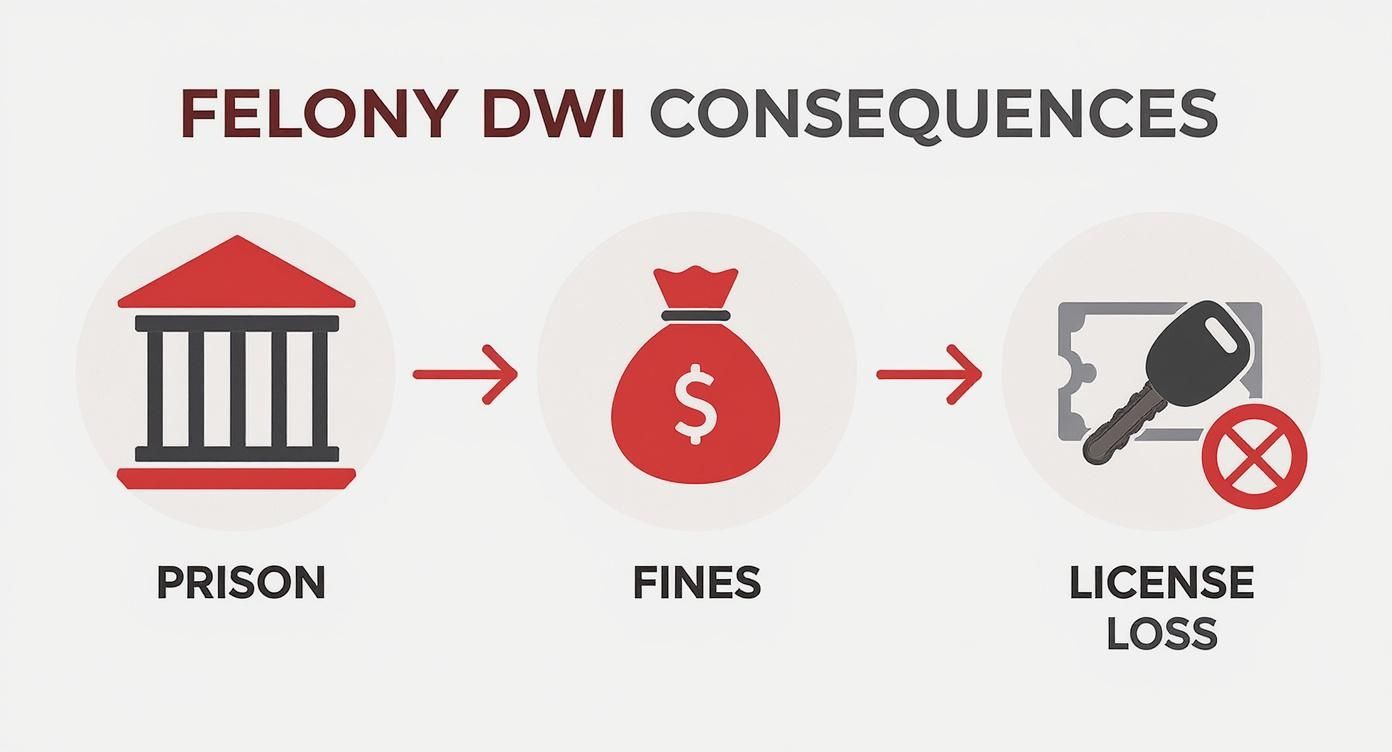
As you can see, the stakes—from prison time to massive fines—are incredibly high, which reinforces the need for a smart, strategic defense from day one.
Pre-Trial and Building Your Defense
Once you are out on bond and the ALR hearing has been requested, your case enters the pre-trial phase. This is where your Texas DUI attorney gets to work. We will file for discovery, the legal process of demanding all evidence the prosecution has against you, including:
- Police reports
- Body and dash camera footage
- Breathalyzer maintenance logs and calibration records
- Blood test lab results
We will comb through every document and video, looking for mistakes, inconsistencies, or violations of your constitutional rights. During this time, plea negotiations may occur. The prosecutor might offer a plea bargain for a lesser charge, and your lawyer will be there to advise you on whether it’s a favorable deal or if you have a better chance at trial.
While the U.S. BAC limit is 0.08%, it’s interesting to see how legal standards vary dramatically around the world, which shows just how complex and location-specific these laws are—much like the intricate procedures in your own case. You can discover more about how drunk driving laws differ globally to get a sense of the bigger picture.
Decoding Key Legal Terms in Your DWI Case
Navigating a DWI case can feel like learning a new language. The legal jargon used by prosecutors, judges, and attorneys can leave you feeling confused and powerless. Let's simplify these key terms so you can take an active role in your defense.
Blood Alcohol Concentration (BAC)
Blood Alcohol Concentration (BAC) is the measurement law enforcement uses to quantify the amount of alcohol in your system. In Texas, the legal limit for most drivers is 0.08%. A BAC at or above this level is considered legally intoxicated.
A BAC of 0.08% means that 0.08% of your blood by volume is alcohol. While this number sounds precise, the tests used to measure it—both breathalyzers and blood draws—are far from perfect. An experienced DWI attorney knows how to identify potential errors, from improper machine calibration to procedural mistakes during the test, that could get the results thrown out of court.
Implied Consent
When you received your Texas driver's license, you automatically agreed to the state's "Implied Consent" law. This law is a condition of being a licensed driver in Texas. By accepting your license, you have consented to provide a breath or blood sample if a police officer lawfully arrests you on suspicion of DWI.
Refusing to take a chemical test doesn't get you off the hook. Thanks to the implied consent law, a refusal triggers an automatic driver's license suspension. This is handled through a completely separate civil process called an Administrative License Revocation (ALR).
This ALR hearing is your first battle, and it happens fast. It runs on a different track from your criminal DWI charge, and you have a very short window of time to fight the suspension. This is why it's so critical to contact a Houston DWI lawyer the moment you're arrested.
Field Sobriety Tests
Before a breathalyzer is mentioned, an officer will likely ask you to perform a series of roadside exercises known as Standardized Field Sobriety Tests (SFSTs). These include the "walk-and-turn" and "one-leg stand" tests.
Their purpose is to help an officer establish probable cause for a DWI arrest. However, these tests are notoriously unreliable and subjective. Countless factors can make a sober person appear impaired. Nerves, fatigue, a medical condition, poor lighting, or uneven pavement can cause you to "fail." A sharp Texas DUI attorney knows how to dismantle the officer's conclusions by highlighting the inherent flaws in these tests.
How to Build a Strategic Defense

An arrest for a 3rd degree DWI is a serious moment, but it is not a conviction. An arrest is an accusation from the state; a conviction is a final legal outcome. The entire process between these two points is where a powerful, strategic defense can change everything.
For every piece of evidence the prosecution plans to use, there is an opportunity to challenge its validity, accuracy, and the method by which it was collected. A skilled Houston DWI lawyer builds a strong case by dismantling the state's case piece by piece.
Challenging the Initial Traffic Stop
Every DWI case begins with a traffic stop. If the police officer did not have a valid, constitutional reason—what the law calls reasonable suspicion—to pull you over, then any evidence gathered afterward could be suppressed.
An officer cannot stop you based on a hunch. They must be able to point to a specific traffic violation or a clear sign of dangerous driving. We will scrutinize the officer’s report and dashcam footage to determine if the stop was lawful.
Scrutinizing Sobriety and Chemical Tests
The evidence used to "prove" intoxication is often the weakest part of the prosecution's case. It typically relies on subjective observations and flawed tests.
- Field Sobriety Tests: These roadside exercises are notoriously unreliable. We can challenge the results by pointing out improper instructions, poor conditions (like uneven ground or bad weather), or your medical conditions that affect balance.
- Breathalyzer Results: Breath test machines are not foolproof. They require constant maintenance and precise calibration. We will demand the device’s service logs to search for a history of errors or missed inspections.
- Blood Test Evidence: For blood tests, we examine the entire chain of custody. Was the blood drawn by a qualified professional? Was it stored correctly to prevent contamination? Any break in this chain of custody can make the results inadmissible in court.
An experienced DWI attorney doesn’t just accept the state's evidence at face value. We investigate the investigation, looking for the procedural errors and violations of your rights that can lead to a dismissal or reduced charge.
Exploring Alternative Explanations
Sometimes, an officer misinterprets symptoms of a medical condition as signs of intoxication. Certain health issues can produce symptoms that mimic impairment.
For instance, conditions like diabetes, vertigo, or even extreme fatigue can affect a person's balance, speech, and behavior. We will explore whether a pre-existing medical issue could explain the officer's observations, presenting an alternative narrative to the one the prosecution wants the jury to believe.
While a strong defense is crucial, it’s also helpful to see the bigger picture. Public safety campaigns have made a huge difference over the years. The rate of drunk driving fatalities in the U.S. actually dropped by 50% between 1991 and 2017. Still, the challenge isn't over, as the U.S. reports around 11,000 deaths from drunk driving each year.
A winning strategy to fight DWI Texas charges often comes down to filing strategic motions to exclude questionable evidence before a jury ever sees it. You can learn more about how our attorneys use Texas DWI pre-trial motions as a key defense tactic.
Common Questions About 3rd Degree DWI Charges
When you are facing a charge as serious as a 3rd degree DWI, it’s natural to have questions. This section provides clear, direct answers to help you better understand what you are up against.
What Counts as a Prior Conviction for a Felony DWI?
Texas law is very clear on this point: any previous DWI conviction on your record, no matter how long ago it occurred or in what state, will be used against you.
Texas has no "lookback period" for DWI offenses. This means a DWI conviction from 20 years ago in another state carries the same legal weight as one from last year in Houston. This strict approach often surprises people and escalates what they thought was a misdemeanor into a felony charge.
Can You Avoid Jail Time with Probation?
While a 3rd degree DWI conviction carries a potential prison sentence of two to ten years, it is sometimes possible to receive probation, known as community supervision in Texas. Achieving this outcome, however, requires a skilled and strategic defense.
A key provision in Texas law often requires a person convicted of a third DWI to serve a minimum of 10 days in jail as a condition of getting probation. An experienced attorney can sometimes negotiate to have this time served in alternative ways, but it’s a stark reminder of how seriously the state treats these cases.
To fight for probation, your attorney must build a compelling case for the judge or jury, demonstrating that you are not a danger to the community and can be successfully supervised outside of prison.
How Does a Felony DWI Affect Your Life Long-Term?
A felony DWI conviction creates a ripple effect that touches nearly every aspect of your future, long after you have completed your sentence.
- Career Impact: Many professions requiring a state license—such as nursing, real estate, or law—can be jeopardized. A felony on your record can lead to license suspension or prevent you from entering certain fields.
- Loss of Civil Rights: In Texas, a felony conviction means losing fundamental rights. You will lose your right to vote (until your sentence is fully completed) and you will permanently lose your right to own or possess a firearm.
- Daily Hurdles: Simple tasks like applying for an apartment, seeking a loan, or volunteering at your child's school can become incredibly difficult due to standard background checks.
Can a Felony DWI Be Cleared from Your Record?
This is one of the toughest realities to face. Unlike many misdemeanor offenses, a felony DWI conviction generally cannot be expunged or sealed through an order of non-disclosure in Texas. In simple terms, it remains on your public criminal record permanently.
The finality of this consequence is precisely why building an aggressive defense from the very beginning is so critical. The best way to keep a felony off your record is to prevent the conviction in the first place. Exploring the details of clearing your record in Texas highlights how limited these options are for felonies.
The answers to these questions underscore the gravity of a 3rd degree DWI charge and the urgent need for a strategic legal defense. At The Law Office of Bryan Fagan, PLLC, we understand what’s at stake—your freedom, your career, and your future. You don't have to navigate this complex process alone. Our experienced Houston DWI lawyers are here to protect your rights and fight for the best possible outcome in your case. Contact us today for a free, confidential consultation to discuss your case.