
A DWI arrest can be overwhelming — but you don’t have to face it alone. At the Law Office of Bryan Fagan, PLLC, our experienced Houston DWI lawyers and Texas DUI attorneys will protect your rights and guide you through each stage of the process.
Quick Overview Of A First DWI In Texas
This snapshot highlights key facts about your first DWI in Texas, including clear definitions of critical terms:
-
BAC (Blood Alcohol Concentration): The percentage of alcohol in your bloodstream.
-
Implied Consent: By driving on Texas roads, you agree to submit to chemical tests (breath, blood, or urine).
-
Field Sobriety Test: Standard roadside tests—Horizontal Gaze Nystagmus, walk-and-turn, one-leg stand—to assess impairment.
-
Administrative License Suspension (ALS): Also known as a DWI license suspension, this takes effect if you refuse or fail a test and don’t file a hearing request in time.
-
Jail Time Minimums: 72 hours up to 180 days
-
Fine Limits: Up to $2,000 plus court costs
-
License Suspension: 90 days to one year
-
ALR Hearing Deadline: 15 days from the date of arrest
Under Texas Penal Code § 49.04, a first DWI is a Class B misdemeanor with a mandatory minimum of 72 hours in jail (up to 180 days) and fines not exceeding $2,000. Your driver’s license can be suspended for 90 days to one year, and the administrative suspension (ALS) starts 40 days after arrest unless you file an ALR hearing within 15 days. You may also face court-ordered DWI education programs, alcohol awareness classes, community service, and probation up to two years. Learn more about what happens after a first DWI in Texas
Comparison Of Penalties For First DWI Scenarios
| Offense Type | BAC Range | Classification | Jail Time | Fine Limit | License Suspension | IID Requirement |
|---|---|---|---|---|---|---|
| Standard First DWI | 0.08%–0.149% | Class B misdemeanor | 72 h–180 d | Up to $2,000 | 90 days–1 year | Possible |
| Elevated BAC DWI | 0.15%+ | Class A misdemeanor | 6 d–365 d | Up to $4,000 | 180 days–2 years | Required |
As you can see, crossing the 0.15% threshold escalates both the classification and the penalties. If you need to fight DWI Texas, swift action matters.
- Explore our ALR hearing guide
- Learn more about DWI education programs
- Read our tips for first-time DWI defense
Your next move is to request a free consultation with our dedicated Houston DWI lawyer to review critical deadlines and begin crafting a defense strategy that fights your first DWI in Texas and protects your driving record.
- File your ALR hearing within 15 days
- Gather witness statements and documentation
- Note discrepancies in testing procedures
Protect your driving privileges today.
Texas DWI Laws And Classifications
If you’re facing a first-time DWI charge under Texas Penal Code 49.04, the classification determines your defense strategy from start to finish. It shapes the evidence you challenge, the penalties you face, and the negotiations ahead.
Under Texas law, intoxication means a BAC of 0.08% or higher, or any noticeable impairment of your mental or physical faculties. Implied consent takes effect the moment you get behind the wheel—refuse or fail a chemical test, and you trigger an administrative license suspension (ALS).
How Intoxication Is Measured
When officers ask you to blow into a breathalyzer or provide blood or urine, they’re looking for that 0.08% breakpoint. But numbers alone don’t win in court. Field sobriety tests—like the Horizontal Gaze Nystagmus, walk-and-turn, or one-leg stand—capture real-world signs of impairment: shaky balance, slurred speech, uneven eye movement.
Think of BAC limits like posted speed limits. Pushing just past 0.08% is like speeding a few miles over—risky enough for a ticket. Hitting 0.15% is like doubling the speed limit—proof positive you’ve lost control.
- 0.08% to 0.149%: Class B misdemeanor
- 0.15% or higher: Class A misdemeanor upgrade
- Common Field Sobriety Tests:
- Horizontal Gaze Nystagmus
- Walk-and-Turn
- One-Leg Stand
Aggravating Factors And Enhanced Charges
A BAC of 0.15% or above automatically elevates a first DWI to a Class A misdemeanor, with fines up to $4,000, jail time up to one year, and a license suspension of 180 days to two years—often paired with an ignition interlock device requirement.
Other red flags can push penalties even higher:
- Passenger under 15 years old: State jail felony under Family Code
- Open container violations: Minimum six days in jail
- Prior DWI arrests—even without conviction—can influence sentencing
First-offender programs like SCRAM alcohol monitoring or house arrest often accompany enhanced charges. Learn more about high BAC penalties on Joseph Ruiz Law
Classification Outcomes And Penalties
- Class B Misdemeanor: 72–180 hours jail, up to $2,000 fine, 90–365 day suspension
- Class A Misdemeanor: 6–365 days jail, up to $4,000 fine, 180–730 day suspension
- State Jail Felony: 180–720 days jail, up to $10,000 fine, 180–730 day suspension
Courts frequently require DWI education courses, community service, and up to two years of probation for first-time offenders. Early consultation with a Texas DUI attorney can prevent surprises and protect your rights under each classification.
Implied Consent And Administrative Suspension
In Texas, simply driving on a public road means you’ve consented to chemical testing. Refuse or fail a breath, blood, or urine test, and your license faces an administrative suspension (ALS). You have 15 days from arrest to request a hearing—miss it, and your license disappears in 40 days.
An ALR hearing can delay or prevent suspension by challenging the legality of the stop or the reliability of the test equipment.
- 15-day deadline to request a hearing
- Suspension triggers 40 days after arrest
- ALS spans 90 days to 2 years based on BAC and prior record
- Common challenges: stop legality, calibration errors
Defense attorneys often leverage ALR hearing victories in plea talks or dismissals when procedural missteps surface.
Why Prosecutors Seek Heightened Charges
Prosecutors push for higher classifications to gain negotiation leverage and lock in mandatory enhancements:
- DASAP education (16–24 hours)
- Community service (24–100 hours)
- SCRAM alcohol monitoring for high BAC readings
- House arrest or electronic monitoring
Each added requirement tightens supervision and strengthens the state’s case. Consult our team for classification guidance today.
Navigating License Suspension And ALR Hearing
A first DWI arrest in Texas triggers both criminal charges and an administrative license suspension (ALS). Under Texas’s implied consent law, the officer will take your license roadside. If you miss the deadline to request an ALR hearing, your license is automatically suspended on day 40 after arrest.
- Request your ALR hearing within 15 days to lock in your right to contest the suspension
- Automatic suspension kicks in on day 40 without action
- Winning the hearing keeps you behind the wheel and bolsters your overall defense
Think of the ALR hearing as a focused mini-trial about your driving privilege. For a detailed roadmap, see our Texas ALR hearing process guide.
What Happens At An ALR Hearing
At the hearing, you and your attorney zero in on the stop and test procedures. It’s your chance to:
- Challenge the legality of the traffic stop
- Question calibration logs to cast doubt on breath or blood results
- Point out officer mistakes in administering sobriety exams
Early counsel involvement in ALR increases success rates by up to 30%.
You’ll testify under oath, and the state’s evidence is limited to license-related issues—no full-blown criminal case yet.
Implied Consent Explained
When you get behind the wheel in Texas, you agree—by implied consent—to chemical testing. Say no or fail a test, and you immediately start that 40-day ALS clock.
- Applies to breath, blood, or urine testing
- Refusal triggers a 40-day automatic suspension
- Winning the hearing stops the suspension and gives you leverage in criminal court
- Refusal can also hurt your criminal defense
Implied consent puts the ball in your court: cooperate or risk losing your driving privileges until your case wraps up.
Suspension And Court Deadlines
Your ALS timeline runs alongside the criminal process:
- DPS notifies you and starts the 40-day suspension countdown if you don’t file within 15 days
- Arraignment happens 1–2 weeks after arrest, where bond conditions like an alcohol ban or IID get set
- Pretrial hearings let you file motions to suppress evidence—studies show 20–30% false positives in low-BAC field sobriety tests
- 90% of cases end in plea deals with probation, fines, and community service
Read the full timeline insights on McConathy Law
Key steps now:
- Gather testing records, calibration logs, and witness statements
- File suppression motions early to challenge lab or stop errors
- Use any ALR win as leverage when negotiating a plea
Preparing For Education And IID
If you beat the ALS suspension, you stay eligible for court-ordered DWI education. Your bond or plea may also require installing an ignition interlock device (IID) for handheld BAC checks.
- Court-ordered classes run 16–24 hours, set by each county
- IID installation costs $70–150 plus monthly monitoring fees
- Completing all requirements speeds up full license restoration
Protect your driving privileges—call our office for a free consultation. Our Texas DUI attorneys will guide you through every deadline and every ALR hearing. Act now.
Building Defense Strategies For First DWI Cases
An arrest for a first-time DWI can feel overwhelming. But you do have options. Seasoned attorneys know how to spot the state’s weak points and fight DWI Texas on your behalf.
- Challenge traffic stops lacking reasonable suspicion by reviewing dashcam footage and reports
- Dispute field sobriety exercises with studies on error rates and by highlighting procedural mistakes
- Question breath and blood results when calibration logs or technician training are inconsistent
Examining Traffic Stop Legality
The first question: Did the officer lawfully stop you? Your lawyer will analyze the officer’s probable cause, dashcam video, and witness statements to find inconsistencies that can topple the prosecution’s foundation.
Disputing Field Sobriety Test Results
Field tests look official, but they rely on human judgment:
- Horizontal Gaze Nystagmus can be misread in low light
- Uneven pavement or nerves can throw off a Walk-and-Turn
- Medical conditions often explain One-Leg Stand failures better than intoxication
Questioning Chemical Test Accuracy
Breathalyzers and blood machines need precise upkeep:
- A 0.01% calibration drift can change your result significantly
- Missing or backdated calibration logs can void machine findings
- Technicians without complete training risk mishandling samples
“Suppressing flawed tests can tilt the outcome in your favor,” says Bryan Fagan.
Case Study On Evidence Suppression
In 2021, our team exposed an unlawful stop and won a suppression motion:
- Charges were dropped before trial, saving months of legal battles
- We used the ALR hearing to block a license suspension
- Without test results, probation terms were significantly reduced
Trial Versus Plea Comparison
| Outcome | Timeframe | Potential Penalties | Cost Impact |
|---|---|---|---|
| Trial | Several months | Misdemeanor conviction or acquittal | Varies by case |
| Plea | A few weeks | Probation and fines | $2,000 to $4,000 |
Use this snapshot to balance risk against certainty. Trust your attorney to recommend the route that best protects your record and privileges.
Negotiating Penalties And Programs
Often, deferred adjudication or diversion replaces harsher punishments:
- Review your record and case details with your attorney
- Explore diversion, probation, or education under the Texas Penal Code
- Negotiate ignition interlock device terms to maintain daily routines
Explore deferred adjudication options on our site: Deferred Adjudication For DWI Cases
Best Practices For Working With Your Attorney
Open, honest communication builds a stronger defense:
- Save all reports and test records in one folder
- Note any witnesses or cameras that captured your stop
- Reply promptly to attorney requests to meet deadlines
Each suppression win adds a layer of protection. Early involvement of counsel can make the difference between a dismissal, a reduced plea, or unexpected penalties.
Ready to fight DWI Texas with confidence?
- Call for a free consultation within 24 hours
- Schedule your case review online or by phone
- Ask about our firm’s experience defending first-time DWI clients
Protect your rights today with the Law Office of Bryan Fagan, PLLC. Our Texas DUI attorneys fight to minimize penalties and keep you on the road.
Step By Step Actions After a First DWI Arrest
A DWI arrest can hit you like a sudden storm. Yet, if you follow a clear roadmap, you’ll start to regain control. Every decision you make now will shape the defense of your first DWI in Texas case.
Key Early Actions:
- File your ALR hearing request within 15 days of arrest to prevent an automatic license suspension
- Arrange bail or bond swiftly so you can go home and work with your defense team
- Schedule a free consultation with a seasoned Houston DWI lawyer to chart your next steps
Critical ALR Hearing Deadline
Under Texas’s implied consent rules, the DPS will start an administrative suspension roughly 40 days after your arrest if you miss the 15-day window. Your attorney can attack the legality of the traffic stop or the breath test procedures during this hearing. Missing the deadline almost always guarantees a license suspension you won’t be able to reverse.
Your lawyer will file Form DPS-4 within two weeks of arrest to lock in your hearing date. In the meantime, gather dashcam footage and witness statements that could tip the scales in your favor.
“Winning the ALR hearing goes a long way toward strengthening your criminal defense,” says Bryan Fagan.
Check out our guide on Steps After a DUI Arrest for all critical dates laid out clearly.
Preparing For Arraignment And Bond
Arraignment kicks your case into gear. You’ll hear the official charges, enter a plea, and learn bond conditions—anything from house arrest to an IID.
Key Arraignment Steps:
- Review the charge sheet and note all upcoming court dates
- Prepare a brief personal statement highlighting your background and clean record
- Line up character references from employers or community leaders
- Alert your attorney to any medical issues that could skew sobriety tests
After arraignment comes pretrial, where your defense files motions—often to suppress shaky evidence or flawed testing. Meanwhile, counties require 16–24 hours of DWI education classes before you can move forward.
Gathering Evidence And References
A solid defense rests on strong proof. Dashcam and surveillance video may reveal road conditions or officer conduct that contradicts the police report. Witness statements add context to your behavior at the scene.
Evidence To Collect:
- Dashcam or smartphone video showing road conditions or stop procedures
- Calibration and maintenance logs for breath and blood testing machines
- Medical records if you have conditions affecting balance or speech
- Statements from passengers or bystanders who observed your condition
Character references remind the judge you’re a responsible community member. Potential witnesses include your boss, coaches, or civic-group leaders. Schedule interviews or signed affidavits early to avoid last-minute rushes.
Enrolling In Courses And Complying With Probation
If you plead guilty or take deferred adjudication, education is non-negotiable. Bond terms often include a DWI course, and probation may add community service or alcohol counseling.
Installing an ignition interlock device lets you keep driving—and keeps the court informed of any failed starts.
| Step | Deadline | Action |
|---|---|---|
| ALR Hearing Request | 15 days | File Form DPS-4 to halt suspension |
| Arraignment | ~2 weeks | Enter plea and set bond terms |
| Pretrial Motions | 30–60 days | File suppression and discovery motions |
| DWI Course | 30 days post-plea | Enroll in county-approved program |
Keep a calendar of every deadline. Use phone alerts and legal apps to track hearings and probation check-ins. Frequent check-ins with your attorney ensure no surprises.
Scheduling Your Consultation And Next Steps
Don’t wait to bring in an attorney. Early involvement can boost your chances of dismissal or favorable plea negotiations. Book a free consultation to review your evidence, deadlines, and defense strategy. Our Houston DWI lawyers and Texas DUI attorneys at the Law Office of Bryan Fagan, PLLC stand ready to guide you through each twist and turn.
Final Trial Preparation And Case Management
As trial approaches, dive into your discovery materials. Mock testimony sessions spotlight weak spots and build confidence. Coordinate with witnesses and secure clear affidavits.
Trial Readiness Tips:
- Dress professionally to show respect and credibility
- Arrive early to sync up with your attorney and practice courtroom flow
- Rehearse direct and cross-examination questions with your legal team
- Ensure exhibits are organized, labeled, and ready to go
Even if a plea seems likely, thorough trial prep strengthens your hand at the negotiation table. Technical defenses revealed in suppression hearings often become leverage in plea discussions.
Managing Ongoing Obligations And Monitoring Progress
After a plea or verdict, your responsibilities continue. Probation check-ins, regular alcohol testing, and IID calibrations must be on your radar. Tell your attorney immediately if you encounter issues—early intervention prevents bigger problems.
Probation Best Practices:
- Keep detailed logs of community service and class attendance
- Store IID installation and calibration receipts in a safe place
- Stay in touch with your probation officer and your lawyer
- Submit travel or work-related requests in writing, with your lawyer’s input
Take action now. The sooner you get organized, the better your chances of a favorable outcome.
Understanding Long-Term Costs And Consequences
A DWI conviction runs deeper than a one-time penalty. When you face a first DWI in Texas, you’re looking at financial and personal hurdles that stretch over years.
Below is an infographic showing the post-arrest process flow from bond to ALR hearing to arraignment.
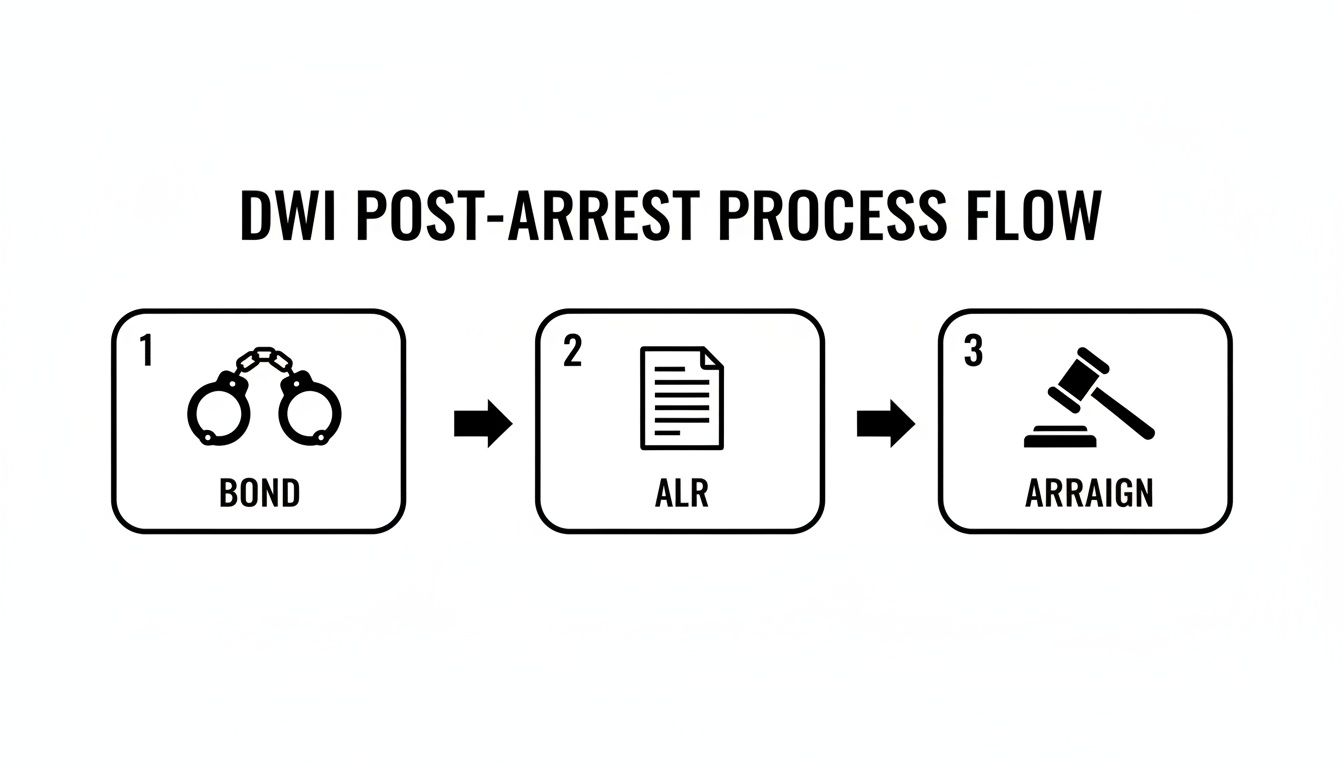
This visualization highlights how early ALR hearing wins can prevent license suspension and shape your overall strategy.
Insurance Premium Increases
One of the first financial blows you’ll notice is at the insurance counter:
- Insurance rates jump by 80–100% after a DWI conviction
- Drivers often pay an extra $1,200 per year for 3–5 years
- Coverage may also require an SR-22 filing at additional cost
Budgeting ahead can soften the impact.
SR-22 Filings And Ignition Interlock Fees
Post-conviction requirements often mean extra paperwork and equipment:
- An SR-22 certificate typically costs between $25–50 to file
- Ignition interlock devices require $70–150 for installation
- Monthly monitoring fees range from $60–100
Breaking down these expenses helps you manage cash flow after court orders.
Effects On Employment And Licenses
A DWI conviction can derail your career:
- Commercial drivers risk losing their CDL or facing carrier penalties
- Licensed professionals must report convictions to state boards
- Academic institutions may suspend enrollment or bar campus parking
A DWI conviction can close doors across industries and delay career advancement.
Eligibility For Record Sealing
Under Texas law, you may qualify for expunction or non-disclosure relief. Eligibility hinges on factors like dismissal or deferred adjudication. Consult your attorney to determine the best path forward.
Strategies To Rebuild Driving Record
Repairing your record takes time and a proactive approach. Consider these steps:
- Complete probation and all court-ordered programs early
- Enroll in voluntary DWI education courses beyond the minimum
- Secure character references from employers or community leaders
- Shop around insurers after three years for potential rate reductions
Learn more about budgeting for long-term expenses in our detailed guide on Costs of a First-Time DUI in Texas. Strategic legal counsel can negotiate favorable probation terms and reduce collateral damage. Connect with our Texas DUI attorneys for a free consultation to review your case and cost mitigation strategies.
Financial Planning Advice
Anticipating fees before they hit can prevent late charges or surprises. Treat your DWI-related costs like a multi-line car payment and allocate funds monthly.
- Bond and attorney retainer often require $1,000–3,000 upfront
- ALR hearing fees or court filing costs can be $100–300
- DWI education courses range $200–400 depending on county
Simple spreadsheets or budgeting apps make it easy to track every expense. Our attorneys review your financial picture in free consultations to tailor a strategy you can afford.
Educational Opportunities And Financial Aid
A DWI conviction can impact scholarships, work-study programs, and professional training:
- Universities may revoke financial aid for code of conduct violations
- Teacher certification or nursing licensure can be delayed pending outcome
Restoring eligibility usually means submitting proof of completed courses and obtaining clearance letters from relevant boards.
Frequently Asked Questions About 1st DWI In Texas
When you face your first DWI in Texas, the unknowns can feel overwhelming. This FAQ cuts through the noise with clear answers on test refusals, deferred adjudication, ALR hearing rights, and sealing your record.
What Happens If I Refuse A Breath Or Blood Test In Texas?
Under Texas’s implied consent law, saying “no” to a breath or blood test triggers an administrative license suspension. The Department of Public Safety will suspend your license 40 days after arrest unless you request an ALR hearing within 15 days. Win that hearing, and you can stall—or even prevent—the suspension entirely.
Am I Eligible For Deferred Adjudication On A First DWI?
Many first-time offenders qualify for deferred adjudication, which means probation instead of a conviction. Complete all court-ordered terms—like DWI classes and community service—and you could see the charge dismissed. Eligibility depends on the facts of your case and the prosecutor’s approval. Don’t hesitate—reach out to your attorney early to map out your options.
Can I Continue Driving While My ALR Hearing Is Pending?
Yes—if you file on time. A timely ALR hearing request keeps your license valid until the hearing decision. Miss the 15-day deadline, and you face automatic suspension 40 days after arrest. Use this grace period to prepare your defense and keep your wheels turning.
Missing an ALR deadline is one of the most common mistakes that leads to unnecessary suspension.
How Long Does A DWI Stay On My Record And Can I Have It Sealed?
A DWI conviction remains visible on most background checks indefinitely. However, you may qualify for non-disclosure relief after completing probation, paying fines, and finishing required education. Consult your attorney to time the expunction or sealing process perfectly.
Ready to protect your driving record and your future? Contact our Houston DWI lawyer and Texas DUI attorney at the Law Office of Bryan Fagan, PLLC today for a free consultation online at https://texasduilawfirm.com